
|
 EgyptSearch Forums EgyptSearch Forums
 Ancient Egypt and Egyptology Ancient Egypt and Egyptology
 Foreigners in Egypt and Nubia from Dyanstic to modern times Foreigners in Egypt and Nubia from Dyanstic to modern times
|
 UBBFriend: Email This Page to Someone! UBBFriend: Email This Page to Someone! |
next newest topic | next oldest topic |
| Author | Topic: Foreigners in Egypt and Nubia from Dyanstic to modern times |
|
ausar Moderator Posts: 2833 |
 posted 12 December 2004 04:25 PM
  
During the Middle Kingdom foreigners are first found: 93.0909 In the M.K. Asiatics of unknown origin were present in Egypt in considerable number. They were designated aAm, "Asiatic." The toponym RTnw is also known; the combination of aAmw of RTnw is attested. Some names look Egyptian, but are foreign. A safe indication is the addition aAm before the name. In Illahun Asiatics are mentioned in registers and letters. The names of the Asiatics are Egyptian for the most part. Asiatic names appear as parent's names or nicknames. Some nicknames seem to be Egyptian. The presence of Hurrian names in the Egyptian during the 19th century B.C. can be assumed. In P. Berol 10002 a large part of the singers (Smaw) is Asiatic, but also titles and activities are attested. It seems that the Asiatics lived under the same circumstances as the Egyptians. Pap. Berol 10004, known as a document concerning the sale of slaves, needs further study. On the basis of the Illahun evidence, Asiatics were appreciated as workers inside and outside of Egypt in the later XIIth Dynasty. Wall pantings in the tomb of Khnumhotep at Beni hassan depict the Oxford History of Ancient Egypt Ian Shaw During the New Kingdom we find Asiatics of Mitanni origin living even in villages of Deir El Medina in modern Luxor: 94.1133 WARD, William A., Foreigners Living in the Village, in: Pharaoh's Workers, 61-85 and 163-174.
foreign personal names in Egyptian texts in general, the author turns to the Deir el-Medina material, where he has identified 22 masculine and 10 feminine names of West-Asiatic origin, most Semitic, but also Hurrian and Hittite. Their bearers lived almost all in the village; the women were mostly married to workmen, but the social status of the men is harder to determine. Appendix A lists 22 foreign names at Deir el-Medina published earlier by him (in "Essays in Ancient Civilization ... H.J. Kantor," Chicago 1989, 255-299) and 13 new ones from the Deir el-Medina texts, among which the extensively discussed knr (kl) and kr. Appendix B concentrates on the occurrences of the name knr (kl) at Deir el-Medina (nos. 1-11) and outside during the N.K. (12-28), and in the T.I.P. (29-30). Appendix C lists 10 occurrences of the name kr(i/y). Also during the New Kingdom was infiltraition of Sea People that were either captured during battles or came to Egypt as mercenaries: The greatest threat to Egypt during the Ramesside Period was the so-called '' Peoples of the Sea,'' a confederation of peoples from the Aegean or Western Anatolia,who attacked northeast Africa and the eastern Mediterranean. From early in the reign of Merneptah,the ships of these people,known more specifically as the Sherdan[perhaps from Ionia and Sardinia], Shekelesh,and Peleset,attacked the western and eastern Mediterranean approaches of Egypt while others attempted to colonize via land routes.Much of the thirty-one year reign of Ramesses II was devoted to thwarting their attacks,and records of great sea battles are carved on the north side of the king's temple at Medinet Abu. The ''People of the Sea'' ultimatley changed the entire balance of power in the Near East,sweeping away the Hittites and setting the stage for the Assyria to step into the void as the new dominant power in the Near East. page 48 Egypt and the Egyptians by Douglas J. Brewer and Emily Teeter Cambridge University Press Due/Published June 1999, 236 pages, paper ISBN 0521449847
page 30
The Land and Legacy copyright @ 1988 First Unversity of Texas Press Paperback Printing,1990
After the 25th dyansty you have interludes from Assyrians,and finally an independent dyansty at Sais. During the 26th dyansty many Saite pharaohs imported Carian and Greek mercenaries and settled them in various parts of Egypt. But more importantly he was able to idenity at Nebeira the site of page 33 Ancient Egypt The Land and Legacy copyright @ 1988 First Unversity of Texas Press Paperback Printing,1990 Later during Persian occupation there were settlements of Jewish mercenaries in parts of modern day Aswan: >"Jewish Life in Ancient Egypt: A Family Archive from the Nile Valley"
Now, thanks to Edward Bleiberg, associate curator of the museum's famed collection of Egyptian and other ancient art, the scrolls are the focus of a small show, ''Jewish Life in Ancient Egypt: A Family Archive From the Nile Valley.'' They tell, over a period of time, the story of Ananiah, a Jewish temple official, and his wife, Tamut, a slave of Meshullam, a military man and fellow Jew. All of them lived on Elephan tine, apparently in harmony with their Egyptian, Greek and Persian neighbors. The scrolls, written in Aramaic, the daily language of Egyptian Jews and Persians, include a marriage contract, a deed of release from slavery, real estate transactions and a loan agreement, but no other objects associated with the family exist. Not too visually engaging by themselves, the scrolls have been bolstered by nearly 40 works of ancient Egyptian and Persian art -- from the museum's own collection -- that relate to the life of the period. Further embellishments include a lovely 1870 view of the island with Roman structures by the well-known British photographer Antonio Beato, a lush painting of it done around 1893 by the American Edwin Blashfield (son-in-law of Charles Wilbour) and a padded recent video presentation. Though thin, the show is of interest not only because its documents confirm the return of Jews to Egypt but also because it points up the good relationships among the various ethnic groups who inhabited the small island. Under the religiously tolerant Persians who ruled Egypt at the time, members of these groups were serving on Elephantine as mercenary forces guarding the country's southern frontier. Not Ananiah, the scrolls' original owner, however. For 47 years (from 449 to 402 B.C.) he was a member of the Jewish priesthood attached to the Temple of Yahou (Jehovah), where animal sacrifices took place. And what were Jews doing back in Egypt? They were descendants of those who had fled from the Babylonians, who had conquered Jerusalem in 586 B.C. and consigned the Jewish elite to exile in Babylonia. Those who made it to Egypt were the soldiers and common people, who practiced a more rudimentary form of Judaism that still involved the worship of more than one god. Ananiah first comes to notice in a marriage document dated Aug. 9, 449 by the Aramaic calendar, that legalized his union with Tamut, an Egyptian woman whose father had sold her to Meshullam, a not uncommon practice in payment of debts. By the time they got around to wedlock, the couple already had a 6-year-old son, not an unusual circumstance for that time and place. The contract freed their son, Palti, from slavery, but not Tamut. In 437 B.C., 12 years after his marriage, Ananiah bought a house from Bagazust, a Persian soldier, and his wife. The rather decrepit property was in a town called Khnum, named for an Egyptian god, right across the street from the temple. The sale is recorded in a third papyrus scroll, assuring clear title to the house, which is described as having a court, standing walls and windows, but no beams. Four more scrolls are concerned with gifts of various parts of the house to Tamut and Yehoishema by Ananiah, and then the sale of the house, in 402 B.C., to Yehoishema's husband, also named Ananiah. (By this time the house had beams and two doors.) Not to be overlooked is a quirky sarcophagus lid (664-332 B.C.) topped by an expressive relief face said to be from a Jewish cemetery at Tura, Egypt. Several very tiny but finely made objects include an amulet of a kneeling ram (664-332 B.C.) worn for protection by Egyptians (but not Jews), and a ram-headed aegis of about the same period, an iconic protective symbol carried by Egyptian priests. (Rams were sacrificed by Jews as well as Egyptians.) A miniature bronze bull (664-425 B.C.)representing the Egyptian god Apis also dates from the show's period. Slightly earlier (664-525 B.C.) is a statuette of the Egyptian goddess Mut, protector of pregnancy and birth, from whose name Tamut derives. ''Jewish Life in Ancient Egypt: A Family Archive From the Nile Valley'' remains at the Brooklyn Museum of Art, 200 Eastern Parkway, at Prospect Park, (718) 638-5000, through May 12. After the Persian occupation was a short rule of indigenous pharaohs until the 32nd when Necho II fled Egypt. When Alexzander the Great invaded Egypt it was under Persian occupation. Egyptians welcome Alexzander against the Persians. Alexzander entrusted Egypt to one of his generals to rule Egypt. The general's name was Ptolomey. Ptolomey was corinated a pharaoh. Still the indigenous Egyptians were despised and looked down upon by the indigenous Ptolomies. Still marriages between Ptoloemiac and native Egyptians did exist amungst the elite and commoners. Only in two regions where Greeks went back to mainland Greece was such marriage banned. This means that regions like Naucratis and Alexzandria would not permit marriage between Egyptians and Greek. Greeks were not the only foreigners,and Syrians were settled in assorted regions across Egypt including parts of Middle Egypt like Fayyyum,Minya,and Beni Suef. These mercenaries intermarried with the local population. See the following: Minshah (Ptolemais) In Graeco-Roman times the city of Ptolemais, in Middle Egypt, was the
1. E. Drioton 'Art syrien et art copte;B.S.A.C. III 1937 ,pp 29-40 page 72 There is another good reason for pausing at Kom Aushim;it is the site of one of the many towns founded in the Faiyum province during the Ptolemaic Period. here at Karanis it is still possible to walk along streets,to step into houses,to saunter in squares,as one can never do in the Nile valley itself. For this was a town which fell into disuse
times by excavations of the Unversity of Michigan.Like its foundation here and elsewhere in Egypt,Karanis was essentially a Greek-speaking towns. On its hieght at Kom Aushim,Karanis lies approximatley at sea-leavel,but when it was founded,like man of its fellow,it lay on the edge of the lake ,which at that time was about six feet below sea-level. it
The Land and Legacy copyright @ 1988 First Unversity of Texas Press Paperback Printing,1990
number of mummies incorporating potraits and of portraits taken from mummies have been found at Saqqara;they probably present us with the closest we may ever get to the likeness of Memphites. page 58 Ancient Egypt The Land and Legacy copyright @ 1988 First Unversity of Texas Press Paperback Printing,1990 Although at the end of the Dyanstic period and in Graeco-Roman times Saqarra was a bustling place throughout the year with constant pilgrimages to many shrines ,were troubled souls sought comfort from the mysteries and incubation treatments available and processions and very occasionally an Apis funeral as special entertainment,the district was also probably rather ran down suffering from the excessive usage of almost three thousand years. To some extent its bustle its bustle reflected the busy life of the city of Men- nefer,which remained the most important centre of commerce and administration untill it was supersededby Alexzandria. It was huge,amorphus,rambling place,with large ''ghettoes'' made over for foregin communities---for Greeks,for Jews,for Carians,for Phonecians.Apart from itws temples it probabaly had few imposing buildings,and was mostly made up of warren-like districts of narrow streets and three-storey houses where collapse and rebuilding went on continuously:unsanitary,smelly,dusty or muddy according to the season,but full of life and interest. page 46
The Land and Legacy copyright @ 1988 First Unversity of Texas Press Paperback Printing,1990 5.0105 Under Roman rule more foreigners were brought into Egypt leaving Roman garrisons across Lower and Middle Egypt. During this time Fellahin Egyptians were barred acess to Alexzandria unless they were serving the Romans.
Rosalie David Handbook to Life in Ancient Egypt One old man with long hair and a white beard ,who had been a member page 43
In Later times right before the Arab invasion of Egypt there were loads of Syrians,Greeks,and other groups in Lower Egypt.
Arab colonization began with the conquest ,and was encouraged by the
The Arab conquest of Egypt in 640-42,was cocrrently ,the first major bedouin migrations to the Nile Valley. The conquering army was made up very largely of tribemen,apparentenly drawn indiscrimatley from most of the tribesmen of the Arabian Peninsula.. By 642,they are said to have numbered nearly 20,000[15]. This is the figure usually given as the size of the Moselem army which unsucessully invaded Nubia in 642[Chapter 14] [16]. How many of these immigrants settled down in Egypt after the conquest is impossible to say,but probabaly the majority did so. During the next twqo centuries their numbers sweled through immigration. According to MacMichael,'The cheif occasions of the immigration were the arivals of the new govenors : each one came escorted by an aqrmy of anything up to 20,000 men,many of whom never returned to Syria or Arabia. A portion of the hordes were Persian,Turkish and other tribes, but the majority here Arabs and would normally be members of the govenor's own tribe[17]. In addition to these regular increments numbers of the Qays Alan tribe were induced to settle Lower Egypt as a counter weight to the influcence of the creasingly rebellious Copts. For from reinforcing the security of the control goverment,however,the tribesmen became a pereenial of rebellion.[18] In the beginning most of the Arabs in Egypt did not go to join the nomad groups alkready resident in the Red Sea Hills and the Western Oases,for unlike bedouins they were not obliged to support themselves entirely or even primarily by pastorial activties They were installed as irregular garrison forces and the provinces of Lower and Middle Egypt,as other Arab groups were similarily installed in the conquest of Iraq and Syria. this enabled them to graze such animals as they had along the margins and over harvested fields of the Nile Valley,with of without the consent of the Fellaheen. More importdantly,to exact tribute from the Fellaheen themselkves.
. In order to mainstain their millitary effectiveness and mobility ,the Arabs in Egypt were forbidden to own land or engage in cultivation .[19] This short sighted policy was ro prove diastrous for civil order. The Arabs were not cut out by training or tradition for the military role which was assigned them once the wars or conquest were over; they were too unruly to serve as provincial garrisons and too undependable to serve as house hold troop . At the same time the prohibition against holding land precluded their settling down to a useful life within the conquered provinces,and pratically condemed them to return to the predatory times,even had they wished to otherwise . After the Abbsaid revolution of 750[20] the Arabs found their military role increasingly pre-empted by slave armies of Persian and Turkish origin. The long series of Arab revolts which further alienated the tribes from goverment which they had helped to create. Finally in A.D. 834 ,'Caliph al-Mutasin inaugerated his rule by dispatching an order to his governor of Egypt to strike off the names of all Arabs from the register of pensions and stoip paying their salaries. This was indeed a turning point in the history of Arabs in Egypt . In short,their service as fighters was no longer needed:they were replaced by Turkish military slaves ..........[21] The disaplecement of Arabs reached its culmination in 868 when one of the Turkish govenors of Egypt,Ibn Tulan,renouched his allegiances to the Caliph and founded the first Egypt's Turkish dyansties. Not suprisngly,many of the discontended and dispossed Arabs began drifting awayt from the Nile Valley and back to nomadic life of earlier times. Some followed the Nile to the relatively freer region of Upper Egypt;others moved to Northern Africa,incidentially over running and Arabizing many of the Berber tribes;still others joined Beja in the eastern hills and along the Red Sea coast. At the beginning of the ninth century most of the Beja who dwelt in the Red Sea Hills were still pagans,although, a few had adpted a nominal Christianityand others,particulary in the coastl districts,may already have embraced Islam[23]. The tribe soon continued to raid Upper Egypt when opportunity presented itself,and in 831 a punative campaign was under taken against them by Caliph al-Mutasim. According to Yusuf Hassan,this was the decisive event in opening up the Red Sea Hills to Arab settlement The Beja were defeated and were forced to sign a capitulation recognicing the caliph as their suzerain and paying an annual tribute. The agreement contained many of the same stipulation as did the baqt treaty with the Nubians,[25],but it was a unilateral capitulation which guaranteed nothing to the Beja in return for their submission. The tribesmen were forbidden to enter the village and towns of Egypt,but there was no provision,as in the case with Nubians,against the Egyptians or Arabs to entering and settling the country of the Beja. According to Hassan,'By agreeing to pay tribute the beja were treated as a conquered people. When Kannun[the principal Beja Cheif] recognized the Abbasaid overlordship and became a vassal,the victorious Arabs found an opportunity to extend their own influce ,at least on paper,as far south as Badi. Arab gains were thus immence and the treaty acted as a spearhead which opened up the country to Arab influce . Arabs were free to move about the area or to settle ;their commercial interests,religious freedom,and personal safety were all safeguarded by their agreement[26] MacMichael adds that'The cheif result to Egypt was a cessation ofg the raids on her southern broder,and to the beja the acquisition of all tribal control by an Arab aristocracy.''[27] 551-554 W.Y. Adams Nubia Corridor to Africa The Tulunid dyansty in Egypt established independence from the Abbasaid Caliph. The rulers of this dyansty were Turkish in origin.
Al-Qahira Islamic capital after al-Fustat, al-Askar and al-Qataii. Al-Qahira is today called Cairo among English speakers. The fortified princely city built by the Fatimids in 969 A.D. and completed in 971 A.D. was divided in four quarters by the Fatimid army, and encompassing communities of Greeks, ethnic Europeans, Armenians, Berbers, Sudanese and Turks. The core of the city Bayn al-Qasrayn ("Between the Two Palaces") was a square separating the Eastern and Western palace that was halfway along its main street (Now Sharia al-Muizz - Walk 1) that stretched from Bab al-Futuh North to Bab Zuwayla South. Also brought during the Fatimid times were Berber troops from Morocco. Meanwhile in Upper Egypt, around the 1200's came a sufi mystic Abul'Hagag that converted the local population in this region to sufism. Of course ancient traditions did not die,for the local mouled in this area still has traces of the old religion. In Later periods Mamelukes begin to take over in Egypt. The Mamelukes were a combination of Kipak Turks and Circussian[literally people from the caucaos mountains]. Many of these people were blonde haired and blue eyed people. Many prominent families in Egypt,Jordan,and Palestine trace their ancestry to these people.
Burgi Mamluks (Circassian)
IP: Logged |
|
Thought2 Member Posts: 654 |
posted 12 December 2004 04:35 PM
Thought Writes: So it is safe to say that Egyptians have CHANGED over time, with more immigration coming from Eurasia. IP: Logged |
|
ausar Moderator Posts: 2833 |
 posted 12 December 2004 06:34 PM
quote: Phenotypically I would say that Lower and parts of Middle Egypt did change. However,I emphasis that this migration did not have a great cultural impact upon the population. Rural Fellahin and sai'idi still pratice many customs that their ancient forefathers praticed. As long as people understand that this despite whatever phenotypical change might have arisen from migrations.
IP: Logged |
|
ausar Moderator Posts: 2833 |
posted 12 December 2004 07:00 PM
More foreigners in Egypt: page XXIII Shahhat,an Egyptian by Richard Critchfield
Turkish occupation of Egypt:
The people who live in Qurna are Saidi people ? that is to say, Upper Egyptians. From Beni Suef to Aswan, these people count themselves as different to those from the Delta. Egyptologists will tell you that these people are the direct descendants of the Ancient Egyptians, and this is of course so. In Qurna, however, many of the families trace their descent back to three brothers who came from Arabia ? not Bedouin but Arab. The branches of the family I know are the Horabati ? the ?Warriors? ? an extended network of cousins and cousins of cousins. My first friend in Egypt, Mohamed Hag Ali Hotabaya, is a Horabati. He is the best of friends ? quick to laugh, incredibly hospitable and generous, and (luckily for me) like so many of the villagers he speaks excellent English. On the other hand he is also quick to take offence and very obstinate. I remember he once confessed to me that he thought his brain was made of granite! His mother gave me first home-cooked food so many years ago and now I am watching Mohamed?s three young sons grow up. http://www.ancientegyptmagazine.com/changing03.htm
Turkish people also sent petty officers to govern parts of Aswan and Lower Nubia: The region had been Christian for less than a century when the Arab armies invaded Egypt in 640 AD. On
Dongola has long been famous for its 'white suq' ,meaning that the merchants of the town,although mostly Sudanese in origin , are remarkably lighter lighter skinned by comparison with the residents of the surrounding districts. They are infact purely Egyptian in origin,and their pressence at Dongola is said to date from the time when the Mameluke rulers were expelled froim Egypt and fled to Nubia at the beginning of the 19th century
Nubia:Corridor to Africa Willam Y. Adams http://www.metimes.com/issue99-43/cultent/play_examines_the.htm
For instance, Mokhtar takes it for granted that his friend Salama cannot be Nubian because of his fair complexion, only to discover that his intellectual friend belongs to a group called the Megraab, the local term for Nubians who are of Hungarian origin (during the Mameluke period many people from Eastern Europe, the Balkans and Cacasus were brought to Egypt, some of whom assimilated with the Egyptian population in the area known as Nubia). As the southern intellectual tells his Cairene friend, the people that are lumped together as Nubians are in fact a mixture of different ethnic groups (African, Arab, Hungarian, and Turkish) united, perhaps, by a common spirit. In this way Mokhtar stops believing in one more stereotype about Nubia - and so do we.
Collections Ptolemaic period The rulers of the Ptolemies of Egypt and the Romans were IP: Logged |
|
Thought2 Member Posts: 654 |
posted 12 December 2004 07:14 PM
{However,I emphasis that this migration did not have a great cultural impact upon the population. Rural Fellahin and sai'idi still pratice many customs that their ancient forefathers praticed. } Thought Writes: I agree 100%! {Understand also that the modern Middle and Upper Egyptian fellahin are the cloest one is going to get to the ancient phenotype in modern day Egypt} Thought Writes: In my opinion, the Beja and Nubians would be closer. IP: Logged |
|
neo*geo Member Posts: 719 |
posted 12 December 2004 07:28 PM
quote: The Beja are Nubians... IP: Logged |
|
Thought2 Member Posts: 654 |
posted 12 December 2004 07:39 PM
quote: Thought Writes: The Nubians speak a Nilo-Saharan language. The Beja speak a Afro-Asiatic dialect, similar to the Ancient Egyptians. IP: Logged |
|
neo*geo Member Posts: 719 |
posted 12 December 2004 07:49 PM
quote: Whatever they speak today, the Beja are descended from the ancient Medjay Nubians who worked as policemen for the Egyptian Pharoahs. IP: Logged |
|
Thought2 Member Posts: 654 |
posted 12 December 2004 07:52 PM
quote: Thought Writes: The Medjai PREDATE the Nubians (A Roman era term), by thousands of years. IP: Logged |
|
neo*geo Member Posts: 719 |
posted 12 December 2004 08:18 PM
quote: Maybe so but they are one of the nomadic groups that inhabited and were part of ancient Nubia along with the Yam, and Ijret Nubians. IP: Logged |
|
Thought2 Member Posts: 654 |
posted 12 December 2004 08:26 PM
quote: Thought Writes: They also occupied parts of the Eastern and Western deserts as far north as Luxor. They still occupy these regions. In the Eastern Desert they are known as the Abadaba. IP: Logged |
|
ausar Moderator Posts: 2833 |
posted 12 December 2004 08:34 PM
quote: Well, I don't know how many Beja or Nubians you have meet. The Ababda people live in some parts of Aswan and Quena and many have mixed with Arabs. Matter of fact, the Ababa don't claim anything other than Arab. The Fellahin have done less mixing with Arabs due to their servile state. Most Fellahin mix with only themselves so the ancient ancestry is preserved better than with Nubians or Beja.
IP: Logged |
|
ausar Moderator Posts: 2833 |
posted 12 December 2004 08:37 PM
quote: You mean as far north as Aswan. There are no Ababda from Luxor,but some are in Quena. IP: Logged |
|
Thought2 Member Posts: 654 |
posted 12 December 2004 08:38 PM
quote: Thought Writes: Ausar, what are the towns/cities that have the most pristine Fellahin/Sai'idi populations. Do you have photos of people from these towns? Thanks. IP: Logged |
|
Thought2 Member Posts: 654 |
posted 12 December 2004 08:54 PM
quote: http://home.worldonline.nl/~kosc/Ababda%20folder/ababda.html The home of the Ababda is the vast expanse of the Eastern Desert between the Red Sea and the Nile Valley, a region covering the land from Kosseir in the north down to the southern borders of Egypt. IP: Logged |
|
rasol Member Posts: 1292 |
posted 12 December 2004 09:05 PM
quote: quote: Well...the problem Neo is that you are just repeating the phrases you learned in the Matrix  instead of critically examining them. The Medijay were not a part of any such thing as 'ancient Nubia'. instead of critically examining them. The Medijay were not a part of any such thing as 'ancient Nubia'.In fact they come into prominence as as warriors in the Kemetic army during the 18th dynasty. They fought against the Hyksos AND they fought against Kush. In fact it was more likely than not the Medijay who were responsible for capturing the Kushite prince and stringing him upside down....a story Eurocentrist love to tell to illustrate "Nubian/Egyptian" division, while obscurring the fact that the terminolgy they used to describe "Nubian" could apply to the Kush, the Medijay and for that matter the origins of the 18th dynasty itself. Somehow you have to break out of the pattern of repeating what you read in [wst] txt. without critically examining it. Otherwise for all your interest in Kemet, you will end up a well intended propaganda victim. IP: Logged |
|
ausar Moderator Posts: 2833 |
posted 12 December 2004 09:25 PM
Thought, I know many Ababda people that live in Edufu,Kom Ombo,and Esna. The G'afra people also live around this region,and I know most of these people control parilment seats for Upper Egypt. Ababda don't claim they are Beja people,but actually claim they are Arabs. Looking at many of them it's apparent they have some Arab ancestry. In Nicolas S. Hopkins book entitled Life Along the Nile he shows pictures of Ababda living around Esna,Edufu,and Aswan region. Look at them for yourself.
The Medijay originate from the Pan-Grave culture.
IP: Logged |
|
Thought2 Member Posts: 654 |
posted 12 December 2004 09:35 PM
quote: Thought Writes: What is your opinion of the "Bedouin" from Wadi Abu Mu'Awwad, pictured in Wilkinsons "Genesis of the Pharaohs"? IP: Logged |
|
neo*geo Member Posts: 719 |
 posted 12 December 2004 09:40 PM
quote: Correction. The Medjay were first employed as mercenaries in the 5th dynasty. However, they became more prominent during the 18th and 19th dynasties. Yes, they did fight alongside Egyptians against the Kushites. But when the Kushite empire arose, Kush came to represent all of lower Nubia and upper Nubia.
quote: What the heck are you talking about? As far as matters involving Nubia go, the Medjay were a people who inhabited Ta Seti. No one disputes that. They were just one of the several groups of Nubians we have records of. IP: Logged |
|
Thought2 Member Posts: 654 |
posted 12 December 2004 09:43 PM
quote: Thought Writes: There were no people known as Nubian during the 5th dynasty. The Medjai inhabited the eastern and western desert areas around Luxor as well as parts of Nubia. IP: Logged |
|
ausar Moderator Posts: 2833 |
posted 12 December 2004 10:15 PM
quote: I have not seen the picture you speak of. I have not read Wilkinson's book yet,but it's on my list. I know he wrote about the pre-dyanstic period in Egypt. IP: Logged |
|
neo*geo Member Posts: 719 |
posted 12 December 2004 10:30 PM
quote: Exactly. They were an ethnic group that inhabited the area which would later become Kush the Meroe. So it is correct to say they were Nubians just like Kushites, Yamites, and the Ijret... IP: Logged |
|
Thought2 Member Posts: 654 |
posted 12 December 2004 10:37 PM
quote: Thought Writes: The Eastern and Western Desert around Luxor is not a part of the geographic local known as Nubia. IP: Logged |
|
kenndo Member Posts: 230 |
posted 13 December 2004 02:58 AM
quote: Two corrections-the nubians of southern nubia marry more so within thier families than the black egyptians. THERE ARE SOME LIGHT SKIN NUBIANS,SOME WITH SOME FORM OF MIXTURE AND SOME THAT ARE UNMIXED,BUT THEY WOULD STILL BE CALLED BLACK,JUST LIKE THE NUBIANS WHO ARE UNMIXED AND THE UNMIXED MAKE ARE THE MAJORITY OF THE NUBIANS BECAUSE MOST OF THOSE STILL MARRY WITHIN THIER FAMILY AND SOME WITH OTHER BLACK AFRICANS.some of this mixing started in lower nubia with some nubians,but during different times in lower nubian history the lower nubians were wiped out,and lower nubia at times had little or nobody living there at all.lower nubia was filled with nubians coming from the south again and in very late ancient times there was alot of mixing there,but no all. Some nubians do live in southern sudan and uganda and other places in africa and the world. NILE NUBIANS BEEN AROUND ALONG TIME. [This message has been edited by kenndo (edited 13 December 2004).] IP: Logged |
|
neo*geo Member Posts: 719 |
posted 13 December 2004 08:01 AM
quote: The Bejas are nomadic just as their ancestors were. But no one disputes that they are one of the ethnic groups that descend from the ancient Nubians... IP: Logged |
|
rasol Member Posts: 1292 |
posted 13 December 2004 09:33 AM
quote: quote: That statement could be made about the "Ancient Egyptians" in general. Have to laugh sometimes as the wildebeast wade one by one into Mara river only to drown, year after year, responding to habit, not able to adapt...having learned nothing. IP: Logged |
|
neo*geo Member Posts: 719 |
posted 13 December 2004 10:31 AM
quote: quote: That statement could be made about the "Ancient Egyptians" in general. [/B][/QUOTE] Who says Lower Egyptians generally descend from peoples in Nubia? IP: Logged |
|
Wally Member Posts: 459 |
posted 13 December 2004 12:40 PM
I invite you to read the following, very carefully... quote: *It is rather doubtful that these prisoners and servants came willingly. **Notice the liberty that is taken with the Kemetian language in order to avoid the important fact (as well as to appear incoherent) that the Kememu were being overwhelmed by Red peoples (Deshretu) from the northern lands (again). ***The tolerant nature of the Kememu allowed for the incorporation of these Asiatics into Kemetian society; these emigrants from the 'Mediterranean region' eventually, from the time of Psammantichus, took control of the country and still dominate, in fact overwhelm it, even to this very day. the nature of Arab rule One wonders what would Neferty's prophesies be about this situation today; would independence be restored once again from the south? and would the south now extend to the cape of Good Hope? IP: Logged |
|
Thought2 Member Posts: 654 |
posted 13 December 2004 02:34 PM
quote: Thought Writes: Neo, I have allready addressed this in my thread "The Model For The Peopling Of The Egyptian Nile". Ancient Egyptains, Ancient Nubians, Ancient Berbers and to a lesser extent certain Ancient Levantine and Aegean populations trace their roots to the Early Holocene expansion out of East Africa. IP: Logged |
|
neo*geo Member Posts: 719 |
posted 13 December 2004 02:59 PM
quote: First you need to distinguish between facts and theories. Secondly, you have to state what your point is. Are you referring to the "Out of Africa" human migration theory? IP: Logged |
|
rasol Member Posts: 1292 |
posted 13 December 2004 03:01 PM
I invite you to read the following, very carefully... quote:
quote: .....anyone want to take up the challenge of explaining "deshrutu" in mdw ntr, as other than 'red ones'? .....anyone want to take up the challenge of explaining why this term is associated with the Aamu, with Syria, and not with Medijay or Irjet, or Nehasi? ....anyone care to explain why an entire group of peoples living in savanna lands, forested lands, as well as dessert lands are none the less referred to as 'red ones'? My contention is that there is no 'informed', honest disagreement over the meaning of these terms; only knowingly fake arguments and trolling. Prove me wrong. IP: Logged |
|
Thought2 Member Posts: 654 |
posted 13 December 2004 07:59 PM
{First you need to distinguish between facts and theories.} Thought Writes: Neo, anytime we are dealing with historical issues we are dealing with theories, because we were not there in the past. The real issue is probable theories versus improbable theories. How do we differentiate between the two? Well, we can take a multi-disciplinary approach and utilize information from specialists who publish their work in peer-reviewed, scientific journals that are accredited by recognized governing bodies. {Secondly, you have to state what your point is} Thought Writes: My points are are clearly laid out in the thread “The Peopling Of The Egyptian Nile”. But to re-cap, based upon multi-disciplinary analysis Egypt and parts of the Levant and Aegean were peopled from Sub-Saharan East Africa during the early Holocene. {Are you referring to the "Out of Africa" human migration theory?} Thought Writes: I am referring to A “Out-Of-Africa” migration, but not THE “Out-Of-Africa” migration that peopled the entire globe. I am referring to the early Holocene “Out-Of-Africa” migration that spread haplotype E-M78 around the circum-Mediterranean basin during the early Holocene/early Neolithic period. IP: Logged |
|
alTakruri Member Posts: 90 |
posted 13 December 2004 09:41 PM
At one time I thought what I wrote below was for this thread but now Im not sure but for lack of where else to put it, here it goes
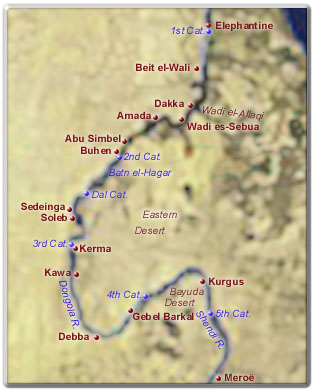
Among the earliest records of relations between Kmtyw (people north On the inscription, an unmanned boat floats over three dead enemies Who were the peoples in TaSeti, the land that in earliest dynastic times A 6th dynasty inscription by Merenre lists the Mazoi, the Irtet, and the They supplied Wawat acacia wood for cargo and tow boats used for Yam was beyond the 2nd cataract. Harkuf, an important courtier of Pepi II had twice in his reign to dispatch troops to Wawat and Irtet to The Medjay on the other hand were mostly quite satisfied being under
IP: Logged |
|
alTakruri Member Posts: 90 |
posted 14 December 2004 07:26 AM
quote:
IP: Logged |
|
ausar Moderator Posts: 2833 |
posted 14 December 2004 08:12 AM
alTakruri,I don't know if you have acess to the Professor Bruce Willams articles in Journal of Near Eastern Studies,but he has a full article about the Gebel Sheikh Suleiman inscriptions. He says it shows an A-Group victory instead of conquest by Djer. You should be able to acess Journal of Near Eastern Studies at Jstor if you have acess to a University library. IP: Logged |
|
ausar Moderator Posts: 2833 |
posted 14 December 2004 08:26 AM
See the following from Yurco on the Gebel Sheikh Suleiman inscriptions: Dear Troy, You have analyzed the evidence regarding Qustul in depth, but you have Most sincerely, -- IP: Logged |
|
alTakruri Member Posts: 90 |
posted 14 December 2004 06:53 PM
quote:
Did Bruce Williams write about the Djebek Sheikh Suliman
quote:
However, I don't follow the rest of Yurco's interpretation and reasoning. Here's why. Terminal A group and early dynastic cultures were contemporaries. That classic and terminal A group is the precursor for some pre/early On the east bank opposite the Djebel are three Khartoum variant sites, I have to doubt A group kings marking one of their own victories as a Maybe Murnane has the answer to all these questions but right now the So in light of the new info you gave I'd alter my statement
IP: Logged |
|
ausar Moderator Posts: 2833 |
posted 14 December 2004 08:32 PM
Which edition of Baines and Malek are you looking at? The Baines and Malek I read stated that A-Group and Naqada culture can barely be distinguished from each other. The other article cited by Yurco is avaiable in Journal of Near Eastern Studies. I might email it to you when I ever recieve a copy of it. IP: Logged |
All times are GMT (+2) | next newest topic | next oldest topic |
  |
|
Contact Us | EgyptSearch!
(c) 2003 EgyptSearch.com
Powered by Infopop www.infopop.com © 2000
Ultimate Bulletin Board 5.45c