
|
 EgyptSearch Forums EgyptSearch Forums
 Ancient Egypt and Egyptology Ancient Egypt and Egyptology
 Kemetians and the new world Kemetians and the new world
|
 UBBFriend: Email This Page to Someone! UBBFriend: Email This Page to Someone! |
next newest topic | next oldest topic |
| Author | Topic: Kemetians and the new world |
|
anacalypsis Member Posts: 75 |
 posted 01 January 2005 10:09 PM
  
I have seen documentaries and read findings showing a kemetian connection to Mesoamerica, any truth to this????? Some connections that are made are.... The pyramids of the Olmecs and west africans... Cocaine found in mummies.... And some think that the land of Punt during Hatshepsput's time might have referred to the New world trade. Any insight on this?? Thanks IP: Logged |
|
sunstorm2004 Member Posts: 214 |
posted 01 January 2005 10:39 PM
A whole thread on the subject, complete with the views of a meso-american  ... ...http://www.egyptsearch.com/forums/Forum8/HTML/000681.html IP: Logged |
|
supercar Member Posts: 1164 |
 posted 01 January 2005 10:49 PM
quote:
[This message has been edited by supercar (edited 01 January 2005).] IP: Logged |
|
supercar Member Posts: 1164 |
posted 01 January 2005 11:01 PM
quote: I must say, looking back at that thread now, some the things said just cracks me up! IP: Logged |
|
EGyPT2005 Member Posts: 45 |
posted 01 January 2005 11:16 PM
quote:
I also have heard, and read some info about the Olmecs and the presence of West Africans, in the Americas. So there may well be a connection, but until more evidence is uncovered to support this theory, or claim! I speculate most in the scientific community, will view this as a moot point! With very little evidence to support it. IP: Logged |
|
lamin Member Posts: 82 |
posted 02 January 2005 12:31 AM
But those giant Olmec heads with helmets still puzzle me. They just don't have that East Asiatic cast that Native Americans seem to have. If my memory is correct I believe I saw some photographs of figurines and carvings of persons with braided Africoid hair in Van Sertima's "They Came before Columbus". Explanations of the origins of the Olmec civilisation have been intriguing--with Hispanic(mestizos of Spanish and Native American ancestries) reacting in a rather hostile manner about the Van Sertima thesis. I also noted that a supposedly pre-Columbian Africoid female skull was found somewhere in South America--again opening up intriguing possiblities. Regardless of the merits of the Africa-Olmec connection I get the distinct impression that the vast majority of non-black scholars in anthropology and history are rather hostile to the notions of blacks(Africans) breaking ranks from their assigned position(just above the Australian aboriginese)in the pecking order of civilisations. IP: Logged |
|
ausar Moderator Posts: 2961 |
 posted 02 January 2005 12:37 AM
quote:
Many scholars in the past have tried to play diffusionist with ancient Egypt,and try to make it seem ancient Egyptians founded every human civlization on this globe. You have to be very carefrul finding small details like pyramids,because the design of the pyramid is fairly universal due to it's simplicity.
I don't rule out the possibility that maybe other cultures made it to the new world,but not the Egyptians. Maybe some Egyptian influence found it's way into the Americas indirectly through Phonecian traders. Since a large part of Phonecian culture was Egyptinized,but I seriously doubt direct contact between the Americas and Egypt. The Meso-American pyramids served a different purpose than the ancient Egyptian ones. Most were built above caves, and if you observe the cosmological function of both you will see how different they really were. IP: Logged |
|
anacalypsis Member Posts: 75 |
posted 02 January 2005 07:09 AM
quote: I see your point. I mean, as the others have also stated, nothing short of iron clad proof would ever change the minds of non african anthropologists that hold most of black africa in serious contempt. But honestly, i am not a afro-centrist, and personally do not like the idea (liken it to reverse racism=eurocentrism). However, I have read the work of Van Sertima, who taught at my sister school, and i must say that he brings up sooo many interesting points that it definitely raises some compelling questions about weather the meso americans were alone. I have read more articles on this alleged connection and some scholars make the connection with the mande tribes of west africa and not directly to the Egyptians themselves. IP: Logged |
|
Thought2 Member Posts: 810 |
posted 02 January 2005 12:47 PM
quote: Thought Writes: East Asian’s originated as did all humans in Africa. Upper Paleolithic remains from Siberia have so-called “Negroid” traits. Melanesian type crania have been found through-out the America’s and have been labeled Paleoamerican. Human occupation in the America’s predates the morphological evolution of the Mongoloid type in Asia. Crania from Baja Mexico only 600 years ago seem to be linked with Melanesian types. Early Olmec dental traits were Sundadont like Melanesians. The early Olmec may have had a Black substratum. But these Blacks would have been genetically Asian and not African. IP: Logged |
|
Kem-Au Member Posts: 789 |
posted 02 January 2005 01:06 PM
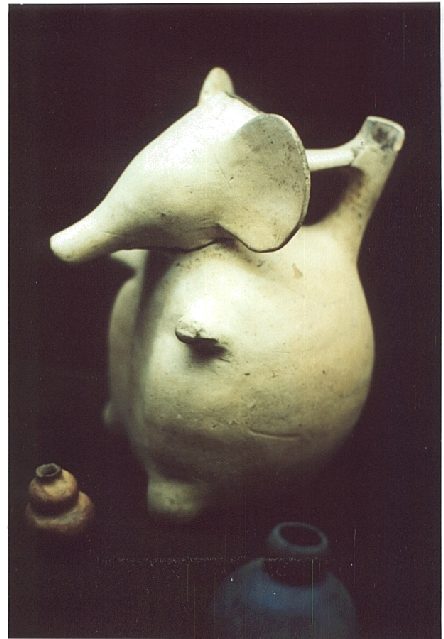
quote: What about ancient art depicting elephants in the Americas. Do you think these people saw African elephants, or could there be another explanation? IP: Logged |
|
Thought2 Member Posts: 810 |
posted 02 January 2005 05:10 PM
quote: Thought Writes: Source please? IP: Logged |
|
ausar Moderator Posts: 2961 |
 posted 02 January 2005 05:43 PM
I think Van Sertima is a resonable man with a reasonable goal to assert and place African history in a right context. The problem,however, is that Van Sertima sometimes exagerated with details. Many of his referces in his They Came Before Columbus books were outdated and extreme diffusionist like Rameses III:Father of the New World. I have personally researched his references and most seem to add up except his few in They Came Before Columbus. My opinion is that African people should focus more on the continent of Africa instead of trying to find Africans in other people's history. I understand that there is a African pressence in some parts of the world,but our duty would be best served reserching and developing profession archaeological teams digging across African. The sad fact is most archaeological and anthropological studies on Africa are still largely controlled by European Universites and funding. Globalization is killing off indigenous culture in Northern,Western,Central, and Southern African countries. Each of these people have a treasure trove of ethno history and oral literature that will dimish because of historical neglect. More Africans and Diasporian Africans have to focus on these people before it's too late. IP: Logged |
|
Kem-Au Member Posts: 789 |
posted 02 January 2005 06:53 PM
quote: http://www.sitchin.com/elephant.htm You might also find this interesting: http://www.cwo.com/~lucumi/critics.html IP: Logged |
|
anacalypsis Member Posts: 75 |
posted 02 January 2005 07:58 PM
quote: Your argument is extremely compiling.. I agree! It is very important for africans to head up this enormous tasks of putting african history in its proper context. Much damage has be done to africa's history through Eurocentric and even quasi arab teaching and interpretations of Africa's history. Once the history of Africa is fully interpreted, developed, and reconstructed then the other connections, I believe, will fall into place. IP: Logged |
|
Thought2 Member Posts: 810 |
posted 02 January 2005 09:35 PM
quote: http://www.sitchin.com/elephant.htm You might also find this interesting: http://www.cwo.com/~lucumi/critics.html [/B][/QUOTE] Thought Writes: Are you certain it is an elephant? Also, where can I find the radio-carbon dates? IP: Logged |
|
rasol Member Posts: 1474 |
posted 02 January 2005 10:20 PM
Sunstorm wrote: A whole thread on the subject, complete with the views of a meso-american ...http://www.egyptsearch.com/forums/Forum8/HTML/000681.html Thought: if you review the thread in the link you will see that the best counter argument to the statue being an African elephant is that it is a picture of a Mastadon. There were "elephants" in ice age America, but were they still around during the time of the Olmecs? Picture of Mastodon hunt: http://encarta.msn.com/media_461543877_761555928_-1_1/Mastodon_Hunt.html [This message has been edited by rasol (edited 02 January 2005).] IP: Logged |
|
ABAZA Member Posts: 671 |
 posted 02 January 2005 11:07 PM
What is truly sad, is that most of the Afrocentric work has focused on Egypt, while ignoring the rest of Africa. Even Nubia, has received a lot less study than Ancient Egypt. The question that should be asked, is why is this happening and is this trend acceptable? Honestly, I think the Afrocentrics are misguided and do a great deal of harm to the rest of Africa, that is purposely ignored in favor of Egypt ( A Non-Black African Culture and Civilization). This is a sad situation, but the good news is that most of the True Objective Scientific work is being done by people who are not biased and carry no Political Agendas, i.e., non-Afrocentrics. IP: Logged |
|
anacalypsis Member Posts: 75 |
posted 02 January 2005 11:50 PM
quote: By your definition, there aren’t any ancient black african civilizations, remember? By your criteria, even the ancient west and south african civilizations would not be black african. Whats funny is that your narrow definition of what's black, is the exact match of what the olmecs statues show/depict.. But, I guess you'd say that they still could not have been black in the first place, despite the match in your criteria of what a black African is. See how your logic works??, and does not work? Not to mention the fact that you never provide any shred of proof to support your thought on this. IP: Logged |
|
EGyPT2005 Member Posts: 45 |
posted 03 January 2005 01:39 AM
quote: Actually, your so called "Objective" Scientific work,is in reality, being done by Eurocentrists, such as yourself ABAZA. IP: Logged |
|
EGyPT2005 Member Posts: 45 |
posted 03 January 2005 02:07 AM
quote: Very True! You would think, when it comes to this particular subject. ABAZA would be leading the pack in agreement with Van Sertima's conclusions. Since the Olmec Heads represent and convey to his simplistic view of what is Negroid(Black African)! [This message has been edited by EGyPT2005 (edited 03 January 2005).] IP: Logged |
|
rasol Member Posts: 1474 |
posted 03 January 2005 07:21 AM
quote: quote:lol. As always, the problem with people like Abaza who are addicted to making phoney/fibbing arguments is that they envariably contradict themselves in an effort to make sense of what they know deep down, are ridiculous opinions - namely their own. His form of argument - that there should be less focus on Egypt and more on the rest of Africa is known as 'begging the dogs off the hunt'. Won't work. Abaza's tactics are too 'simple' to be effective on anyone other than himself. IP: Logged |
|
rasol Member Posts: 1474 |
posted 03 January 2005 07:28 AM
Abaza: Here is a specific answer to your 'question' from an earlier post, followed by a specific question: alTakuri wrote: quote: Question, please give us a list of works by African scholars that you have actually read or are familiar with. You appear to offer a series of biased statements in lieu of informed opinion. We think you are clueless and therefore not qualified to assess the works of scholars whom you in fact, have never read. Thank you. [This message has been edited by rasol (edited 03 January 2005).] IP: Logged |
|
Kem-Au Member Posts: 789 |
posted 03 January 2005 08:46 AM
quote: I'd put my money on this being an elephant: As far as radio-carbon dates, I'm not sure. I was just wondering if you we familiar with the elephant. IP: Logged |
|
rasol Member Posts: 1474 |
posted 03 January 2005 09:04 AM
Case in point...in case someone did not get the point. The Scientific Existence of African People The astronomical knowledge of many African societies (Egyptians, the Dogons, the Yorubas, etc.) was accompanied by a complex mathematical system. Further, the trading nature of Africans required the existence of a numbering system. Evidence of the use of a numbering system in Africa was found on a bone 8000 yrs. old. The Yorubas have a mathematical system which would baffle most mathematicians. In navigation, Africans built many sophisticated vessels for traveling the Nile and Niger river. These vessels were used to carry out trade between the several empires: between the west coast and Lake Chad, between Mali and the Songhay empires, between Jenné and Timbuktu. The Chinese recorded Africans coming to the Court of China with elephants in such vessels in the thirteenth century. There is evidence that African navigational ingenuity brought them to the Americas before Columbus. There were other African feats in agricultural science, writing systems, and of course, medical science. The Egyptian Imhotep is the first known medical doctor. African plant medicine involved a complex body of knowledge related to the diagnosis of diseases, anesthetics, antiseptics, and vaccination. African doctors were also well-versed in surgical procedures and techniques. The Bantu used the bark of a plant Salix Capensis to treat musculoskeletal pains. This family of plants yielded salicylic acid the active ingredient in aspirin. In Mali, an effective cure for diarrhea used kaolin, the active ingredient in Kaopectate. African doctors also pioneered the use of herbal treatments in the treatment of psychosis. Many of the herbs used contained tranquilizers. African medical practice have always emphasized holism as a philosophy. Western medicine only now attempting to adopt this philosophy. Closer to the Caribbean, in America, Africans have had several feats in the field of science and invention. In accordance with the saying, "necessity is the mother of invention", many enslaved Africans who were skilled artisans and craftspersons, designed implements to make their work easier. Not being recognized as humans under US law, many were unable to register and patent their inventions. Once freed, they were able to do so. At the turn of the century, an American trade exhibit in Paris wanted to feature a "Negro Exhibit". The US patent office put out a call for any information on inventions by African Americans. An overwhelming response produced some 400 inventions by more some 190 inventors. Some of these late 1800 registered patents included: lawn mower, street sweepers, car coupler, train alarm, self-setting animal trap, valves for steam engine, the golf tee, foot power hammer, bread crumbing machine, shoe lasting machine, lubricator for steam engines, fertilizer distributor, clothes drier, fire escape ladder, and a paper bag machine. Elijah McCoy, after whom the phrase "The real McCoy" is coined, had some 25 patents to his name between 1872 - 1899. Some other well-known African American inventors in addition to Elijah McCoy, include: Lewis Latimer who developed production techniques for making carbon filaments for bulbs, and designed a cotton filament that made it possible to bring electric light to homes. Latimer also drew the plans for Alexander Graham Bell’s telephone. Garrett Morgan invented the first automatic street light and a smoke inhalator for safety in fire fighting. Norbert Rillieux, born enslaved in Louisiana, patented a process which revolutionized sugar processing. Granville Woods invented a railway induction telegraph system which reduced the number of train collisions. Lewis Temple, a blacksmith in Massachusetts, designed a moving head harpoon which revolutionized the whaling industry. As we move up in time, many scientific feats are being performed by Africans all over the globe, even as we speak, Africans are involved with all of the pure sciences, space technology, energy systems, and engineering. This is not to say that other societies are not involved in the field of science, but rather to dispel the myth that Africans operate on the periphery rather than at the heart of the scientific world. Space limitation does not allow a lenthy exposé of Africans in Science. For the reader who wants to know more, I recommend the book Blacks in Science: Ancient and Modern, edited by Ivan Van Sertima, http://husky1.stmarys.ca/~hmillar/Afrsci.htm
1. The Dogon of Mali had an excellent understanding of the solar system and the universe 700 years ago. The Dogon had detailed knowledge of a white dwarf companion star to Sirius A which was not visible to the naked eye. Western scientists stated that there was no way that the Dogon could have uncovered this knowledge on their own and that it must have been supplied to them by a visiting European or an extra- terrestrial visitor. 2. The Yoruba tribe had an exceedingly complex number system based on twenty. 3. A 35,000 year old, fossilized baboon bone found in Zaire, the Ishango bone, is covered with a series of notches or tally marks, which makes it the oldest mathematical object in the world, and the world's earliest number system. The bone is also a lunar phase counter, which suggest that African women were the first mathematicians since keeping track of menstrual cycles requires a lunar calendar. 4. There was a very accurate calendar system in Eastern Africa by the first millenium B.C. (Lynch & Robbins 1984). 5. A megalithic site similar to stonehenge dating to 300 B.C. was found in northwest Kenya. Its nineteen basalt pillars were aligned extremely accurately with the stars and constellations (Lynch & Robbins 1984). 6. A model of a glider dated to the 4th or 3rd century B.C. was found in Egypt. The structure of the object was most definitely aerodynamically designed (Messiha et al. 1984). 7. An iron-ore mine in Swaziland, the oldest found in the world, was dated as 43,000 years old. The ore specularite was used as a cosmetic and pigment (Zaslavsky 1984). 8. Africans developed technology to build sea-worthy boats and the ability to navigate over long expanses of ocean . There is ample evidence to suggest that African explorers reached South and Central America long before Columbus made his journeys (Malloy 1984). 9. 1500 to 2000 years ago near Lake Victoria, carbon steel was made in blast furnaces. The temperature achieved in the furnaces, 1,800C, was much higher than was managed in Europe until modern times (Van Sertima 1984). 10. By the year 1000 AD, in the Middle East, Ibn al-Haytham, a Muslim mathematician and astronomer, was studying atmospheric refraction, and by the 1100s a fellow Muslim, geographer Abu Abdallah Muhammad al-Idrisi, divided the world into seven climatic zones. Climate changes have long since tuned vast savannas and grasslands bodering Africa’s Sahara into desert. Translations of Arabic texts into Latin help spread knowledge of such instruments as the astrolobe.History of Mathamatics in Africa: http://www.saxakali.com/COLOR_ASP/historymaf.htm [This message has been edited by rasol (edited 03 January 2005).] IP: Logged |
|
anacalypsis Member Posts: 75 |
posted 03 January 2005 09:11 PM
quote: Thanks Rasol, iteresting reading indeed. Do you know of any good and credible documentaries/books, that covers the possibility of Africans in early america (other than VSertima)?? IP: Logged |
|
anacalypsis Member Posts: 75 |
posted 03 January 2005 09:22 PM
quote:
Besides, I also read that according to the oral traditions of the mesoamericans, they themselves believed that black faced men came in boats across seas and settled amongst them?? How come no one has mentioned this?? I mean, I know that native americans do not like the sound of this because of all the other implications that follows it, but still, I wonder how much truth is in this? IP: Logged |
|
alTakruri Member Posts: 242 |
posted 03 January 2005 09:52 PM
quote:
The terra cotta figures the Central and South Americans bequeathed
Best bet is to buy Van Sertimas Ancient America Revisited and
IP: Logged |
|
Thought2 Member Posts: 810 |
posted 03 January 2005 10:01 PM
quote: Thought Writes: by looking at Von Wuthenau's artifacts how would one differentiate between indigenous paleoindians (melanesean type) and Africans or indigenous mongoloid types and Chinese? IP: Logged |
|
anacalypsis Member Posts: 75 |
posted 03 January 2005 10:02 PM
quote: Really, I have never seen those. I have read VSertima's Before Columbus book and do not recall seeing any chinese type Olmecs.
quote: Do you have any pics of these?? Please share.. Thanks IP: Logged |
|
Thought2 Member Posts: 810 |
posted 03 January 2005 10:06 PM
APA 2005 Abstract: ****Using discriminant function analysis, Spirit Cave fell in the area of overlap between Amerindians and African Americans, while the other fossil crania had a higher probability Amerindian classification.**** Midfacial variation in recent human, Zhoukoudian Upper Cave, and Paleoindian crania. IP: Logged |
|
alTakruri Member Posts: 242 |
posted 03 January 2005 10:46 PM
quote: You have to get the book. I doubt if the stuff is on the web. IP: Logged |
|
anacalypsis Member Posts: 75 |
posted 03 January 2005 11:39 PM
quote: Sorry to go backwards, but revisiting old posts on this subject, Xicanconnection was waaaaaaaaaaaaaaaaaaaaaaay off with this analogy in my opinion... IP: Logged |
|
supercar Member Posts: 1164 |
posted 04 January 2005 12:14 AM
quote: Interesting link. It does provide an interesting case, concerning phenotypical relationship between the Olmec Heads and contemporary Mesoamericans. Here is an interesting link that I provided earlier, in that same thread referenced above. It gives a more broader look at Olmec sculptures: Xicanconnection appeared to be struggling with making a solid case against any African affiliation with ancient MesoAmerica, in the face of information about some African-type plant(s) that found their way to MesoAmerica, excerpts of Van Sertima's answers to his critics, the elephant sculpture, and a case made about connections between Proto-Saharan and MesoAmerican script. It boiled down to whether the said Elephant depictions were influenced by knowledge passed on by invaders, or knowledge passed on from a very distant past, when the Mammoth-like creatures and Mastodons were around. Time gap became a key issue here, which in my opinion, still hasn't been addressed. Nevertheless, the Mastodons became a more compelling case for symbolic depictions of Elephants in Olmec art, considering that no elephants live in that part of the world. Good topic; I certainly learnt some new stuff from that discussion. [This message has been edited by supercar (edited 04 January 2005).] IP: Logged |
|
anacalypsis Member Posts: 75 |
posted 04 January 2005 06:58 PM
quote:
But I agree with you though, there are compelling arguments on both sides. The truth, I am sure, is something in the middle.. But what is funny to me is that, even what many would consider stereotypically black/Negroid African, funny how it isn't when it is not convenient to be so.. IP: Logged |
|
supercar Member Posts: 1164 |
posted 04 January 2005 08:05 PM
quote: I am not advocating that Africans are the creators of the Olmec civilization; I simply don't rule out the possibility of Africans making their way to this part of the world from earlier times. That Africans made their way early to MesoAmerica in history (without any outside assistance), is not actually in doubt. The question appears to be centered on when it first happened: there are those who argue for an earlier contact, given the clues/conditions I mentioned in my last post, while there are others (including apologists) who will only acknowledge the more recent and hence irrefutable African discovery of America, spearheaded by Mansa Musa of Mali (said to have found America before Columbus). What many fail to see is that African history, for the most part, is speculation on the part of Europeans. This is a part of the world that they've just recently started learning about, aside from Early Ancient Nile Valley contacts with Southern Europeans and the outside world. And so, it appears that Africans aren't suppose to have done anything before European arrival, despite the fact that African civilizations (aside the Nile Valley civilization) had sprung up in ancient times. History is somehow suppose to be boxed within the limits of the knowledge of European historians. The contact between the greater part of Europe and Africa is a fairly recent development. Asians have had longer contact with various African groups, than Europeans. Whatever clues are used by some scholars for making their case about earlier Afro-MesoAmerican contact, isn't 'worthy of attention' unless it is considered an all-out "concrete" evidence. Even the peopling of Africa is often ignored by various scholars, in favor of the assumption that the continent has always been as it is today. This is essential piece of information, as it gives an idea of early settlements and communal activities. Many European historians admit that they don't know much about other ancient African developments, even as attention to clues and other evidence is on the all-time low. Yet there are a lot of European myths about this continent, and it is funny how these go unchallenged against real evidence, and in the absence of 'all-out' concrete evidence. Egyptian authorities have put a system in place, so as to have a greater control in the dissemination of their history, than in the past. Many South East Asian contries had long adopted such systems. Similar attempts are being made in various other African nations, but as usual funding has continued to be a problem in some cases. Until funding and full dedication is adequately put in place by African leaders, the dissemination of their nations' history may well be outsourced to those, who expectedly have no interest in promoting history as it should be. IP: Logged |
|
anacalypsis Member Posts: 75 |
posted 04 January 2005 10:16 PM
quote: well said! IP: Logged |
|
anacalypsis Member Posts: 75 |
posted 04 January 2005 10:19 PM
quote: Wait, are you saying that modern scholarship is in agreement wit IP: Logged |
|
anacalypsis Member Posts: 75 |
posted 04 January 2005 10:24 PM
quote: Wait, are you saying that modern scholarship is in agreement with the notion that the people of Mali made it to the new world before Colombus? I have not read any mainstream confirmations on this. Could you please share any sources??? Also, it was rumored that the Vikings made it to the Americas before Colombus, still fanning that torch for the European claim to first. IP: Logged |
|
supercar Member Posts: 1164 |
posted 05 January 2005 12:10 AM
quote: I don’t know what you consider “modern scholarship”, but it is has been acknowledged by many that Mansa Musa had conducted expeditions, with America being one of places they discovered. Now, the timeline of Mansa Musa (1307-1332) reign pre-dates Columbus discovery, but it is up to you to do the math and come to the logical conclusion. Moreover, I usually advice people to read what was said very carefully before jumping to any conclusion. This certainly applies to my words. As for any sources, I can only give you what I am able to find on the internet, but as always, you are more than welcome to check with your nearest local library to verify the accuracy of these sources: Excerpt 1: “C: ARABIC( ISLAMIC )INSCRIPTIONS: Source: America Discovered, by Dr. Youssef Mroueh. Excerpt 2: A relative, Abu Bakar the II, decided to find a way by sea to go to Mecca. Abu Bakar II is said to be Mansa Musa’s uncle. In 1324 while visiting Cairo, Mansa Musa reported how he became the King of Mali. He explained that he became King of Mali, his predecessor, Abu Bakar II (who belonged to the senior branch of the ruling family), decided to sail in order to discover what lies behind the Ocean, he had never come back .What Mansa Musa (who belongs to the Junior branch of the ruling family) said, then, was recorded by Ibn Amir Adjib, Governor of Cairo and Karafa. Abu Bakar and his maritime expedition left the shores of Senegal and sailed in the Atlantic Ocean. They encountered so much difficulties and challenges that they came back to Senegal. Abu Bakar reorganized his expedition, took enough provisions and a huge army with him. This expedition has never been seen again. Today, there is a strong historical evidence pointing to the possibility that this Malian prince was the first one to discover America. In Brazil for instance, there is a presence of the mandinka language, traditions and customs. Source: History of Timbuktu, from Timbuktu Foundation.org Excerpt 3: Some Atlantic crossings by Africans departed Muslim Spain between 929–961 and others, probably Mandinkas (Mandingos), sailed from the Guinea coast in the 14 century, during the time of Mansa Musa. These explorations have been reported in Muhammedan writings. See Ivan Van Sertima’s [i]They Came before Columbus (1976) and Alexander von Wuthenau’s Unexpected Faces in Ancient Africa, 1500 BC–AD 1500 (1975). For further information consult Carter G. Woodson, The Story of the Negro Retold (Washington, DC, 1942); Justin Winsor, Critical History of America (Boston, 1884-1889; W.E.B. DuBois, The Gift of Black Folk (Boston, 1924), pp. 35-51; Roland B. Dixon, Racial History of Man (New York, 1923), pp. 393-406, 436-451 and 459; J.B. Thatcher, Christopher Columbus, Vol. 2 (New York, 1903-1904), pp. 379-380; J. McCabe, The Splendor of Moorish Spain (London, 1935), pp. 179-202; A. Quatrefages, Introduction a l'étude des races humaines (Paris, 1889), p. 406; Leo Wiener, Africa and the Discovery of America, Vol. 1 (Chicago, 1922), pp. 169-170, 172, 174, 175 and Vol. 3, pp. 225-261, 264-266, 314-322; Harold Lawrence, "African Explorers in the New World," Crisis, 1962, pp. 321-332; N. Leon, História géneral de México (México, 1919), p. 14; Carter G. Woodson, African Background Outlined (Washington, DC, 1936), pp. 3-19; Almose A. Thompson, "Pre-Columbian Black Presence in the Western Hemisphere," Negro History Bulletin, 1975, pp. 452-456; James Churchward, The Lost Continent of Mu (New York, 1968-1969).[/i]
More reading from Amazon.com: The Lost Treasure of King Juba: The Evidence of Africans in America before Columbus, by Frank Joseph. Dawn Voyage: The Black African Discovery of America , by Michael Bradley Islam in the African-American Experience by Richard Brent-“Covers a lot of ground -- Mansa Musa of Mali & Abu Bakari, Duse Muhammad Ali, Noble Dru Ali, Master Fard Muhammad, Elijah Muhammad, W D Muhammad, Imaam Isa of the Ansaar Nubian Islamic Hebrews, etc.”
This is believed to be one of two expeditions by North Africans, the other one landing in Yucatan. Archealogical excavation in Mexico in the 1860s found evidence such as the "Cabeza Colosal." According to an inscription on a nearby stone associated with it, it was carved 1,783 years before the arrival of Columbus. Experts agree that it was the work of Africans or people under their direct influence. The fact that traditional accounts ignore the African contribution to pre-Columbian America illustrates the eurocentric version of history taught in our schools and with which our culture is imbued. This outlook seeks to show that Europe was the pinnacle of civilization, discoveries and progress and, by virtue of the same, that European cultures and "races" were (and are) the most advanced. In fact, Africans knew the world was a sphere long before the Europeans. Towards the middle of the 12th century, a North African scientist, El Idrisi, wrote, "What results from the opinion of philosophers, learned men, and those skilled in observation of the heavenly bodies, is that the world is as round as a sphere, of which the waters are adherent and maintained upon its surface by natural equilibrium. African historians such as Abulfeda who lived in the late 13th and early 14th centuries, had been teaching students that the world was round and that ships had circumnavigated it. The noted African scholar Al Omari, published a book in the 1340s, which recounted that people from the Mali Empire had crossed the Atlantic Ocean and reached America during the reign of the great Mansa Musa (c. 1312-1334) whose empire was the size of present-day Europe.” Source: Shunpikin Online, reprinted from “Youth Today, Vol. 2, No.2, February 1996. In 1996, Sandra L. Smith, presently the National Leader of the Communist Party of Canada (Marxist-Leninist), was the project co-ordinator for Youth Today.” …And I am sure you can do your own research on this, and come to your own conclusions. However, it is well known that Mansa Musa expeditions led to their discovery of America(s). IP: Logged |
|
alTakruri Member Posts: 242 |
posted 05 January 2005 06:16 PM
While cognizant that there were voyages, whether intentional or I consider supposed explorations of the Americas ordered by The failure of the early 14th century emperor to return home is
quote: There‘s evidence of nongovernmental directed trade between
quote: This guanin is precisely the same word kanine in Kono, a language Columbus mention of the black traders of guanin accompanies an Another trade item intimately tied into African and Middle American quote: Like guanin, almaizar was of economic importance being used as currency in West Africa and in Middle America. The siik cotton tree was grown in Middle America and the Americans wove almaizar of their own. Was this a botanical and technological transplant following the wake of pre Luso-Hispanic trans-Atlantic West African trade set up by Mandinka settlers? Philological ethnonymic and historic anthropology evidence shows that several names of towns and ethnies in Middle America were of West African derivation. These things are well documented and of certain surety unlike stray Trade involves goods from at least two terminals. What made it worth IP: Logged |
|
anacalypsis Member Posts: 75 |
posted 05 January 2005 08:20 PM
Thank you good Sir, for the great information, good show! IP: Logged |


All times are GMT (+2) | next newest topic | next oldest topic |
  |
|
Contact Us | EgyptSearch!
(c) 2003 EgyptSearch.com
Powered by Infopop www.infopop.com © 2000
Ultimate Bulletin Board 5.45c