I find the discussions about the appearance of Kemetians somewhat simplistic, without taking into account the fact indigenous culture can be used to make a powerful statement about to how African it is. I’ve noticed that diffusionists usually become silent when one goes deeper into Kemetian culture, and for obvious reasons. Recalling my exchange with Multisphinx, he touched on something worth noting, at least indirectly. His rational was that Europeans would have behaved in a certain way, while blacks and other colored people would have in another. Of course, I didn’t entirely agree on the particular example he chose, but in a way, he was onto something. Now, I am going to touch on some interesting aspects of Kemetian culture, and one must ask themselves: did Eurasian societies act this way, and if so, are they the likely spreaders of this tradition? Have we seen anything like this in other African cultures?
Marriage: The ancient Egyptians were the first people who stated marriage laws in the world. They regarded marriage as a civil and legal relationship. Marriage in ancient Egypt was a religious imposition. The ancient Egyptian laws organized the marriage relationship and indicated all rights and duties for the couples. Many of the old marriage contracts have been found, and they were registered and signed by three officers. The ancient Egyptian laws gave the right of divorce to women as well as men. The wife was respected greatly, and she had high prestige. The couple had a lot of chances to get to know each other before the engagement; for example, in the temples or at the common feasts. There was a custom in the Egyptian family which allowed the adult daughter to welcome the guests who came to visit her parents. The ancient Egyptians knew the engagement before getting married, and its customs were similar to the engagement customs in Egypt's countryside nowadays. It started by the suitor's parents visiting to his fiancee's house to get her family approval to complete this marriage and reaching an agreement, which contains two main items: an amount of money, called Mahr, paid by suitor to his fiancee's family to help them prepar the furniture of their daughter and a valuable jewelry gift, called Shabka, given by the suitor to his fiancee. The value of this gift depended on the financial and social levels of the suitor"s family. When the two parties completed the agreement, they fixed an appointment for the engagement party. Most of relatives and friends attended the party in one of the common banquet halls, which was decorated with several kinds of flowers and lights. The fiancee wore the engagement dress which was simpler than the wedding dress and its color was blue or pink while the groom put on the finger of his fiancee a ring, the ancient Egyptians gift to the old and new world, which was a symbol of immortality. In addition, the groom gave his fiancee the valuable jewelry gift had agreed on before. During the party, the attendands ate and drank several kinds of food and drinks. When the house of the new family became ready, the two families fixed an oppointment of the wedding party. The night before wedding day, the relatives, the friends and the neighbors got together to celebrate "the Henna Night". The women went to the bride's house, while the men went to the groom's house. At the bride's house the women danced and sang all night while the bride wore a pink dress made with silk or cotton fibers, and her hands and feet were bleached with henna. Meanwhile, the men danced and sang all night at the groom's house, and the groom wear an expensive clean suit. The next day, the marriage contract was signed and registered by priest in the temple in the attendance of the couple and most of their families and friends.After sun set, the wedding party started, and the couple wore their best dresses and jewelry. The bride was transferred to her new house on a horse or a camel with a musical band, and the attendants sprayed the cortege with green wheat as a symbol of fertility. Several kinds of cooked meats as well as vegetables and fruit were prepared for the attendants, who danced and sang with music all night. In the morning, the wife's mother and her sisters visited her and gave her some food. The wife's friends and relatives visited her after seven days from the date of her wedding party, and they offered gifts and some food, while she gave them some sweets and fruits. Ancient Egyptian marriage customs are the most effective marriage customs in Egypt's history although Egypt has been exposed to many civilization, such as, Greek, Roman and Islam.
Nowadays, the marriage customs in the Egyptian countryside are similar to the ancient customs, but in the city the picture is quite different, where the couple has many chances to get to know each other at university, work, clubs and other public places. However, the engagement agreement between the families still includes the two main items: the "mahr" and "shabka";furthermore, the engagement party is quite similar to the engagement party in Ancient Egypt.
Adultery in Egypt was wrong. Women got the worst punishment for adultery - a man might just be forced into a divorce, but a woman could conceivably be killed for that crime. In the Tale of Two Brothers, the adulterous wife was found out, murdered and her body was thrown to the dogs.
Unmarried women, on the other hand, seem to be free to choose partners as they so desire, and enjoy their love life to its fullest.
Source:TourEgypt.net
continued...
Posted by Supercar (Member # 6477) on :
Continued...
Sex: The Egyptians even believed in sex in the afterlife. Sex was not taboo... Even the Egyptian religion was filled with tales of adultery, incest, homosexuality and masturbation... with hints of necrophillia!
Prostitutes advertised themselves through their clothing and make up. Some prostitutes wore blue faience beaded fish-net dresses, some of which is kept in the Weingreen Museum of Biblical Archaeology in Dublin. They painted their lips red, and tattooed themselves on the breasts or thighs and even went around totally nude.
Contraception They had both contraceptives and abortions, mostly these were prescriptions that were filled with unpleasant ingredients such as crocodile dung. Here is one of the nicer ones: Prescription to make a woman cease to become pregnant for one, two or three years: Grind together finely a measure of acacia dates with some honey. Moisten seed-wool with the mixture and insert it in the vagina. -- Ebers Medical Papyrus
Incest: There were probably some brother and sister marriages, but more likely than not, the siblings in question would have been half-brothers and half-sisters. The problem arises from the limited Egyptian terms of kinship, which are very confusing. A 'father' could refer to the actual father, the grandfather or male ancestors, while 'mother' could be the same, but for the females of the family. 'Sister' could mean a lover, a wife, a mistress or concubine, niece or aunt!
Note: In various African societies, and it certainly appears to be the case in Ancient Egypt, uncles can actually be referred to as “Father”, cousins as “brother” or “sister”, while aunts can be referred to as “mother”.
The royal family, on the other hand, did have more incestuous marriages. The royal blood ran through the females, not the males. To become pharaoh, a man had to marry a royal princess...which would be his sister or half-sister.
The prevalence of brother-sister marriages within the New Kingdom royal family, a custom in obvious contrast to contemporary non-royal marriage patters, appears to have been an attempt to reinforce the links between the royal family and the gods who themselves frequently indulged in brother-sister unions.
Even the gods had sex in ancient Egypt
One Creation Story Ra, the god of creation, masturbated, and from his ejaculation he created the other gods, namely Shu and Tefnut.
Note: How did he supposedly do this?
He took his phallus in his grasp that he might create orgasm by means of it, and so were born the twins, Shu and Tefnut
Isis and Osiris Osiris was hacked into pieces by his brother Seth. Isis pieced him back together but was unable to find his phallus, so she created a new phallus. Egyptians would have a celebration of this event, during which women would walk through the streets singing and walking with puppets that had extremely large genitals.
Bes Bes was the dwarf god with a very large phallus. He was considered a protector of women and some would tatoo Bes on their thigh. Bes is celebrated in physical sex and rooms came to be known as 'Bes Chambers.'
Hathor Hathor was the goddess of love and music. In one story she exposed her genitals to her father, the sun god who smiled.
Temple of Amun The Temple of Amun had different practices over Egyptian history, but at one point, a woman would go into the temple, have sex with whomever she pleased until menstruation, after which there was a celebration. Then she was married.
Artwork The Turin Papyrus contains various pictures of sexual activity, perhaps focused on Ramses II and his many wives, or maybe depicting an ancient Egyptian brothel. It has been theorised that, more likely, it is just the fantasies of an ancient Egyptian who happened to sketch them out on papyrus. Most of the positions drawn on this papyrus seem to be rather uncomfortable!
Another sexual sketch - this time graffiti - from ancient Egypt shows a woman with a pharaoh's crown, maybe Hatshepsut engaging in sex with a male that many presume to be Senmut. This sketch has caused many people to believe that Hatshepsut and her favourite courtier were lovers.
Is this meant to be Senmut and Hatshepsut doing it doggy style?
The Egyptian god if the Nile, Hapi, was a masculine deity, given female properties because of the fertility of the Nile river. Without the Nile, there would be no Egypt. Due to the duality of Egyptian thought, there were two Hapi gods - one of Upper Egypt wearing the lotus on his head, and one of Lower Egypt wearing papyrus. He was usually depicted as a blue or green coloured man with a protuding belly, carrying libation jugs. He also has full breasts, indicating his ability to nourish Egypt. Despite being a hermaphrodite god, both Hapis were given wives - Nekhebet in Upper Egypt and Uatchet in Lower Egypt. Hapi, Nile God with breasts
Note: Then are stories of sexual relations between various other well known Gods like, Osiris and Nephthys, Nut and Geb, Horus and Set, and so forth.
Nut raised above Geb
Afterlife: The Egyptians thought of their afterlives as more of a continuation of life on earth (albeit a better life). This being the case, the Egyptians believed in sex life after death! Egyptian men had false penises attached to their mummies while Egyptian women had artificial nipples attached. Both would become fully functional in the afterlife, where they were free to engage in sexual intercourse, if they so desired. There were even fertility dolls in many graves - women with wide, child-bearing hips that were often carrying children in their arms. Other fertility dolls, known as paddle dolls, don't have any legs, and their bodies end in very wide pubic area, with tiny heads and arms. An ancient paddle doll
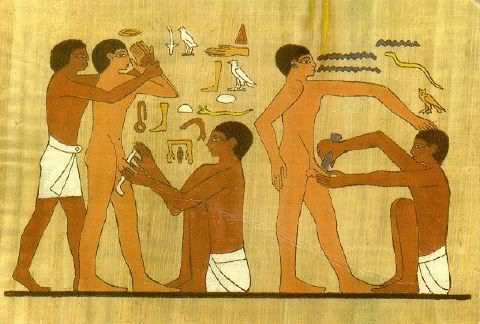
Cleanliness: In Ancient Egypt cleanliness was placed right there, among top moral values. This encouraged folks to get rid of certain bodily hairs, including the shaving of their head (which could be covered by a wig). Circumcision was also very common, as a way to prevent the build up of dirt and bacteria under the foreskin. Of course circumcision was considered a rite of passage (adulthood). In Ancient Egypt men were mostly circumcised, but it appears at times, female circumcision also occurred (Male and Female Circumcision). This was also found in certain African societies.
Herodotus:
"... the Colchians, Egyptians, and Ethiopians alone of all the races of men have practised circumcision from the first. The Phoenicians and the Syrians who dwell in Palestine confess themselves that they have learnt it from the Egyptians, and the Syrians about the river Thermodon and the river Parthenios, and the Macronians, who are their neighbors, say that they have learnt it lately from the Colchians. These are the only races of men who practise circumcision, and these evidently practise it in the same manner as the Egyptians. Of the Egyptians themselves however and the Ethiopians, I am not able to say which learnt from the other, for undoubtedly it is a most ancient custom; but that the other nations learnt it by intercourse with the Egyptians, this among others is to me a strong proof, namely that those of the Phoenicians who have intercourse with Hellas cease to follow the example of the Egyptians in this matter, and do not circumcise their children."
Sources: ToureEgypt and Bigeye.
Posted by Supercar (Member # 6477) on :
Continued...
Kingship:
The Rainmaker concept Among the Lulubo and Lokoya, responsibility for the various aspects of the natural environment that can be critical for community survival is allocated to the different clans. In case of a crisis (drought, infertility) the clan associated with the problem, is the target of investigations. The main investigation strategy is to check, one by one, the quarrels members of that clan have been involved in. When such a conflict has been identified, a solution is suggested: by way of reconciliation or restitution. Of particular interest are provocations of the responsible clan official. If a settlement of the dispute fails to bring the required result, there will be more rounds of investigation. If no solution is found the official of the clan associated with the disorder will be suspected of deliberately sabotaging the community. Accusations and counter-accusations will be thrown back and forth. The clan-official stands face-to-face with the community. If the disaster subsides, and if he uses the expectations focused on him cleverly, he may come out as a more powerful and wealthier member of the community. If the disaster prolongs, and there are no other candidates left to be blamed, he must be killed. He ends up as the scapegoat of his community.
This type of drama is most elaborate in the case of the Rainmaker. Of the various public concerns the weather has the greatest dramatic potential. Rains are capricious and localised. Rain falls over a period of 9 months. Its timeliness is a precondition for the two main harvests. The tension is particularly high in June when the first crop is about to be harvested and the annual period of hunger is peaking. The power of Rainmakers is built on this suspense. If they manage the rains well they gain in prestige. If the rains fail the community turns against its Rainmaker blaming him or her of drought. For as long as the drought persists, the confrontation between the king and his community will escalate. The process follows the steps listed in the attached table. It may ultimately lead to the Rainmaker being killed. In the area I studied I identified 26 cases of accomplished killings of kings within living memory. As the crisis deepens and the need for a solution rises all members of the community, including women and children, are gradually drawn into the process. It is the most dramatic manifestation of the community acting as a unified entity… The clan-leaders, Rainmakers, the Master of the Bush, Master of the Soil, the Master of Birds etc. are given recognition by being given designated parts of game after a hunt, the first catch of white ants, etc. They may be reminded of their responsibility by an annual sacrifice at the beginning of the season. Clan- officials are also called on on a private basis: to bless a newly cleared field, heal barrenness, to protect against pests… Between the different ecological responsibilities, rain is the most important. The importance not only depends on its practical importance for agriculture but also on its potential for generating social consensus during a period of crisis. While the Rainmaker usually shares the title of ‘King’ (Lulubo ‘osi’, Lokoya, ‘ohobu’ Lotuho ‘hobu’) with two or three other officials (usually fertility and soil) their cosmological position as ‘kings of heaven’ is matched by the highest social status. Reciprocity in the management of natural order may be negative as well as positive. If the members of the community provoke the clan official, disorder will follow: leopards may turn up at unusual places, the soil will turn infertile, and women have miscarriages. Initial solutions for addressing such disorder are through mechanisms of exchange, by way of restitution and restoration. However the reciprocity is not between the community and the environment but between different clans using their ecological powers to blackmail others and create dependency…
In few ethnographic areas is the continuity between kingship and divinity, captured in Rene Girard’s famous phrase that “gods are dead kings as much as sacred kings are gods who have not yet died”, so easily visible as in the Nilotic world. The death of the Eastern Nilotic Rainmaker/King plays a key role. If he dies as a victim of the crowd, his death is expected to release the rain and to re-activate ecological normality. If the King dies a non-violent death his powers will remain active for at least one complete season. For that period the tomb will be the object of ritual attention. For about one year after his death the King will not be succeeded. The dead King reigns. Before the new rainy season, after the tomb has been flattened, a new person will take over. We could say that these kings enjoy a short-lived divinity. The power of the king and that of divinity are continuous. The same terms are used for both. To say that a certain rainmaker’s powers are effective the Lulubo will say: the man is really ‘ juok’ . “Juok’ is the word used for God
Source: http://www.bezinningscentrum.nl/teksten/girard/s/Simonse_Simon_1.htm ... an interesting piece that goes over the impact of ecological situations on interaction within communities and visa versa, how that ties into Kingship and ritualisation. The above is the example for the Rainmaker.
[This message has been edited by Super car (edited 28 January 2005).]
Posted by screw_hawass (Member # 6434) on :
KEEP IN MIND THAT BISEXUALITY WAS A MAJOR PART OF EVERY ANCIENT CIVILZATION I HAVE SEEN PICS IN TOMB OF MEN KISSING MEN AND WOMEN ENGAGING IN SEX WITH OTHER WOMEN..BACK IN THE ANCIENT DAYS BISEXUALITY WAS NOT FORBIDDEN IT WAS JUST REGULAR SEX,,TODAY THE IGNORANCE O MANKIND BELIEVEING THERE BULLSHIT RELIGIONS MAKES THEM THINK HOMOSEXUALITY AND BISEXUALITY ARE NASTY
Posted by King_Scorpion (Member # 4818) on :
It's nasty based on personal opinion. Religon has nothing to do with it
Posted by HERU (Member # 6085) on :
quote:Originally posted by Super car: Cleanliness: In Ancient Egypt cleanliness was placed right there, among top moral values. This encouraged folks to get rid of certain bodily hairs, including the shaving of their head (which could be covered by a wig). Circumcision was also very common, as a way to prevent the build up of dirt and bacteria under the foreskin. Of course circumcision was considered a rite of passage (adulthood). In Ancient Egypt men were mostly circumcised, but it appears at times, female circumcision also occurred ([b]Male and Female Circumcision). This was also found in certain African societies.
If I heard correctly, female circumcision comes from Egypt. This is still practiced in parts of Africa. I do have a question though. What does cutting off the clitoris have to do with cleanliness?
[This message has been edited by HERU (edited 29 January 2005).]
Posted by screw_hawass (Member # 6434) on :
KEEP IN MIND THAT BISEXUALITY WAS A MAJOR PART OF EVERY ANCIENT CIVILZATION I HAVE SEEN PICS IN TOMB OF MEN KISSING MEN AND WOMEN ENGAGING IN SEX WITH OTHER WOMEN..BACK IN THE ANCIENT DAYS BISEXUALITY WAS NOT FORBIDDEN IT WAS JUST REGULAR SEX,,TODAY THE IGNORANCE O MANKIND BELIEVEING THERE BULLSHIT RELIGIONS MAKES THEM THINK HOMOSEXUALITY AND BISEXUALITY ARE NASTY
Posted by Keins (Member # 6476) on :
quote:Originally posted by Super car: [
Adultery in Egypt was wrong. Women got the worst punishment for adultery - a man might just be forced into a divorce, but a woman could conceivably be killed for that crime. In the Tale of Two Brothers, the adulterous wife was found out, murdered and her body was thrown to the dogs.
Unmarried women, on the other hand, seem to be free to choose partners as they so desire, and enjoy their love life to its fullest.
Source:TourEgypt.net [/list] continued...
[This message has been edited by Super car (edited 28 January 2005).]
It makes sense that the punishment for an unfaithful wife/woman would be harsher. THe royal blood line was passed down through the woman. So imagine a woman of royal lineage (lets say upper egypt) cheating on her husband with a foreigner or someone asiatic. what if she then became pregnant!?
What would be the punishment or action taken if the female adultress was pregnant by her "jumpoff"? LOL! Would she still be possibly killed if she was with child?
Posted by sunstorm2004 (Member # 3932) on :
quote:screw_hawass wrote:
KEEP IN MIND THAT BISEXUALITY WAS A MAJOR PART OF EVERY ANCIENT CIVILZATION I HAVE SEEN PICS IN TOMB OF MEN KISSING MEN AND WOMEN ENGAGING IN SEX WITH OTHER WOMEN..BACK IN THE ANCIENT DAYS BISEXUALITY WAS NOT FORBIDDEN IT WAS JUST REGULAR SEX,,TODAY THE IGNORANCE O MANKIND BELIEVEING THERE BULLSHIT RELIGIONS MAKES THEM THINK HOMOSEXUALITY AND BISEXUALITY ARE NASTY
A clue to AE attitudes toward homosexuality might be gleaned from the story of the contendings of heru & set.
If I remember correctly, at one point, a "victor" was decided by whose semen had been deposited in whom...
This suggests that the AE looked down on men who take semen into themselves (the "catcher"). By association, they probably also looked down on men who laid with men who took semen into themselves (the "pitcher"), though in some societies the taboo against homosexuality doesn't extend to the "pitcher" (notably latin societies, and of course, prison society).
In any case, the taboo against men being penetrated (or "invaded") is likely the basis of most taboos against male homosexuality, and it looks like the AE had that taboo.
...So I think their attitudes toward homosexuality were probably similar to our own -- a measure of tolerance, a measure of taboo.
I've also read in one version of the negative confessions the line "I have not committed homosexuality", though of course who knows how accurate that translation might be...
Posted by Supercar (Member # 6477) on :
quote:Originally posted by HERU: If I heard correctly, female circumcision comes from Egypt. This is still practiced in parts of Africa. I do have a question though. What does cutting off the clitoris have to do with cleanliness?
The origins of circumcision itself may be somewhat obscure. Even Herodotus'says that he isn't sure between the Ethiopians and the Egyptians who influenced whom, when it comes to this tradition. But it seems clear from his reaction, that this was foreign to the Europeans, and various parts of the world at the time. He gives us other's account of how it reached their communities. The circumcision was not just about cleanliness, although in the case of men, it had that effect. However, it was also a rite of passage. The rite of passage into adulthood might explain the extension of this practice to females. The circumcision of males at an early age was common.
Posted by Supercar (Member # 6477) on :
quote:Originally posted by screw_hawass: ...I HAVE SEEN PICS IN TOMB OF MEN KISSING MEN AND WOMEN ENGAGING IN SEX WITH OTHER WOMEN..
Not suggesting that bisexual relations didn't exist in antiquity, but could it be possible that the supposed kissing between two males was also a form of greeting? It is not uncommon to find that in certain societies, cheek to cheek kissing is as a form of greeting.
Posted by ausar (Member # 1797) on :
Here is a quote from the Negative Confession in the Book of the Dead. Usually the BOD is used to guide the soul through the Amduat and when judged before 24 judges. The akhu of the person recites the negative confessions which includes good or bad deeds the person preformed on this earth.
Here are some quotes about homosexuality in Kmt:
R.O Faulkner's The Ancient Egyptian Book of the Dead (Rev. Ed., 1985), we have "O Wememty-snake who came forth from the place of execution, I have not committed homosexuality." and further along we read, "O You whose face is behind him who came forth from the Cavern of Wrong, I have neither misconducted myself nor copulated with a boy." (p. 32)
Posted by Keins (Member # 6476) on :
quote:Originally posted by Super car: The origins of circumcision itself may be somewhat obscure. Even Herodotus'says that he isn't sure between the Ethiopians and the Egyptians who influenced whom, when it comes to this tradition. But it seems clear from his reaction, that this was foreign to the Europeans, and various parts of the world at the time. He gives us other's account of how it reached their communities. The circumcision was not just about cleanliness, although in the case of men, it had that effect. However, it was also a rite of passage. The rite of passage into adulthood might explain the extension of this practice to females. The circumcision of males at an early age was common.
UP!!
Posted by Djehuti (Member # 6698) on :
I have read many books on African culture which explain the common beliefs in sex and fertility. Many African cultures regard sex as not only a part of life but the after-life as well. Which is why sex is also associated with death.
Many Europeans were shocked at some of sexual customs and icons. For example, people in West Africa have wooden male fertility dolls with large erect phalluses or female dolls with cleavage etc. This is similar to figures of the Egyptian god Min with his erect phallus.
Sex was intrinsically tied with religion. There were deities that were of a certain sex while some more powerful ones were androgynous.
Women had more sexual freedom and expression, and with the exception of marriage there wasn't much restriction in fulfilling sexual desires.
Of course this all shocked Europeans. To Europeans, this was one of the evidences that black Africans were "wild" and "savage". Which is why to this day whites have stereotypes about blacks somehow being 'oversexed' that black men are big phallused perverts and women whores etc. This all goes back to European stereotypes of the sexuality of the black African "savage".
Supercar is correct to point out the irony that Egyptian culture was alot like other African cultures in its regards to sex. Which is why when the wives and female associates of Victiorian 'Egyptologist' came to visit the sites of their men. The men were careful to cover any "shameful" archaeological scenes.
Posted by Mansa Musa (Member # 6800) on :
Well since you like that bit about circumsicion and the right of passage Keins here is a picture depicting such an act:
Like many African cultures Egyptians circumcised their children around the age of puberty rather than as an infant. In this image I am not sure if it was restored and the colors were done by an artist. If the color is authentic notice that the Egyptians doing the circumsicion are painted brown but the ones recieving it are painted yellow. This would seem to be consistent with the symbolic colorism of women and certain men being painted light to represent "weakness".
As it regards culture it is well established that Egypt had a significant similarity to other African cultures. In debates many opponents to Egypt being an indegenious African culture promote a "Near Eastern" basis for Egyptian civilization often considering the Nile Valley Civilization to be an extention of West Asian cultures and peoples, citing similarities between Ancient Egypt and Mesopatamia.
I had a good link to an essay on the subject but I cannot find it at the moment. Can anyone give any details on how Mesopotamia and Egypt were similar and how they were different?
Posted by Doug M (Member # 7650) on :
quote:Originally posted by Mansa Musa: Well since you like that bit about circumsicion and the right of passage Keins here is a picture depicting such an act:
Like many African cultures Egyptians circumcised their children around the age of puberty rather than as an infant. In this image I am not sure if it was restored and the colors were done by an artist. If the color is authentic notice that the Egyptians doing the circumsicion are painted brown but the ones recieving it are painted yellow. This would seem to be consistent with the symbolic colorism of women and certain men being painted light to represent "weakness".
As it regards culture it is well established that Egypt had a significant similarity to other African cultures. In debates many opponents to Egypt being an indegenious African culture promote a "Near Eastern" basis for Egyptian civilization often considering the Nile Valley Civilization to be an extention of West Asian cultures and peoples, citing similarities between Ancient Egypt and Mesopatamia.
I had a good link to an essay on the subject but I cannot find it at the moment. Can anyone give any details on how Mesopotamia and Egypt were similar and how they were different?
In general, the two main areas in which Egypt was supposed to have been influenced by Mesopotamia were writing and architecture. However, this idea has been somewhat diminished as one looks at the dates involved. For example, early pictographic symbols have been found that were precursors to the heiroglyphs and are the oldest alphabet ever discovered. These pictographs were found in a burial site in Abydos, I think. However, there is still a preponderance of predynastic and early dynastic writings that are quite similar to the pictographs used in Mesopotamia. However, IMO, it is not necessarily the case that this pictographic style came FROM Mesopotamia as opposed to being spread TO Mesopotamia from Egypt or elsewhere.
In terms of architecture, it is a similar scenario. Early predynastic temples and other mud brick or stone structures seem to be similar to those found in Mesopotamia. Especially in the case of mud brick dwellings, since many ancient Mesopotamian structures, such as the Ziggarut of Ur are made of mud brick. The style of Mesopotamian architecture featured crenellated facades made up of repeated patterns of small recesses over the surface of the structure. The funny thing though, is that there are no surviving examples of this type of architecture in Mesopotamia that predates those found in Egypt. Once again it is a question of who influenced who.
However, at some point, Egyptian language and architecture became the unique style that we all know of today as ancient Egyptian.
Posted by Djehuti (Member # 6698) on :
quote:Originally posted by Doug M: In general, the two main areas in which Egypt was supposed to have been influenced by Mesopotamia were writing and architecture. However, this idea has been somewhat diminished as one looks at the dates involved. For example, early pictographic symbols have been found that were precursors to the heiroglyphs and are the oldest alphabet ever discovered. These pictographs were found in a burial site in Abydos, I think. However, there is still a preponderance of predynastic and early dynastic writings that are quite similar to the pictographs used in Mesopotamia. However, IMO, it is not necessarily the case that this pictographic style came FROM Mesopotamia as opposed to being spread TO Mesopotamia from Egypt or elsewhere.
In terms of architecture, it is a similar scenario. Early predynastic temples and other mud brick or stone structures seem to be similar to those found in Mesopotamia. Especially in the case of mud brick dwellings, since many ancient Mesopotamian structures, such as the Ziggarut of Ur are made of mud brick. The style of Mesopotamian architecture featured crenellated facades made up of repeated patterns of small recesses over the surface of the structure. The funny thing though, is that there are no surviving examples of this type of architecture in Mesopotamia that predates those found in Egypt. Once again it is a question of who influenced who.
However, at some point, Egyptian language and architecture became the unique style that we all know of today as ancient Egyptian.
Doug, one of the earliest pictographic writings were also found in Nubia in areas like Sayala. These writings show that the earliest kingship probably came from Nubia as stated by Trigger, O Conner et al.
Posted by Supercar (Member # 6477) on :
quote:Originally posted by Doug M:
In general, the two main areas in which Egypt was supposed to have been influenced by Mesopotamia were writing and architecture. However, this idea has been somewhat diminished as one looks at the dates involved. For example, early pictographic symbols have been found that were precursors to the heiroglyphs and are the oldest alphabet ever discovered. These pictographs were found in a burial site in Abydos, I think. However, there is still a preponderance of predynastic and early dynastic writings that are quite similar to the pictographs used in Mesopotamia. However, IMO, it is not necessarily the case that this pictographic style came FROM Mesopotamia as opposed to being spread TO Mesopotamia from Egypt or elsewhere.
In terms of architecture, it is a similar scenario. Early predynastic temples and other mud brick or stone structures seem to be similar to those found in Mesopotamia. Especially in the case of mud brick dwellings, since many ancient Mesopotamian structures, such as the Ziggarut of Ur are made of mud brick. The style of Mesopotamian architecture featured crenellated facades made up of repeated patterns of small recesses over the surface of the structure. The funny thing though, is that there are no surviving examples of this type of architecture in Mesopotamia that predates those found in Egypt. Once again it is a question of who influenced who.
However, at some point, Egyptian language and architecture became the unique style that we all know of today as ancient Egyptian.
Sounds like a subtle form of diffusionism! There is no evidence of Egyptian culture coming from Mesopotamia or vice versa, much less their writing. There is however, evidence of contact. Egyptian complex culture has been determined to have flowed from the SOUTHWARD direction, not NORTH!
Posted by ausar (Member # 1797) on :
quote:In general, the two main areas in which Egypt was supposed to have been influenced by Mesopotamia were writing and architecture. However, this idea has been somewhat diminished as one looks at the dates involved. For example, early pictographic symbols have been found that were precursors to the heiroglyphs and are the oldest alphabet ever discovered. These pictographs were found in a burial site in Abydos, I think. However, there is still a preponderance of predynastic and early dynastic writings that are quite similar to the pictographs used in Mesopotamia. However, IMO, it is not necessarily the case that this pictographic style came FROM Mesopotamia as opposed to being spread TO Mesopotamia from Egypt or elsewhere.
In terms of architecture, it is a similar scenario. Early predynastic temples and other mud brick or stone structures seem to be similar to those found in Mesopotamia. Especially in the case of mud brick dwellings, since many ancient Mesopotamian structures, such as the Ziggarut of Ur are made of mud brick. The style of Mesopotamian architecture featured crenellated facades made up of repeated patterns of small recesses over the surface of the structure. The funny thing though, is that there are no surviving examples of this type of architecture in Mesopotamia that predates those found in Egypt. Once again it is a question of who influenced who.
However, at some point, Egyptian language and architecture became the unique style that we all know of today as ancient Egyptian.
What about the early stone circles and tombs at Nabta Playa? Or the tombs in A-group Nubia?In the book ''The Complete Temples and Tombs'' Richard Wilkinson agrees that the temple models for ancient Egypt came from Nabta Playa.
For the most part most believe whatever Mesopotamian influence in ancient Egyptian society came through the Delta. Some examples of influence are found around a pre-dyanstic town known as Buto. We also see slight Palestinean influence around the house design at Maadi.
Most of the advocates of the diffusionist of Mesopotamian elements use the Gebel Arak knife handle to argue an invasion of Mesopotaminans into Egypt based upon the boat depictions.
Earlier Egyptologist like Sir Flinders Petrie argued that during Naqada II a ''Dyanstic'' race from Mesopotamia invaded and civlized the pre-dyanstic inhabitants. This theory is no longer upheld for the belief that ancient Egyptian civlization was indigenous in origin.
If you want to understand more about early Egypt there are many great essays written by various scholars in a book entitled ''Egypt in Africa by Theodore Celenko.
Posted by Doug M (Member # 7650) on :
Calm down guys!
I was only pointing out the two main areas where ancient Egypt was SUPPOSED to have been influenced by Mesopotamia. There are similarities between Egyptian pictographic writing styles at a certain period and those from Mesopotamia at some period. The same is also true about architecture. What is not agreed upon is whether this represents influence FROM Mesopotamia to Egypt or Egypt TO Mesopotamia. I am inclined to believe in the latter. How many of you actually understand the architectural style or pictographic form that I actually speak of? And, furthermore, BOTH of these styles eventually disappeared from Egyptian architecture and writing to be replaced with the style we most commonly see today. Why did those styles dissappear? It seems there is more to this and it is not hard to understand why archaeologist would attribute the appearance or disappearance of a certain STYLE of writing or architecture to influence from elsewhere. Whether this is always accurate is another story. Sometimes it is, sometimes it isn't.
Another area of supposed influence that I forgot, however, was the introduction of the horse and chariot as well as iron tools and implements. Many archaeologists believe that these were imported into Egypt from the ANE. These claims may be a bit more substantial.
[This message has been edited by Doug M (edited 23 October 2005).]
Posted by Supercar (Member # 6477) on :
quote:Originally posted by Doug M: I am inclined to believe in the latter. How many of you actually understand the architectural style or pictographic form that I actually speak of?
Well, where is this pictographic form you are actually speaking of, not to mention architecture? Let's get to the bottom of this.
Posted by Doug M (Member # 7650) on :
quote:Originally posted by Super car: Well, where is this pictographic form you are actually speaking of, not to mention architecture? Let's get to the bottom of this.
Here is a quote from an archeologist that sums up the view of the establishment on certain things they feel represent some sort of contact between Egypt and Mesopotamia/Sumer:
Quote: Some iconographic motives recurring in the predynastic Egyptian 'art' since the Naqada IIc period are assumed to have been introduced through various kinds of contacts with Near Eastern contemporary cultures. The Master of the Beasts, an hero depicted frontally while grasping with his hands two rampant lions beside him, surely had a precise symbolical meaning. Certainly the Egyptians were initially inspired by the iconography of late Uruk and Elamite glyptic - cylinder seals, which they knew through long distance commercial contacts; but they re-elaborated and manipulated these visual metaphors according to their own ideology: later in Naqada III another similar motif, that of the two 'serpopards' with their long necks held with ropes, recurs in the central register of the Narmer palette obverse. It has been advanced that this would have the same value as the later fusion of the Upper and Lower Egyptian heraldic plants which symbolized the Union of the two Lands. EndQuote:
Now, do not be CONFUSED, just because I am quoting this does not mean I AGREE with it. The point is that many archaeologists have come to the same conclusion when they are given the evidence.
Some examples of the pictographic style in question: (actually this is the most famous and most often referred to example suggesting such influence)
Here is a more detailed explanation about the issue of serekhs (early inscriptions indicating kingship in Egypt) and how they relate to the possible influence of Mesopotamia on early Egyptian writing: http://xoomer.virgilio.it/francescoraf/hesyra/Dyn0serekhs.htm
If you read these pages, you will notice that the author stresses that there are issues of chronology that must be worked out concerning the ideas of influence. He also makes the point that while there may be some influence, that these objects are distinctly African in character.
I would go even farther than that. The problem with the whole Mesopotamia/Egypt influence question is that most early archaeologists seemed to focus SOLELY to the Tigris and Euphrates cultures when looking for contemporaries to the predynastic Egyptian cultures. Because of this, any similarities between the two were automatically assumed to be from the former to the latter. More recent research is changing this view, especially in light of the societies and cultures of the ancient Sahara who are well known for their rock carvings. If anyone had an influence on the iconography in predynastic Egypt, it would have been the descendants of those from the Saharan civilizations who would most likely have migrated to the Nile valley as the Sahara dried up. Ultimately, this iconographic style featuring people, animals, boats and plants eventually became more mainstream and was developed further into a true pictographic language that spread FROM North Africa to the Tigiris and Euphrates. Unfortunately, the latest findings in the Sahara will take a long time to change the ideas of the archaeological establishment, who seem content to only focus on the two river valley societies when studying the development of civilization, as opposed to looking at the developments in other areas that are also just as important.
Posted by Supercar (Member # 6477) on :
quote:Originally posted by Doug M: I would go even farther than that. The problem with the whole Mesopotamia/Egypt influence question is that most early archaeologists seemed to focus SOLELY to the Tigris and Euphrates cultures when looking for contemporaries to the predynastic Egyptian cultures. Because of this, any similarities between the two were automatically assumed to be from the former to the latter. More recent research is changing this view, especially in light of the societies and cultures of the ancient Sahara who are well known for their rock carvings. If anyone had an influence on the iconography in predynastic Egypt, it would have been the descendants of those from the Saharan civilizations who would most likely have migrated to the Nile valley as the Sahara dried up. Ultimately, this iconographic style featuring people, animals, boats and plants eventually became more mainstream and was developed further into a true pictographic language that spread FROM North Africa to the Tigiris and Euphrates. Unfortunately, the latest findings in the Sahara will take a long time to change the ideas of the archaeological establishment, who seem content to only focus on the two river valley societies when studying the development of civilization, as opposed to looking at the developments in other areas that are also just as important.
Been there, done that! But if we must,...
The alphabet:
On the track of an ancient road in the desert west of the Nile, where soldiers, couriers and traders once traveled from Thebes to Abydos, Egyptologists have found limestone inscriptions that they say are the earliest known examples of alphabetic writing.
Their discovery is expected to help fix the time and place for the origin of the alphabet, one of the foremost innovations of civilization.
Carved in the cliffs of soft stone, the writing, in a Semitic script with Egyptian influences, has been dated to somewhere between 1900 and 1800 B.C., two or three centuries earlier than previously recognized uses of a nascent alphabet. The first experiments with alphabet thus appeared to be the work of Semitic people living deep in Egypt, not in their homelands in the Syria-Palestine region, as had been thought.
"These are the earliest alphabetic inscriptions, considerably earlier than anyone had thought likely," Dr. John Coleman Darnell, an Egyptologist at Yale University, said last week in an interview about the discovery.
"They seem to provide us with evidence to tell us when the alphabet itself was invented, and just how."
Dr. Darnell and his wife, Deborah, a Ph.D. student in Egyptology, made the find while conducting a survey of ancient travel routes in the desert of southern Egypt, across from the royal city of Thebes and beyond the pharaohs' tombs in the Valley of the Kings. In the 1993-94 season, they came upon walls of limestone marked with graffiti at the forlorn Wadi el-Hol, roughly translated as Gulch of Terror…
Dr. Frank M. Cross, an emeritus professor of Near Eastern languages and culture at Harvard University, who was not a member of the research team but who has examined the evidence, judged the inscriptions "clearly the oldest of alphabetic writing and very important." He said that enough of the symbols in the inscriptions were identical or similar to later Semitic alphabetic writing to conclude that "this belongs to a single evolution of the alphabet."
The previously oldest evidence for an alphabet, dated about 1600 B.C., was found near or in Semitic-speaking territory, in the Sinai Peninsula and farther north in the Syria-Palestine region occupied by the ancient Canaanites. These examples, known as Proto-Sinaitic and Proto-Canaanite alphabetic inscriptions, were the basis for scholars' assuming that Semites developed the alphabet by borrowing and simplifying Egyptian hieroglyphs, but doing this in their own lands and not in Egypt itself…
Although it is still possible that the Semites took the alphabet idea with them to Egypt, Dr. McCarter of Johns Hopkins said that the considerable evidence of Egyptian symbols and the absence of any contemporary writing of a similar nature anywhere in the Syria-Palestine lands made this unlikely…
Courtesy of New York times 'Science' archives
Writing:
The earliest writing ever seen may have been discovered in southern Egypt. The hieroglyphics record linen and oil deliveries made over 5,000 years ago.
The find challenges the widely-held belief that the first people to write were the Sumerians of Mesopotamia (modern-day Iraq) sometime before 3000 BC.
The exact date of Sumerian writing remains in doubt but the new Egyptian discoveries have been confidently dated to between 3300 BC and 3200 BC using carbon isotopes…
It was possible that Sumerians who traded with Egypt copied their inscriptions, Dr Dreyer said. "But we have to wait for further evidence," he warned, saying publication of his results would appear in early 1999...
Evolution of dynastic cultures from predynastic Nile Valley cultures:
In northern Egypt, where Predynastic burials of the Maadi culture are relatively unspectacular, with only a few pots, or no burial goods at all, earlier excavations focused equally on settlements. But settlements in the north focused may also have been better preserved than in the south. Evidence at Maadi of rectangular buildings and subterranean structures suggests good preservation of architecture constructed mainly of wattle and matting (Rizkana and Seeher 1989: 75). Conditions for preservation of stratified remains in the Delta and its margins may be the best in Egypt, if reports of recent excavations there are correct (Chlodnicki, Fattovich, and Salvatori 1991; Eiwanger 1988; van den Brink 1988; von der Way 1987, 1988, 1989)…
Archaeological evidence in Lower Egypt consists mainly of settlements, with very simple burials in cemeteries, and suggests a culture different from that of Upper Egypt, where cemeteries with elaborate burials are found. While the rich grave goods in several major cemeteries in Upper Egypt represent the acquired wealth of higher social strata, the economic sources of this wealth cannot be satisfactorily determined because there are so few settlement data, though the larger cemeteries were probably associated with centers of craft production. Trade and exchange of finished goods and luxury materials from the Eastern and Western Deserts and Nubia would also have taken place in such centers. In Lower Egypt, however, settlement data permit a broader reconstruction of the prehistoric economy, which at present does not suggest any great socio-economic complexity.
Differentiation in the Predynastic cemeteries of Upper Egypt (but not Lower Egypt) is symbolic of status display and rivalry (Trigger 1987: 60), which probably represent the earliest processes of competition and the aggrandizement of local polities in Egypt. The importation of exotic materials for craft goods found in burials may have become a political strategy, and the control of prestige goods would have reinforced the position of a chief among his supporters.
The unification of Egypt took place in late Predynastic times, but the processes involved in this major transition to the Dynastic state are poorly understood. What is truly unique about this state is the integration of rule over an extensive geographic region, in contrast to the other contemporaneous Near Eastern polities in Nubia, Mesopotamia, Palestine and the Levant.
Present evidence suggests that the state which emerged by the First Dynasty had its roots in the Nagada culture of Upper Egypt, where grave types, pottery, and artifacts demonstrate an evolution of form from the Predynastic to the First Dynasty. This cannot be demonstrated in Lower Egypt.
Hierarchical society with much social and economic differentiation, as symbolized in the Nagada II cemeteries of Upper Egypt, does not seem to have been present, then, in Lower Egypt, a fact which also supports an Upper Egyptian origin for the unified state. Thus archaeological evidence cannot support the earlier theories that the founders of Egyptian civilization were an invading Dynastic race, from the East (Petrie 1920: 49, 1939: 77; Emery 1967: 38 ), or from the south, in Nubia (Williams 1986: 177).
How this transformation was accomplished and the amount of time involved are points of disagreement.
Egyptian contact in the 4th millennium B.C. with SW Asia is undeniable, but the effect of this contact on state formation in Egypt is less clear (Wenke 1991: 301). There is the archaeological evidence of Palestinian wares at Maadi and later Abydos (Tomb U0j), and also Nagada classes of pottery and stone vessels in forms resembling Palestinian prototypes (wavy-handles and ledge-handles). Cylinder seals of Egyptian manufacture, which undeniably originated in Mesopotamia, are found in a few late Predynastic graves (see Kantor 1952: 246), and Uruk culture architectural elements have recently been excavated at Tell el-Fara'in/Buto (see von der Way 1992b: 220-223). The unified state which emerged in Egypt in the 3rd millennium B.C., however, is unlike the polities in Mesopotamia, the Levant, northern Syria, or Early Bronze Age Palestine - in sociopolitical organization, material culture, and belief system. There was undoubtedly heightened commercial contact with SW Asia in the late 4th millennium B.C., but the Early Dynastic state which emerged in Egypt was unique and indigenous in character.
…the roots of the major transition from autonomous villages to an early state in Egypt from simple to complex society - are to be found in Upper Egypt at large centers such as Nagada, where Predynastic cemeteries provide the main evidence for this culture.
So, again, while contact with the “Near East” is not in doubt, preponderance of evidences shows that dynastic Egypt, was the result of evolution of “indigenous’ Nile Valley cultures, and as this article appropriately phrases it, “the roots of the major transition from autonomous villages to an early state in Egypt from simple to complex society - are to be found in Upper Egypt at large centers such as Nagada, where Predynastic cemeteries provide the main evidence for this culture.” People who like to even think about using cultural diffusion from the Near East to Explain the Nile Valley complex, avoid the simplest logic of all, which is that the build up of the Nile Valley complex, starts from within the continent, I.e., from south to northward direction, not vice versa. The same goes for evidence of writing, its roots are found in the south, not north. There is no evidence, whatsoever that Egyptian burial systems, including Mastabas, developed from Near Eastern burial systems! There is however, such evidence from its precursors in the Upper Nile Valley.
[This message has been edited by Super car (edited 24 October 2005).]
Posted by Djehuti (Member # 6698) on :
Perhaps another thing to point out also would be that Hindu web article acknowledging that Egyptian culture is African.
I forgot actual link to this article, but Ausar posted it before. It's really funny because it featured a Fellahin boy with three ithyphallic figures of men. He points to the one with the biggest phallus and says "that's Egyptian", points to the one with second largest phallus and says "that's Nubian", and then points to the one with the smallest phallus and smirks "and that's Arab"! LOL
Posted by Djehuti (Member # 6698) on :
I found it! By the way, this article comes from an Indian-Hindu site :
...Islam has perhaps not penetrated into the consciousness of the Upper Egyptians as deeply as it has in other parts of the world because it is still in some ways considered an alien import. The people in these parts are most definitely African in their physiognomy and culture. Traces of other races are noticeable in physical features and Arabic is, of course, the sole spoken language. But for all that the pride in being African is unmistakable. At a factory producing alabaster figurines for sale to tourists a Saidi (as the denizens of Upper Egypt are called) points to three phallic figures of different sizes. ``This is Egyptian'', he says pointing to the largest one and then at the middle-sized one, ``that is Nubian''. (The Nubians are the African people who live in the stretch between the southern Egyptian town of Aswan and Sudan). Then pointing to the smallest- sized he says with a smirk, ``And that is Arab''.
Besides being proud of their Africanness, the people of Upper Egypt also appear to be stubbornly rural. Like the peasantry in large parts of India these people seem to be in deliberate resistance to sophistication and even to look on some of the mores of modern life as being beneath their dignity. They look well-fed but even those farmers who seem more prosperous than their brethren seem to look on modern conveniences as something not really relevant to their lives. TV antennae sprout from every house-top (and as always, Mr. Amitabh Bachhan is a topic of conversation).
[This message has been edited by Djehuti (edited 24 October 2005).]
Posted by Djehuti (Member # 6698) on :
Again, it seems our resident fools have nothing to say about this subject!
Could it be that they are speechless about the fact that Egyptian culture has the SAME views most traditional African cultures have in regards to sex and sexuality.
The reverance for fertility in all its aspects; the freedom of sexual expression Egyptian women had compared to their sequestered Near-Eastern peers; the so-called African "fetishes" and figures...
Nothing at all from the idiots Abozo and Hore??..
I'm sure that these trolls still hold on to the stereotype of the black African "savages" and their "wild" hyper-sexuality. I wonder what they make of the Egyptians exhibiting the same cultural behavior?!
Posted by Djehuti (Member # 6698) on :
...
Posted by BigMix (Member # 6969) on :
quote:Originally posted by screw_hawass: KEEP IN MIND THAT BISEXUALITY WAS A MAJOR PART OF EVERY ANCIENT CIVILZATION I HAVE SEEN PICS IN TOMB OF MEN KISSING MEN AND WOMEN ENGAGING IN SEX WITH OTHER WOMEN..BACK IN THE ANCIENT DAYS BISEXUALITY WAS NOT FORBIDDEN IT WAS JUST REGULAR SEX,,TODAY THE IGNORANCE O MANKIND BELIEVEING THERE BULLSHIT RELIGIONS MAKES THEM THINK HOMOSEXUALITY AND BISEXUALITY ARE NASTY
Are you a homosexual, or bisexual or engage in such activities?
Posted by Keins (Member # 6476) on :
Nuff respect to the rural upper egyptians brethren!
quote:Originally posted by Djehuti: I found it! By the way, this article comes from an Indian-Hindu site :
...Islam has perhaps not penetrated into the consciousness of the Upper Egyptians as deeply as it has in other parts of the world because it is still in some ways considered an alien import. [b]The people in these parts are most definitely African in their physiognomy and culture. Traces of other races are noticeable in physical features and Arabic is, of course, the sole spoken language. But for all that the pride in being African is unmistakable. At a factory producing alabaster figurines for sale to tourists a Saidi (as the denizens of Upper Egypt are called) points to three phallic figures of different sizes. ``This is Egyptian'', he says pointing to the largest one and then at the middle-sized one, ``that is Nubian''. (The Nubians are the African people who live in the stretch between the southern Egyptian town of Aswan and Sudan). Then pointing to the smallest- sized he says with a smirk, ``And that is Arab''.
Besides being proud of their Africanness, the people of Upper Egypt also appear to be stubbornly rural. Like the peasantry in large parts of India these people seem to be in deliberate resistance to sophistication and even to look on some of the mores of modern life as being beneath their dignity. They look well-fed but even those farmers who seem more prosperous than their brethren seem to look on modern conveniences as something not really relevant to their lives. TV antennae sprout from every house-top (and as always, Mr. Amitabh Bachhan is a topic of conversation).
[This message has been edited by Djehuti (edited 24 October 2005).][/B]
Posted by Djehuti (Member # 6698) on :
quote:Originally posted by BigMix: Are you a homosexual, or bisexual or engage in such activities?
LMAO I believe Screw-Hawass confuses ancient Egyptian society with that of Greece! I believe Ausar has pointed out that homosexuality was considered a sin. It is also interesting that the god associated with this act is Set who represents the strange or deviant
Posted by Djehuti (Member # 6698) on :
Strange how our resident trolls have no comment on the sexual beliefs and practices of the Egyptians (which are African)...
Posted by Big_Kane (Member # 9098) on :
It obviously contradicts their ideology, but the Near-Eastern such as Greece had a homosexual 'backbone'. On the other hand, I'm not too sure about the other civilizations east of Egypt.
Posted by Djehuti (Member # 6698) on :
I learned another thing interesting about Kemetian sexual beliefs upon reading a book about modern Western religious concepts of sexuality throughout history and compared with other cultures.
In male-dominated societies like Greece and Mesopotamia, the standard sexual position was "missionary" with a male on top of a female. The position itself symbolized the males dominant position over females in these societies. But in Egypt, where things are "upside-down", "reversed", or topsy-turvy as foreigners like the Greek Herodotus put it, the standard sexual position was with the females on top. The Egyptians did not view whoever's on top as a kind of dominance but a kind of reciprocance. (and it was more comfortable for the female especially if it is her first time).
This also reflects their religious views since the sky goddess Nut was on top of her mate, the earth god Geb.
Posted by KING (Member # 9422) on :
So even sexually the ancient egyptians were Afircan. With all this info about Ancient Egyptians I wonder how egypt was ever NOT regarded as an African civilization.
Posted by Djehuti (Member # 6698) on :
quote:Originally posted by KING: So even sexually the ancient egyptians were Afircan. With all this info about Ancient Egyptians I wonder how egypt was ever NOT regarded as an African civilization.
LOL What do you mean by "sexually"?! Again, we are talking about culture. Sex is sex, what varies are peoples views and how sexual behavior is expressed. All of this depends on the culture.
Unfortunately Europeans who visited Africa did not understand these views and add to that their own 'uptight' hang-ups over sex that they had acculated through their own Augustinian history, it is easy why they developed certain racists views concerning black people and sex!!
Black Africans weren't the only victims, many peoples whom Europens encountered that had similar 'liberal' attitudes about sex were also seen as over-sexed perverts and etc. but black Africans and their descendants seem to be the most associated with it.
Try reading most of the info in this thread from the beginning and you can see that the Egyptians expressed a reverence for fertility and fecundity that you see in many traditional African cultures. This is the side of Egypt you NEVER hear about! Posted by Supercar (Member # 6477) on :
quote:Originally posted by Djehuti: LOL What do you mean by "sexually"?! Again, we are talking about culture. Sex is sex,...
Indeed, LOL! Posted by Djehuti (Member # 6698) on :
Where are Hore's comments and opinions on Egyptian views on sexuality? Posted by KING (Member # 9422) on :
He has none because then he would have to admit to them being African
Posted by Keins (Member # 6476) on :
I noticed from many of the Ancient Egyptians' depiction of the male phallic always shows it extra long and oversized. Is this a common african theme or motif for displaying their sexualness so to speak. I know about the rumors about the "black penis" but I was specifically wondering if its is an african cultural style. I know the Greeks thought small penises were better and often depicted theirs in that manner.
Any answers?
quote:Originally posted by Djehuti: I learned another thing interesting about Kemetian sexual beliefs upon reading a book about modern Western religious concepts of sexuality throughout history and compared with other cultures.
In male-dominated societies like Greece and Mesopotamia, the standard sexual position was "missionary" with a male on top of a female. The position itslef symbolized the males dominant position over females in these societies. But in Egypt, where things are "upside-down", "reversed", or topsy-turvy as foreigners like the Greek Herodotus put it, the standard sexual position was with the females on top. The Egyptians did not view whoever's on top as a kind of dominance but a kind of reciprocance. (and it was more comfortable for the female especially if it is her first time).
This also reflects their religious views since the sky goddess Nut was on top of her mate, the earth god Geb.
Posted by Supercar (Member # 6477) on :
quote:Originally posted by Keins: I noticed from many of the Ancient Egyptians' depiction of the male phallic always shows it extra long and oversized. Is this a common african theme or motif for displaying their sexualness so to speak. I know about the rumors about the "black penis" but I was specifically wondering if its is an african cultural style. I know the Greeks thought small penises were better and often depicted theirs in that manner.
Any answers?
Interesting observation, in so far as ancient Egyptian artistic examples of the phallus, and those of classical Greeks, are concerned. Perhaps, something worth exploring further!
Posted by Mansa Musa (Member # 6800) on :
quote:Originally posted by Keins: [QB] I noticed from many of the Ancient Egyptians' depiction of the male phallic always shows it extra long and oversized. Is this a common african theme or motif for displaying their sexualness so to speak. I know about the rumors about the "black penis" but I was specifically wondering if its is an african cultural style. I know the Greeks thought small penises were better and often depicted theirs in that manner.
Any answers?
I'm not aware of any African cultural tradition to depict enormous penises in art, but scripture offers interesting insight into the endowment of Ancient Egyptian males.
Ezekiel 23:19-20
Yet she became more and more promiscuous as she recalled the days of her youth, when she was a prostitute in Egypt. There she lusted after her lovers, whose genitals were like those of donkeys and whose emission was like that of horses.
As far as Greeks are concerned I'm not so sure that the statues were a convention, from what I understand Greeks used cadavers to make scultures in detail.... or maybe that was Michaelangelo. In any case they seem to have favored a realistic representation in art as evidenced by accurate depctions of body structure.
And to the black penis myth, I read a study concerning erect penises that determined that Black men on average have a longer erect member. The overall average is about 6"-6.2" and Black men have a higher frequency of males with sizes over 7 inches than other ethnic groups.
Caucasians always came in second in these studies and Asian men last with the average Black penis being anywhere from one centimeter to a few centimeters or 10ths of an inch longer than the Caucasian or White.
Other sources state that Black men only appear larger because they are longer in the flaccid state and that some men are "showers" and some are "growers" meaning that erect most men are usually even but men with longer flaccid penises have an advantage in the shower while men who are smaller grow longer by percentage.
Anyway, I wouldn't read to much into that wall painting it looked rather old and I highly doubt it was based on any sort of realistic body proportions.
Posted by Djehuti (Member # 6698) on :
Actually in her book Reign of the Phallus, Eva Keuls says that Greeks preferred small 'dainty' penises which were symbolic of sexual control than large ones.
Ironically, the example that Greeks used of men with 'over-sized' penises were Egyptians!!
I believe Ausar himself has said that even today in Egypt, there is the stereotype that Fellahin men have large penises!
Posted by Serpent Wizdom (Member # 7652) on :
This talk about penises is really getting to me!! After all I haven't had one in over 5 years!!!! Ha! Ha! Ha!
Anyway, ya'll need to get back on the subject for real this time.
Posted by Djehuti (Member # 6698) on :
This subject is starting to disturb me as well! LOL Posted by Djehuti (Member # 6698) on :
But getting back on topic, where are Hore and imperfect's inputs? Surely perfect has something to say about the sexual customs of her presumed ancient ancestors being so similar to black Africans? Posted by Mansa Musa (Member # 6800) on :
Imperfect Egyptian.
That's a good one the trolls all need nicknames.
Considering some of his posts imposter Egyptian might be more like it.
Posted by Obelisk_18 (Member # 11966) on :
Supercar, I've been researching on the architecture of early egypt, and you say mastabas have predecessors from further south? give me a link babe, I'm interested.
Posted by Djehuti (Member # 6698) on :
^And how does that relate to the topic of this thread?
Posted by Obelisk_18 (Member # 11966) on :
Supercar mentioned mastabas having architectural predecessors further up the nile, I want to know the specifics, back off, huti .
Posted by Djehuti (Member # 6698) on :
^The only reason why I asked is because the topic of this thread is ancient Egyptian sexual practices, is all.
Posted by Obelisk_18 (Member # 11966) on :
quote:Originally posted by Djehuti: ^The only reason why I asked is because the topic of this thread is ancient Egyptian sexual practices, is all.
Oooh, sorry I wasn't really paying attention to what supercar wrote...in that case, Egyptian women had junk in the trunk, source, well I don't know, I just know .
Posted by Djehuti (Member # 6698) on :
^Sexual practices not 'looks' is the topic, however there are examples in artwork showing Egyptians women to be somewhat 'stacked in the back'. LOL Posted by What Box (Member # 10819) on :
quote:This is the side of Egypt you NEVER hear about!
I don't know about that, the egyptian ladies were pretty scantally clad in The Mummy 2!
Posted by Djehuti (Member # 6698) on :
^^Of course, but no doubt this was done for the typical Hollywood 'sex appeal'.
I'm sure not many people really know that not only were women (as well as men) were scantally clad, but in some cases nude (like African nude)!
Posted by Tee85 (Member # 10823) on :
I was reaading somewhere that "Set" didn't become like a bad god of homosexuality and deviancy until he was adopted by the Hyksos.
Posted by Djehuti (Member # 6698) on :
^Not really, because that whole story about him and sexual assocations with Heru took place during late predynastic times long before the Hyksos came.



 :
: ![[Wink]](wink.gif)
![[Big Grin]](biggrin.gif)
![[Eek!]](eek.gif)
![[Smile]](smile.gif) .
.