Mende ............................................................................. Nsibidi ................................................................................................................. Shumon
Liberian Vai; note the similarity and complexity between Vai and Ethiopic (pi, pa, pu, pe, pE, p3, po...) Posted by Neferet (Member # 17109) on :
Don't forget about the old Yemeni (South Arabian) Script. It has some similarities too.
Posted by Just call me Jari (Member # 14451) on :
^^^^Yemen is not in Africa
Posted by Clyde Winters (Member # 10129) on :
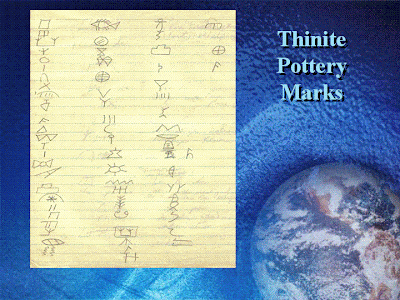
The first syllabic writing system of Africans was the Thinite script. This writing was used first by Blacks in Nubia, like the Niger-Congo people who migrated out of this region into the rest of Africa.
The Thinite script provides many of the signs that are included in later scripts used by Africans.
In Nubia, Black Africans were using Thinite symbols before the rise of Egypt to record their ideas and report on important events.
At this time your people may have been living in the caves of the Caucasus mountains.
This writing was later used by Africans to write inscriptions throughout Middle Africa.
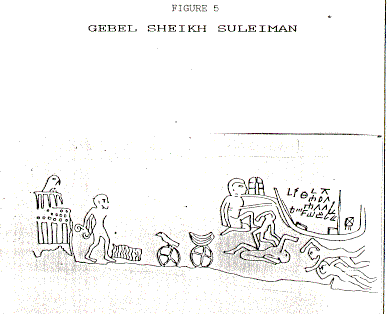
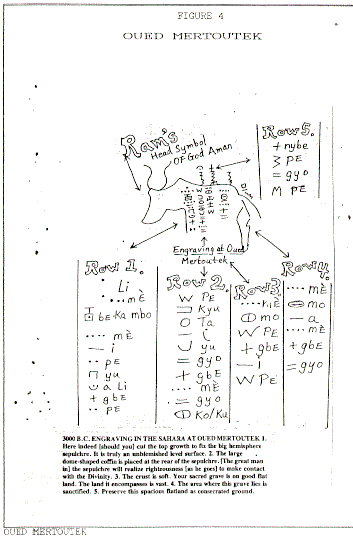
The evidence of this writing is found throughout the Sahara. By the time Mande speaking people settled Dar Tichitt they left numerous inscriptions.
The people of Dar Tichitt were Mande speakers. These Mande speaking people also lived in the Fezzan where they were called Garamante/Garamandes. The Garamante settled Crete and are recognized as the Eteo-Cretans or Minoans.
As you can see from the above chart the Linear A signs and Mande/Manding signs are identical. If you look careful you will note that Africans, or Black people had also taken their writing system to Anatolia were your ancestors were living in the Caucasus mountains as hunter-gatherers.
The Minoans, who were Africans introduced Linear A, whose signs are identical to the writing left by Africans throughout the Sahara, like those found at Tichitt and presently represented in the Vai and several other West African scripts.
Your people adopted this writing to write business documents and we know it as Linear B.
Europeans only got writing from the Egyptians. The Greeks who obtained writing from the Blacks of Africa and Phonesia passed on writing to the Romans. With the fall of Rome Western Europeans got writing from the African Muslims who taught them the arts and sciences.
Posted by Clyde Winters (Member # 10129) on :
quote:Originally posted by Just call me Jari: ^^^^Yemen is not in Africa
Correct but the writing was taken there by East Africans.
In relation to Ethiopia we find three things: 1) a long tradition of statehood (Egyptian and Ethiopian records), 2) early engagement in trade (Sumerian and Egyptian text discussing the Puntite and Meluhha civilizations), and 3) oldest evidence of writing existing in Ethiopia (Drewes 1962), not Yemen. Put these elements together we have to acknowledge that the Sabaeans and their writing probably originated in Ethiopia not Yemen.
Fattowich gives a great discussion of the rise of urbanism in Northeast Africa. He makes it clear that the Tihama pottery was related to the C-Group and Kerma people. This supports the movement of some of the groups into the Horn from this region.
In reading the article I found nothing proving that the Da'amat culture was founded by South Arabians. It would appear that Fattowich's insistence that the Sabaeans founded Da'amat is bsed purely on conjecture. And as I have noted in earlier post the earliest Sabaean inscriptions have been found in Ethiopia at Matara
The earliest Sabaen inscription found at Ma'rib is hundreds of years later:
Let's not forget that Ethiopia has a long history of civilizations and Empires beginning with Punt they also had a highly devloped system of government led by kings and queens like the rest of Africa, as indicated by the statues from Haulti/Hawlti
Daniels has a fine book and Fattowich provides great evidence on the rise of civilization in Ethiopia, but if we are to use these two sources to gage the origin of literacy on the Horn, it would appear that Sabaean originated in Ethiopia and not Yemen. The Yemeni cultures are dated much later than those in Ethiopia, and support Ethiopia traditions that civilization was taken from Ethiopia to Yemen and not the other way around.
.
Posted by Clyde Winters (Member # 10129) on :
It is very important to note that the state building in Ethiopia had its roots in Africa, not Yemen. Fattovich notes that:
A sedentary people, apparently with Afro-Arabian cultural traditions, was settled on the plateau around Asmara (Eritrea) in the late second millennium BC (the ‘Ona Group A’ with red pottery, c. 1500–1000 BC). They were in contact with the Jebel Mokram people of the western lowlands and the coastal ones along the Red Sea. Some finds from ‘Ona Group A’ sites suggest that this population was directly in contact with Egypt through the Red Sea maritime route. The same evidence, recording some chiefs of Punt, might suggest that a complex society arose on the eastern plateau in the mid-second millennium BC (Fig. 5; Tringali 1979; Tringali 1981; Fattovich 1988; Fattovich 1993). Peoples with similar pottery were living along the Eritrean and south Arabian coast of the Red Sea and the Gulf of Aden in the mid-second millennium BC (the ‘Tihama Cultural Complex’, c. 1500–1200 BC). Evidence for this has been recorded at Adulis near the Gulf of Zula in Eritrea, Sihi in the Saudi Tihama, Wadi Urq’ in the Yemeni Tihama, and Subr near Aden. The pottery from these sites shows some similarities to that from the Kerma and ‘C-Group’ of the middle Nile valley. The lithic industry is similar to that of the ‘Gash Group’ at Kassala, pointing to a possible early influence from the African hinterland (Fig. 5; Paribeni 1907; Doe 1963, Doe 1971; Zarins, Al-Jawarad Murad & Al-Yish 1981; Zarins & Al-Badr 1986; Tosi 1986; Tosi 1987). Comparable pottery occurs in the lower strata at Matara on the eastern Tigrean plateau, suggesting that this region too was included in the area of cultural influence of the Tihama complex (see Anfray 1966; Fattovich 1980). In the first millennium BC, cattle herders were moving on the Tigrean plateau in Eritrea and eastern Tigray. They are identified by rock pictures of cattle in Ethio-Arabian, seminaturalistic, and very schematic styles. Some groups practiced milking and a rock picture of ploughing at Amba Focada rock shelter (eastern Tigray) might suggest that the ‘plough and cereal complex’ was already established on the plateau (Graziosi 1941; Conti Rossini 1948; Graziosi 1964a; Graziosi 1964b; Cervicek 1979). By the first millennium BC, also the Atbara and Gash alluvial plains in the western lowlands were occupied by cattle herders, practicing some cultivation of cereals (the ‘Hagiz Group’, c. 500 BC–AD 300/400) (Fattovich, Marks & Ali 1984; Marks & Sadr 1988; Fattovich, Sadr & Vitagliano 1988–89; Fattovich 1990b; Fattovich 1991b; Sadr 1991). The classical sources, however, suggest that in the Hellenistic times the hinterland regions towards the plateau were inhabited by peoples who hunted large savanna mammals, particularly elephants (Conti Rossini 1928; Fattovich 1987a; Fattovich 1990b).
Researchers claim a Yemeni origin for the Ethiopian civilizations without any support what so ever for example Fattovich noted that:
During the first millennium BC, a state with Sabean characteristics appeared on the plateau in Tigray and Eritrea. It is archaeologically identified by the so-called pre-Aksumite culture (c. 1000/900 BC–100 BC/AD 100). This state is recorded in the inscriptions with the name of ‘Kingdom of Da’amat’. It most likely relied on the ‘plough and cereal complex’. The ruins of a stone dam, possibly going back to this period, at Safra in the Kohaito region (central Eritrea) suggest that artificial irrigation also was practiced (Anfray 1967; Anfray 1968; Fattovich 1977a; Fattovich 1977b; Fattovich 1980; de Contenson 1981; Fattovich 1988; Anfray 1990; Fattovich 1990c).
On linguistic, epigraphic and monumental evidence, the origins of this state have been usually ascribed to a south Arabian – more specifically Sabean – colonization of the plateau in the first half of the first millennium BC (see Conti Rossini 1928; von Wissmann 1975; Ricci 1984). At present, it seems that the kingdom originated from the contacts between an indigenous chiefdom and the southern Arabians, who deeply affected the local cultural pattern (Drewes 1962; Anfray 1968; Schneider 1976; Fattovich 1977b; Fattovich 1980; Fattovich 1990c). So far, the pre-Aksumite culture has been divided into three main phases of development (Fattovich 1977b; Fattovich 1980; Fattovich 1990c): 1 The Early pre-Aksumite Phase (c. 1000–800/700 BC). In this phase, the pre-Aksumite cultural area was apparently divided into two regions: (a) central Eritrea and northern Tigray and (b) western Tigray. They probably reflected a cultural division of the plateau going back to late prehistoric times (see Fattovich 1988). It is possible that chiefdoms already existed (Schneider 1976), but no safe archaeological evidence of them is yet available. The people of western Tigray who were definitely in contact with the southern Arabians worked iron, as we can infer from slag found at Gobedra rock shelter near Aksum (see Phillipson 1977; Fattovich 1980; Fattovich 1990c). The late ‘Jebel Mokram Group’ people in the lowlands were in contact with those of western Tigray (Fig. 5). 2 The Middle pre-Aksumite Phase (c. 700/600–300 BC). The kingdom of Da’amat appeared in this phase. Its territory stretched from western Tigray to central Eritrea. Most likely, the capital was located at Yeha (western Tigray) and monumental and epigraphical evidence stresses a direct link with the kingdom of Saba in southern Arabia. Some rock inscriptions recorded in Eritrea point to contacts with other south Arabian peoples and there were also contacts with the Nubian kingdom of Kush, the Achemenian Empire, and the Greek world.
This statement is contradictory. On the one hand Fattovich makes it clear that Sabaean inscriptions dating back to the Di'amat Kingdom were first found in Ethiopia as well as the earliest dam. Yet, in the next breath the author claims these elements came from Yemen, yet Fattovich does not provide any archaeological sites from Yemen dating back to this period which supports his bold claim. Lets not remember that the Yemeni dam and inscriptions date to the 4th century BC, 600 years after similar monuments appeared in Ethiopia.
Given the evidence, I am making only one claim: archaeological evidence indicate that the Oldest Sabaean inscriptions are found in Ethiopia, along with monumental architecture. This means only one thing: Sabaean writing was invented by the Ethiopians who took the writing to Yemen, no matter what some experts claim.
The archaeology does not indicate a higher civilization in Yemen than in Ethiopia. All the archaeological data indicate that Ethiopian civilizations were homegrown and taken to Yemen by the ancient Ethiopians who probably founded Saba or Sheba.
Posted by Brada-Anansi (Member # 16371) on :
Big-up to Wally for reintroducing the Topic here.
Like I had stated on another thread and over at ESR some of those African writing systems survived the middle passage and is still being used by secret societies in the Americas sometimes it seeped into the larger culture as designs and works of art. Illustration of "woman" and "congress" headstones (dissertation p.3) The basis of Malcolm-Woods's dissertation is her conclusion that the cemetery's headstones are engraved with "Nsibidi, an ancient Ejagham writing system from Nigeria" (dissertation p.2) demonstrating "the existence and survival of an Igbo community despite the subjugation of slavery" and "the maintenance of African rituals and beliefs in antebellum Virginia" (dissertation p.1) Approvingly citing Hidden in Plain View (so far as to use the book's title as the heading for Chapter 4 (dissertation p.104), she draws a connection between the "quilt code" symbols and the marks on the headstones. http://www.ugrrquilt.hartcottagequilts.com/woods
Left, from top: The burial ground headstones, identified by Malcolm-Woods as "woman", "congress" and "journey" nsibidi. Right, from top, carving and chamfering on three late 19th century stone mantlepieces, the top three in Eastlake style The woman under Malcolm-Woods's "nsibidi" headstone is Samuel Downey's first wife, Susan Compton. Multiple census records and her photograph all confirm that like her husband, she was white. The burial ground is situated on land owned by the Wood family; after Susan's death, Samuel married widow Susan Bier Wood. Census records indicate the Woods were also white. As with the Downeys, there is no record they or their parents owned any slaves.
See how an ancient African writing tradition can seep into another culture almost un-noticed? Much of the quilt making tradition in America is Nsibidi writing tradition morphed into American popular culture. American quilt inspired by Nsibedi design
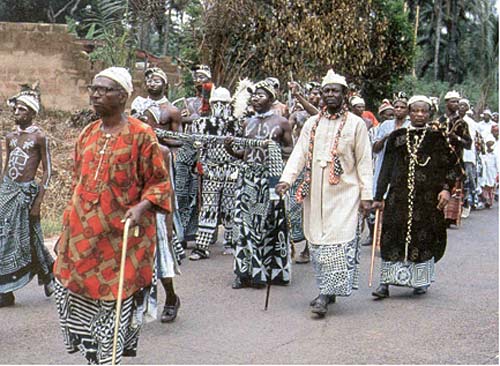
Nigerian Leopard Society members have created some of the most brilliant and elaborate displays of nsibidi. On ritual occasions, members create a dramatic presence with nsibidi-laden ukara cloth. An abundance of signs (leopards, lizards, drums, staffs, geometric and organic shapes) cover the surface of the cloths that each member ties around his waist to form a long skirt. The nsibidi is created by tightly stitching the design on a white cloth that is then dyed with indigo. After drying, the stitching and ties are removed to reveal the white nsibidi signs that appear against the deep blue background, creating a stunning cloth that is immediately recognizable as an emblem of the Leopard Society and a testament to their possession of knowledge, power, and beauty.