posted
We've discussed Egyptian artistic convention when it came to skin color and size but not enough on bodily proportions.
quote: The Canon of Proportions Whenever the Ancient Egyptian artists sculptured, inscribed or painted figures, their proportions would be determined by a canon of proportions. Up until the end of the New Kingdom's 26th Dynasty, the Ancient Egyptians used a grid that measured 18 units to the hairline, or 19 units to the top of the head. The height of the figure was usually measured to the hairline rather than the top of the head, this part of the head often being concealed by a crown or head piece making it difficult to base a canon of proportions on. 1
This separation of the crown of the skull from the rest of the body reduces the height of the figure to 18 units and provides a consistent point upon which a figure's proportions could be based.
In the Old Kingdom a more simple canon was used, from which the later grid of 18 squares evolved. Also based on the height of the forehead or hairline, this canon had generally six lines, five of which form the basis of, and therefore corresponded to the later 18/19 canon. Occasionally a line level with the top of the head corresponding with the later canon's 19th line was added, though in many Old Kingdom examples this line is omitted.
"In other words, these horizontals in the (18/19) grid system correspond to (the Old Kingdom) guide lines. Clearly, therefore, the squared grid system in which a standing figure consisted of 18 squares from the soles to the hairline must have developed out of the guide line system. It was able to incorporate all of the earlier lines except those marking the armpits and the crown of the head....The old vertical axial guide line became incorporated as a vertical guide line." 2
This vertical axial line usually passed in front of the ear. In the grid that evolved out of this earlier guideline system, the vertical line immediately in front of this axial line runs through the eye.
This more simple system of horizontal guide lines may have developed into the grid of 18 squares during the Old Kingdom. Grids have been found dating to the third dynasty or possibly earlier. Gay Robins writes:
"There is no doubt that grids had already been employed for other purposes in the Old Kingdom....Certainly with the majority of surviving tombs decorated in relief, evidence for the artist's original layout on the wall must have been lost in most cases. By contrast, painted tombs, which were more likely to show evidence of the initial stages of working, have on the whole not been well preserved. So the number of tombs known at the moment to have guidelines is a very small portion of all surviving Old Kingdom tombs. It is possible therefore, that evidence for figures drawn on grids has simply not survived..." 3 In his paper, Rudolf Gantenbrink established that the King's chamber 'air shafts' theoretically meet at a point that is 11/18 of the horizontal distance between the outer openings of the two shafts on the face of the pyramid. He illustrates this with a diagram of the pyramid's cross section in which the shafts are contained in a grid that is 18 squares in width. 4
By laying a hypothetical grid over figures from early dynasties it can be demonstrated that their proportions are identical to those of later dynasties. This would of course be expected if the grid was based upon this earlier system of horizontal lines.
The three figures above have a hypothetical grid of 19 squares overlaid to show the 18:11 relationship between the height of the hairline and navel
It must be said, however, that the canon of proportions did vary over the thousands of years of Egyptian civilisation. By applying the hypothetical grid of 19 squares to figures from different eras, Gay Robins demonstrates that though different systems were used in different eras, it is possible to speak of what she terms "classic proportions".
These classic proportions began to appear in royal figures of the Third Dynasty and were found almost universally in the Fifth and Sixth dynasties. She adds that draftsman deliberately returned to these proportions from time to time throughout history after periods of political upheaval and artistic change.
quote: The Cosmic Proportion Of The Human Figure Proportion is the commensuration of the various constituent parts with the whole. The human body is a prime example of such harmonic proportion, where the human frame has been formed with such propriety that the several members are commensurate with the whole.
The Ancient Egyptian canon for the harmonic proportion of human figures differed only between children and adults. The differences were reflective of the actual physical differences at these two stages. At birth, it is the navel that divides the height of child into two halves. Upon maturation (reaching puberty), the junction of both legs (reproductive organs) is at mid-height of the adult figure. The position of the navel now divides the height into unequal parts that make the parts and the whole in compliance with the Neb (Golden) Proportion.
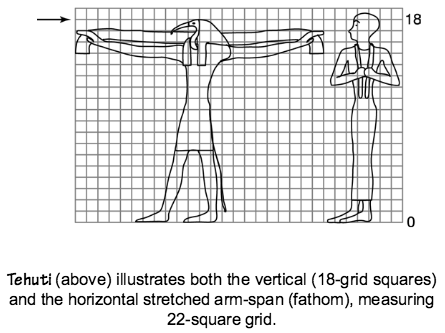
The oldest discovered records from the 5th Dynasty show that the highest defined point along the vertical axis is the hairline of the person’s head, when presented in the earthly realm.
Egyptian figurations carefully mark—with a headband, crown, diadem, or joint—a dividing line for the top of the skull of the earthly man, thus separating the crown of the skull. The height of the body was measured exclusive of the crown, as shown herein in this recovered Ancient Egyptian grid.
The representation of the neteru (gods/goddesses) and/or human beings in the afterlife are shown on an 18-square grid, for the full height to the top of the head (i.e. including the crown of the head).
The difference in the height between the two realms reflects the Ancient Egyptian’s deep understanding of the physiology and role of humans on Earth.
The removal of this part of the human brain (the crown of the head) leaves man alive but without discernment, hence with no personal judgment. The person is in a vegetative state, living and acting only as the executant of an impulse that he receives, without actual choice. It is like a person in a coma.
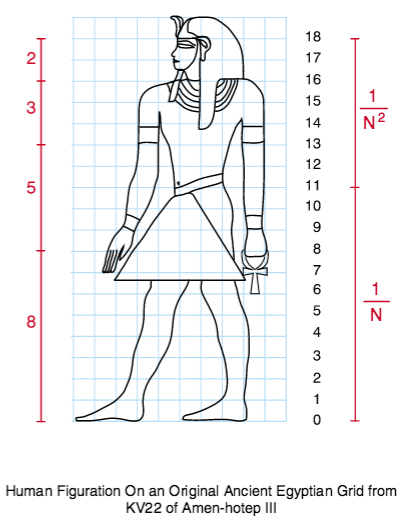
The navel is located about 11.1 grid squares from the bottom of the heel on the 18-square grid system (or the same equivalent ratio 0.618 for grid or non-grid systems). Such division follows the laws of harmony between the two parts themselves, and the parts to the whole, as per the following two relationships:
1. The ratio between the Two (top and lower) Parts of the divine height (18 grid squares) are harmonic.
Top : Lower is 0.618 Lower : Top is 1.618
2. Between the Two Parts to the whole Unity (divine height)—taking the full height (to the hairline of the earthly man’s head) as 1—the body from the feet to the navel, in the Egyptian canon, is equal to the reciprocal of the Neb (Golden) Proportion (1/N), i.e. 0.618. The portion from the navel to the hairline of the head equals the power 2 of the reciprocal of the Neb (Golden) Proportion (1/N2), or 0.382.
1 / N + 1 / N2 = 1 0.618 + 0.382 = 1 where N = the Neb (Golden) Proportion (1.618)
Because of the intimate relationship between the Summation Series and the Neb (Golden) proportion, we find that the different parts of the figure also follow the Summation Series [as depicted in the above original grid from KV22 of Amenhotep III].
we see in the early period with Narmer his legs are longer and torso shorter than the other figures Hesire's navel can be seen at 11. Narmer's navel would be at that belt area at 12 Narmer's knees are also one unit higher than the others. Narmer's proportions resemble a young teen age boy as compared to the others
Posts: 42921 | From: , | Registered: Jan 2010
| IP: Logged |
posted
^ Good observation. Who's to say Narmer wasn't a teenager?! You realize that kings started their careers early especially in ancient times when lifespans were short as it was. Boys ascended the throne in their early teens if not preteens and fought wars from thence on.
Posts: 26243 | From: Atlanta, Georgia, USA | Registered: Feb 2005
| IP: Logged |
posted
All the figures on the palettes have those kind of proportions, on the enemies too heads kind of big for the bodies also (as compared) at Persepolis and in Assyrian I see similar figures, people looking like people of shorter proportions , like and adult head on a 13 year old's body
Posts: 42921 | From: , | Registered: Jan 2010
| IP: Logged |
posted
^ Well if that's the case then perhaps they haven't perfected their proportioning yet since after all the Narmer Palette dates to the Predynastic period.
Posts: 26243 | From: Atlanta, Georgia, USA | Registered: Feb 2005
| IP: Logged |



 UBBFriend: Email this page to someone!




 Printer-friendly view of this topic