posted
^Generally speaking, we're better off using common sense than to rely too much on media announcements that leave out research specifics. Both WHG and early farmers, had darker skin. Look at the time she was born: farming had just arrived in Iberia, so it must only have been a matter of generations for her WHG and farmer ancestors to come together. Common sense says, she should not deviate that much from other products of WHG-farmer admixture.
See where her time of birth puts her on the depigmentation timeline of Europe.
So, I'm thinking this was either fumbled by a team who doesn't understand the wider context of skin pigmentation (she's not the first early farmer reconstructed with light skin; you can even see they have given Otzi light skin in the past, even though we know that this is not what the learned opinion is), OR, we're dealing with a unique situation where she and her people were genetic outliers (I understand that in Scandinavia, for instance, some hunter gatherers had derived alleles for several skin pigmentation genes).
Posts: 8877 | From: Discovery Channel's Mythbusters | Registered: Dec 2009
| IP: Logged |
quote:Originally posted by Swenet To clarify, I'm not even saying the scene is not authentic. I'm just saying, it's not admissible as far as I'm concerned, without some evidence vouching for it. Evidence I'd accept would be dating of organic materials in the paint, or sth like that.
Rock art can sometimes be hard to date since there is not always any way to date it directly. If one is lucky paintings can contain organic material which one can date, while carvings can totally lack such material. So many times one must date the art on stylistic grounds. One can also take a look at objects depicted in a picture and compare with objects found in archaeological excavations and compare. Sometimes the art can depict objects which are very specific for a certain time. Also pictures of certain animals can be used for assessment of age. Other ways is to see if the art is associated with other findings such as a hearth (with datable carbon) under a rock outcrop that contains paintings or carvings. Up here in Scandinavia some art is dated by its position in relation to the sea's shorelines, which has changed over time. One can sometimes also analyze weathering, patina, and in some cases formation of stalactites and stalagmites on the art (in calcareous caves). And one also looks at an artwork's relation to other artwork in a certain area.
Some art have also been associated with astronomical phenomena that would have occurred during a certain time, but that kind of association is often contested and debated.
When it concerns if a painting is real or not one can sometimes chemically test the paint to see if it contains pigments that did not exist in prehistoric times. Dating organic ingredients in the color is possible in some cases. Weathering and patina can also be used. Other factors are: Is a motif consistent with other motifs from a certain time and place? Is the arts position in the terrain plausible? Sometimes a trained eye can immediately spot a fake painting.
I agree. Did you catch my earlier post? They dated a Silsilian engraving recently, where they dated the build up of deposits. Impressive.
Long doubted, the existence of Pleistocene rock art in North Africa is here proven through the dating of petroglyph panels displaying aurochs and other animals at Qurta in the Upper Egyptian Nile Valley. The method used was optically stimulated luminescence (OSL) applied to deposits of wind-blown sediment covering the images. This gave a minimum age of ∼15 000 calendar years making the rock engravings at Qurta the oldest so far found in North Africa. First evidence of Pleistocene rock art in North Africa: Securing the age of the Qurta petroglyphs (Egypt) through OSL dating
Posts: 8877 | From: Discovery Channel's Mythbusters | Registered: Dec 2009
| IP: Logged |
quote:Originally posted by Swenet: ^Generally speaking, we're better off using common sense than to rely too much on media announcements that leave out research specifics. Both WHG and early farmers, had darker skin. Look at the time she was born: farming had just arrived in Iberia, so it must only have been a matter of generations for her WHG and farmer ancestors to come together. Common sense says, she should not deviate that much from other products of WHG-farmer admixture.
See where her time of birth puts her on the depigmentation timeline of Europe.
So, I'm thinking this was either fumbled by a team who doesn't understand the wider context of skin pigmentation (she's not the first early farmer reconstructed with light skin; you can even see they have given Otzi light skin in the past, even though we know that this is not what the learned opinion is), OR, we're dealing with a unique situation where she and her people were genetic outliers (I understand that in Scandinavia, for instance, some hunter gatherers had derived alleles for several skin pigmentation genes).
Yes, some of the Scandinavian Hunter Gatherers (SGH) seem to have had derived alleles for lighter skin and also for lighter hair. Some would also have light eyes. SHG had traits both from WHG and EHG, and there seems to have been a rather strong selection for lighter skin in Scandinavia.
quote:We find a surprise in six Scandinavian hunter-gatherers (SHG) from the Motala site in southern Sweden. In three out of six samples, we observe the haplotype carrying the derived allele of rs3827760 in the EDAR gene (Extended Data Fig. 5), which affects tooth morphology and hair thickness and has been the subject of a selective sweep in East Asia, and today is at high frequency in East Asians and Native Americans. The EDAR derived allele is largely absent in present-day Europe except in Scandinavia, plausibly due to Siberian movements into the region millennia after the date of the Motala samples. The SHG have no evidence of East Asian ancestry, suggesting that the EDAR derived allele may not have originated not in East Asians as previously suggested. A second surprise is that, unlike closely related western hunter-gatherers, the Motala samples have predominantly derived pigmentation alleles at SLC45A2 and SLC24A5.
The c 8000 years old Motala individuals belonged to SHG and also the c 10 000 years old so called Bredgård man from Western Sweden.
See this thread about the Bredgård man. The thread also includes an artistic interpretation and speculations about Lola, a c 5700 years old WHG girl whose DNA was found in a "chewing gum" made from birch tar, and facial reconstructions of two of the c 8000 years old Motala SHG individuals. Topic: The oldest reconstructed face in Sweden
About the woman from Gibraltar it seems she is included in a study from 2019:
quote:Ancient DNA studies have begun to help us understand the genetic history and movements of people across the globe. Focusing on the Iberian Peninsula, Olalde et al. report genome-wide data from 271 ancient individuals from Iberia (see the Perspective by Vander Linden). The findings provide a comprehensive genetic time transect of the region. Linguistics analysis and genetic analysis of archaeological human remains dating from about 7000 years ago to the present elucidate the genetic impact of prehistoric and historic migrations from Europe and North Africa.
quote:Researchers were most excited about what DNA revealed about Calpeia’s ancestry. Only 10 percent of Calpeia’s genome comes from the population found in the Iberian Peninsula, while the remaining 90 percent has its origin in Anatolia, modern-day Turkey. Farmers from Anatolia during the Neolithic period had a high percentage of alleles for dark eyes and light skin. By contrast, hunter-gatherers from central and western Europe show genetic markers for dark skin and light eyes.
quote:Originally posted by Swenet: I agree. Did you catch my earlier post? They dated a Silsilian engraving recently, where they dated the build up of deposits. Impressive.
Long doubted, the existence of Pleistocene rock art in North Africa is here proven through the dating of petroglyph panels displaying aurochs and other animals at Qurta in the Upper Egyptian Nile Valley. The method used was optically stimulated luminescence (OSL) applied to deposits of wind-blown sediment covering the images. This gave a minimum age of ∼15 000 calendar years making the rock engravings at Qurta the oldest so far found in North Africa.
First evidence of Pleistocene rock art in North Africa: Securing the age of the Qurta petroglyphs (Egypt) through OSL dating
Indeed impressive, the different luminescence techniques are really interesting.
The earlier mentioned Jean-Loïc Le Quellec also discusses the chronology of Saharan rock art in an old article from 2013:
quote:Originally posted by Archeopteryx: A couple of the women also wear a kind of dome shaped objects on their head. Parallels can be seen in Egyptian art but have also been observed among late African cultures. I want to remember that they have been discussed in some previous thread here on ES.
We don't even know what those objects are let alone if they have any relation to the perfume cones Egyptians and other Africans wore. Those objects could be small pots or containers.
quote:When it comes to the paintings at Uan Derbuaen they are interesting among others because of the choice of colors on the ladies. The color scheme is well thought out and executed. The skin is very pale while the hair (or hair gear) is colorful. Also their clothes are colorful. The skin is very pale even compared to most people who live along the Mediterranean far to the north. Many times it can be hard to know exactly what the choice of certain colors mean. Realistic or symbolic?
I've already shown other examples of unpainted silhouettes in the Sahara including those of animals. That does not mean the figures were that of literal pale skinned individuals. At least in Egypt, the first evidence we see of pale skinned Libyans was the Middle Kingdom and none of the women sport Fulani or other West African type hairstyles.
quote:Originally posted by Swenet: Generally speaking, we're better off using common sense than to rely too much on media announcements that leave out research specifics. Both WHG and early farmers, had darker skin. Look at the time she was born: farming had just arrived in Iberia, so it must only have been a matter of generations for her WHG and farmer ancestors to come together. Common sense says, she should not deviate that much from other products of WHG-farmer admixture.
See where her time of birth puts her on the depigmentation timeline of Europe.
So, I'm thinking this was either fumbled by a team who doesn't understand the wider context of skin pigmentation (she's not the first early farmer reconstructed with light skin; you can even see they have given Otzi light skin in the past, even though we know that this is not what the learned opinion is), OR, we're dealing with a unique situation where she and her people were genetic outliers (I understand that in Scandinavia, for instance, some hunter gatherers had derived alleles for several skin pigmentation genes).
This is another issue. When they say that these early Eurasians had dark skin, the question is exactly how dark, because I still question the Cheddar Man reconstruction showing him to have the same complexion as equatorial Africans. How can a population living that far north be that dark??
The Peștera cu Oase reconstruction below makes more sense in regards to complexion...
..yet Oase Man lived further south than Cheddar Man.
Posts: 26853 | From: Atlanta, Georgia, USA | Registered: Feb 2005
| IP: Logged |
quote:This is another issue. When they say that these early Eurasians had dark skin, the question is exactly how dark, because I still question the Cheddar Man reconstruction showing him to have the same complexion as equatorial Africans. How can a population living that far north be that dark??
I understand why you might question those results, but the techniques they used to predict Cheddar Man and other WHGs' skin tone are the same (or similar) to the ones predicting dark skin for ancient North African samples. If you don't mind me asking, why do you accept those techniques when they assess North African samples but not when they assess Mesolithic southern and western Europeans?
Also, I think Swenet has proposed that Cheddar Man might have North African ancestry. If there was indeed substantial gene flow from North Africa into south and then western Europe before the European Mesolithic, maybe that explains their dark skin tones?
posted
What difference does it make exactly how light or dark some ancient population was? Why should we care?
Posts: 43388 | From: , | Registered: Jan 2010
| IP: Logged |
quote:Originally posted by Djehuti I've already shown other examples of unpainted silhouettes in the Sahara including those of animals. That does not mean the figures were that of literal pale skinned individuals. At least in Egypt, the first evidence we see of pale skinned Libyans was the Middle Kingdom and none of the women sport Fulani or other West African type hairstyles.
White figures can mean different things in different contexts. Are they from the same time and place? What is the relationship between skin color, clothes and hair? Why did the painters of the Uan Derbuaen choose to paint hair and clothes in vivid colors, but not the skin? It is not that the figures are unpainted, it is mostly the skin parties which are white. We do not have the exact keys to their imagery.
Both in Egypt and among Minoans and others there have been later traditions of painting very light skinned women, while the men are depicted darker. Maybe it is a similar symbolism here? It could be quite local in a somewhat limited area. Or there can be a totally other symbolism.
Their exact skin color we do not know but we can guess they were not as white as in the paintings. Not even Mediterraneans are so white.
Otherwise the occasion maybe explain the choice of color. Augustin Holl for example in the article I referred to above interpret them as the participants in a wedding party.
The colors of their hair can be different forms of ochre (yellow, red, brown), but can also be symbolic, or something else.
As for the objects on their heads, they can be anything from clay pots (which we have seen in other parts of Africa) to ostrich eggs. As long as we have not found the objects themselves we cannot be sure.
Sometimes to be able to more advanced interpretations one must see the paintings in real life and in their right context. How are their real colors? How degraded are they? What is their relation to other, nearby paintings? Even then there is room for speculations.
Also we sometimes impose todays views of race and similar on ancient times and populations. Some like to see white figures in Sahara, others like to see black figures in Northern Europe.
One more painting in the Iheren style. Seems that it was common to depict people in light colors but with colorful clothes
-------------------- Once an archaeologist, always an archaeologist Posts: 3058 | From: Sweden | Registered: Mar 2020
| IP: Logged |
quote:Originally posted by the lioness,: What difference does it make exactly how light or dark some ancient population was? Why should we care?
You are right, in many cases it does not matter. The reason we still discuss it have often more to do with todays racial issues then what it has to do with the world of the ancient peoples.
Of course if one does research about how skin color affects our biology, and how skin color is affected by external factors, and how it has changed over the millennia, then it is relevant. But many skin color discussions in various fora online are often more political than scientific.
-------------------- Once an archaeologist, always an archaeologist Posts: 3058 | From: Sweden | Registered: Mar 2020
| IP: Logged |
posted
It is interesting that when artist Tom Björklund painted his interpretation of "Lola", a WHG-girl from Lolland in Denmark, known only by DNA preserved in a chewing gum made from birch tar, he got reactions from some people who thought he had made her way too dark. But he also got reactions from other people who thought he had painted her too light.
-------------------- Once an archaeologist, always an archaeologist Posts: 3058 | From: Sweden | Registered: Mar 2020
| IP: Logged |
quote:This is another issue. When they say that these early Eurasians had dark skin, the question is exactly how dark, because I still question the Cheddar Man reconstruction showing him to have the same complexion as equatorial Africans. How can a population living that far north be that dark??
I understand why you might question those results, but the techniques they used to predict Cheddar Man and other WHGs' skin tone are the same (or similar) to the ones predicting dark skin for ancient North African samples. If you don't mind me asking, why do you accept those techniques when they assess North African samples but not when they assess Mesolithic southern and western Europeans?
Also, I think Swenet has proposed that Cheddar Man might have North African ancestry. If there was indeed substantial gene flow from North Africa into south and then western Europe before the European Mesolithic, maybe that explains their dark skin tones?
Yes, I did, but I was still waiting for more evidence. In my response to SlimJim I mentioned Kom Ombo Man. In the past I've speculated that his unusually wide and prominent frontal bone could be the source of the same feature showing up in parts of West Eurasia, after his people (Sebilians?) disappeared from Upper Egypt, as part of a larger evacuation of the Egyptian Nile:
There came an end to the visibility of human presence after 13 ka calBP and for a long period of several millennia no sites have been documented in Upper Egypt, except some rare Epipalaeolithic sites around 9.0 ka calBP (Vermeersch, 1978). Only with the end of the Holocene pluvial at about 5.5 ka calBP when Predynastic culture is developing, is a high number of sites observed in the area (Kuper and Kr€ opelin, 2006). Nile behaviour and Late Palaeolithic humans in Upper Egypt during the Late Pleistocene https://www.sciencedirect.com/science/article/pii/S0277379115001328
Angel on wide frontal bones showing up in different roughly contemporary sites (Angel doesn't list him, but Cheddar Man also has this feature, and he also belongs to this general post-glacial time period):
This Egyptian ancestry, if it's even responsible for spreading this phenotype, could have hitch-hiked to Europe as part of this postglacial migration from Middle East (which Cheddar Man's genome, also shows some admixture with):
During the major warming period after ~14,000 years ago, a genetic component related to present-day Near Easterners became widespread in Europe. These results document how population turnover and migration have been recurring themes of European prehistory. The genetic history of Ice Age Europe https://www.nature.com/articles/nature17993
^Just some context, so I don't look crazy being paraphrased saying Cheddar Man may have African ancestry (Its def possible to go overboard w/ seeing African ancestry everywhere, as some others do).
Posts: 8877 | From: Discovery Channel's Mythbusters | Registered: Dec 2009
| IP: Logged |
posted
British stone age is quite interesting since several different waves of humans have inhabited the land. Wiki gives a brief summary:
quote:Several species of humans have intermittently occupied Great Britain for almost a million years. The earliest evidence of human occupation around 900,000 years ago is at Happisburgh on the Norfolk coast, with stone tools and footprints probably made by Homo antecessor. The oldest human fossils, around 500,000 years old, are of Homo heidelbergensis at Boxgrove in Sussex. Until this time Britain had been permanently connected to the Continent by a chalk ridge between South East England and northern France called the Weald-Artois Anticline, but during the Anglian Glaciation around 425,000 years ago a megaflood broke through the ridge, and Britain became an island when sea levels rose during the following Hoxnian interglacial.
Fossils of very early Neanderthals dating to around 400,000 years ago have been found at Swanscombe in Kent, and of classic Neanderthals about 225,000 years old at Pontnewydd in Wales. Britain was unoccupied by humans between 180,000 and 60,000 years ago, when Neanderthals returned. By 40,000 years ago they had become extinct and modern humans had reached Britain. But even their occupations were brief and intermittent due to a climate which swung between low temperatures with a tundra habitat and severe ice ages which made Britain uninhabitable for long periods. The last of these, the Younger Dryas, ended around 11,700 years ago, and since then Britain has been continuously occupied.
One famous fossil of Homo sapiens is the 33000 years old Red "Lady" of Paviland. But his (it was actually a man) people disappeared when the climate deteroriated again.
So Cheddar man is rather late on the stage. But he seems to be related with many other WHG:s in Europe.
After the reconstruction where they depicted him as rather dark there were some discussions about the reliability of the methods to determine his skin color.
Here is a newsflash from 2018
quote:Was Cheddar man white after all? There's no way to know that the first Briton had ‘dark to black skin’ says scientist who helped reconstruct his 10,000-year-old face
T-he bones are the oldest near-complete human skeleton ever found in Britain
-Experts tested DNA taken from bone powder by drilling a hole through the skull
-It showed there was a 76 per cent chance that Cheddar Man was ‘dark to black’
-Scientist behind the test used says it is impossible to be certain of this fact
quote:Originally posted by Swenet: ^Just some context, so I don't look crazy being paraphrased saying Cheddar Man may have African ancestry (Its def possible to go overboard w/ seeing African ancestry everywhere, as some others do).
One can just hope his relatives had the time to stop for a cup of tea on the way from Africa to England
-------------------- Once an archaeologist, always an archaeologist Posts: 3058 | From: Sweden | Registered: Mar 2020
| IP: Logged |
quote:Originally posted by Swenet: ^Just some context, so I don't look crazy being paraphrased saying Cheddar Man may have African ancestry (Its def possible to go overboard w/ seeing African ancestry everywhere, as some others do).
One can just hope his relatives had the time to stop for a cup of tea on the way from Africa to England
What is the saying? Necessity is the mother of all inventions? Unlike some others, when postulating migration, I follow the necessity (climatic pressures, and other forces that drive ancient history), not personal whims. W/ necessity everything else follows, including finding the time for that cup of tea. Posts: 8877 | From: Discovery Channel's Mythbusters | Registered: Dec 2009
| IP: Logged |
quote:Originally posted by Swenet: Generally speaking, we're better off using common sense than to rely too much on media announcements that leave out research specifics. Both WHG and early farmers, had darker skin. Look at the time she was born: farming had just arrived in Iberia, so it must only have been a matter of generations for her WHG and farmer ancestors to come together. Common sense says, she should not deviate that much from other products of WHG-farmer admixture.
See where her time of birth puts her on the depigmentation timeline of Europe.
So, I'm thinking this was either fumbled by a team who doesn't understand the wider context of skin pigmentation (she's not the first early farmer reconstructed with light skin; you can even see they have given Otzi light skin in the past, even though we know that this is not what the learned opinion is), OR, we're dealing with a unique situation where she and her people were genetic outliers (I understand that in Scandinavia, for instance, some hunter gatherers had derived alleles for several skin pigmentation genes).
This is another issue. When they say that these early Eurasians had dark skin, the question is exactly how dark, because I still question the Cheddar Man reconstruction showing him to have the same complexion as equatorial Africans. How can a population living that far north be that dark??
The Peștera cu Oase reconstruction below makes more sense in regards to complexion...
..yet Oase Man lived further south than Cheddar Man. [/QB]
I try to stay ahead of such difficult questions, by speaking in relative terms. Generally I avoid 'black', and when I speak on WHG and farmers I use dark and darker.
~44% of skin pigmentation is controlled by the genome (ie many SNPs distributed throughout the genome prolly contribute to depigmentation), while the major alleles (SLC24A5, etc) control ~35%. The percentage breakdown differs depending on the study.
Figure 7. Genetic architecture of skin color variation.
(a) Effect sizes of the loci associated with skin color. Effect values represent the beta values obtained from a regression model containing the four associated loci plus ancestry. (b) The pie chart represents the proportion of phenotypic variation accounted for by the different components, including non-heritable factors (∼20%), the four major loci (∼35%, color-coded as in [a]), and average genomic ancestry (44%). The heritable contributions were estimated by regression and variance decomposition as described in Material and Methods, and are also represented below the pie chart separately as grey (genomic ancestry) or open (four major loci) areas. However, because of admixture stratification, the heritable contributions overlap as described in the text. Genetic Architecture of Skin and Eye Color in an African-European Admixed Population https://journals.plos.org/plosgenetics/article?id=10.1371/journal.pgen.1003372
This should give an idea of what can be known, and what can't be known w/ current science. This works for me most of the time. I don't feel like I always have to know the exact level of pigmentation. Sometimes ancient art (eg cave art) will fill in the blanks, sometimes there is nothing to go along and its fine for me to leave it at dark skin.
Posts: 8877 | From: Discovery Channel's Mythbusters | Registered: Dec 2009
| IP: Logged |
posted
The map from this paper might be useful in imagining how the alleles for lighter skin in West Eurasian (and later North African) humans would have been distributed between the Paleolithic to Neolithic:
You can see that those West Eurasian alleles for lighter skin did in fact exist during the UP after 28-22 kya, but they would have been concentrated in the northern and eastern parts of Europe before the Neolithic. WHG having ancestry from further south as Swenet mentioned could further account for their darker complexions.
posted
^ Yes one reason the Scandinavians relatively early got people with light skin is that two early migration waves met here, WHG from the south and EHG from the east. It seems that there was a strong selection for light skin so those alleles became more common.
Britain on the other hand never received any EHG migrants only WHG, so they would have looked different. The distribution of different groups, and their pigments are represented in the map above.
Later came the Neolithic migrations and after them the Steppe peoples which would change big parts of western Europe.
Interestingly there were people with alleles for light skin, light eyes and light hair in Israel during chalcolithic time, around 6000 years ago. They probably got those alleles from immigrations from North East, from todays Iran.
quote: Originally posted by Swenet Quoting a scholar who swears by these images is appeal to authority fallacy. I go by evidence, and evidence, only. Note by Iz tellss yous sos by some phd.
In one way or another we often have to trust the interpretations of those who for example have written a study or report. Often the data is presented in a way that makes it possible to interpret them, but some times it can be hard since we were not present during the obtaining of the data through for example excavations, surveys or similar. There can be details and subtleties which is evident in the field but for some reason are not clear or evident in a report or study. Long field experience can make that one can assess for example an archaeological site in another way than people who only read about it. So it can be hard to dismiss observations done by an experienced researcher who actually seen and examined the objects in real life. But if one wants clarity or more details one can in many cases actually ask the researcher in question.
The problem is that there are tens of thousands of rock art images around Tassili N'Ajjer and many of them date from the last wet phase, when many more Africans from the interior were present. SO the question becomes how "representative" are those images of those females vs any other forms of rock art. As far as I am aware, those images were considered frauds because of how unique they are compared to the majority of the rest of the artwork. And the problem is we don't have the full context on where they were found, what other art was in the area and whether those images still exist in their original context or not.
quote: Tassili n'Ajjer is a vast plateau in south-east Algeria at the borders of Libya, Niger and Mali, covering an area of 72,000 sq. km. The exceptional density of paintings and engravings, and the presence of many prehistoric vestiges, are remarkable testimonies to Prehistory. From 10,000 BC to the first centuries of our era, successive peoples left many archaeological remains, habitations, burial mounds and enclosures which have yielded abundant lithic and ceramic material. However, it is the rock art (engravings and paintings) that have made Tassili world famous as from 1933, the date of its discovery. 15,000 engravings have been identified to date.
The property is also of great geological and aesthetic interest: the panorama of geological formations with "rock forests" of eroded sandstone resembles a strange lunar landscape.
Criterion (i): The impressive array of paintings and rock engravings of various periods gives world recognition to the property. The representations of the Round Heads Period evoke possible magic-religious practices some 10,000 years old, whereas the representations of the Cattle Period depicting daily and social life, and which are amongst the most famous prehistoric parietal art, have an aesthetic naturalistic realism. The last images represent the taming of horses and camels.
Criterion (iii): The rock art images cover a period of about 10,000 years. With the archaeological remains, they testify in a particularly lively manner to climate changes, changes in fauna and flora, and particularly to possibilities provided for farming and pastoral life linked to impregnable defensive sites during certain prehistoric periods.
quote:Originally posted by Archeopteryx: Talking about skin color in North Africa. Here is the cover of a French comic book about a girl in Tassili during neolithic time,
Front cover of the comic book « Tassili, une femme libre au Néolithique » (Tassili, a Free Woman in the Neolithic Age) from 2022
LOL Is someone going to make a comic about black people of Mesolithic Britain?
I take it this comic was based on those relatively few unpainted silhouettes amidst the masses of painted ones. I'm surprised the artist did not give the girl in the cover the Fulani hairstyle.
Then again this is unsurprising since if the white washing of North Africa was never limited to Egypt or northeast Africa.
Posts: 26853 | From: Atlanta, Georgia, USA | Registered: Feb 2005
| IP: Logged |
quote:Originally posted by BrandonP: The map from this paper might be useful in imagining how the alleles for lighter skin in West Eurasian (and later North African) humans would have been distributed between the Paleolithic to Neolithic:
https://i.imgur.com/nvCKRvbh.jpeg You can see that those West Eurasian alleles for lighter skin did in fact exist during the UP after 28-22 kya, but they would have been concentrated in the northern and eastern parts of Europe before the Neolithic. WHG having ancestry from further south as Swenet mentioned could further account for their darker complexions.
Every once in a while, Ish Gebor posted a depiction of a brown skinned man in leopard garment, I believe it was, from a Neolithic(?) Anatolian site (Çatalhöyük?). If your map is correct about farmers having light to intermediate skin, it could be that pic is not representative, for whatever reason.
On the other hand, Sumeria was near Anatolia. If it can be confirmed they had these two alleles, we'll know (given the brown pigment used for skin in their early dynastic art, according to that study you posted) that these alelles alone, do not produce light, or even intermediate skin.
Prolly, this science is too young and too hindered by conflicting interests, for media reports and even scientific publications to be trusted to handle this balance and consistency. Somalis, for instance, have unusually high levels of SLC24A5. The Chl samples from the Levant have only SLC24A5 confirmed, yet the authors are cautiously leaning to a phenotype of light skin. Considering what I've just said about Somalis possessing derived SLC24A5 at levels much higher than expected, KEB, Levant Chl, farmers, with only one allele (or with two alleles, but one of the two at low freq), cannot be said to have light skin.
Global distribution of the A111T mutation in SLC24A5 The geographical distribution of the A111T allele of SLC24A5 (Norton et al. 2007), updated with the use of additional population samples (Figure 1), shows that A111T is nearly fixed in all of Europe and most of the Middle East, extending east to some populations in present-day Pakistan and north India. A111T shows a latitudinal decline toward the Equator, with high frequencies in Northern Africa (.0.80), in- termediate (0.4 - 0.6) in Ethiopia and Somalia, and lower (,0.35) in sub-Saharan Africa. Molecular Phylogeography of a Human Autosomal Skin Color Locus Under Natural Selection https://pubmed.ncbi.nlm.nih.gov/24048645/
^Somalis have derived SLC24A5 at 60%, which is apparently more than Ethiopians (who are generally lighter in skin tone). So much for KEB and other ancients having pale skin on the basis of one allele.
Posts: 8877 | From: Discovery Channel's Mythbusters | Registered: Dec 2009
| IP: Logged |
quote:Originally posted by Doug The problem is that there are tens of thousands of rock art images around Tassili N'Ajjer and many of them date from the last wet phase, when many more Africans from the interior were present. SO the question becomes how "representative" are those images of those females vs any other forms of rock art. As far as I am aware, those images were considered frauds because of how unique they are compared to the majority of the rest of the artwork. And the problem is we don't have the full context on where they were found, what other art was in the area and whether those images still exist in their original context or not.
It seems those ladies belong to a certain style where the artist sometimes contrast the light skin of human figures with bright colored clothes. The Iheren paintings are of course just a part of all paintings which exist in Sahara and in Tassili. Most painted figures are dark.
A good example is this painting from the so called round head period which precedes the pastoralist period (whereof the Iheren style is a part).
About the Iheren style, here is a map of it´s distribution on the Tassili plateau (yellow dots).
-------------------- Once an archaeologist, always an archaeologist Posts: 3058 | From: Sweden | Registered: Mar 2020
| IP: Logged |
quote:Originally posted by Djehuti: Is someone going to make a comic about black people of Mesolithic Britain?
I take it this comic was based on those relatively few unpainted silhouettes amidst the masses of painted ones. I'm surprised the artist did not give the girl in the cover the Fulani hairstyle.
Then again this is unsurprising since if the white washing of North Africa was never limited to Egypt or northeast Africa. [/QB]
We already see childrens carton about Black Romans in Britain and in Swedish TV people of African descent play Western Hunter Gatherers
-------------------- Once an archaeologist, always an archaeologist Posts: 3058 | From: Sweden | Registered: Mar 2020
| IP: Logged |
Prolly, this science is too young and too hindered by conflicting interests, for media reports and even scientific publications to be trusted to handle this balance and consistency. Somalis, for instance, have unusually high levels of SLC24A5. The Chl samples from the Levant have only SLC24A5 confirmed, yet the authors are cautiously leaning to a phenotype of light skin. Considering what I've just said about Somalis possessing derived SLC24A5 at levels much higher than expected, KEB, Levant Chl, farmers, with only one allele (or with two alleles, but one of the two at low freq), cannot be said to have light skin.
Global distribution of the A111T mutation in SLC24A5 The geographical distribution of the A111T allele of SLC24A5 (Norton et al. 2007), updated with the use of additional population samples (Figure 1), shows that A111T is nearly fixed in all of Europe and most of the Middle East, extending east to some populations in present-day Pakistan and north India. A111T shows a latitudinal decline toward the Equator, with high frequencies in Northern Africa (.0.80), in- termediate (0.4 - 0.6) in Ethiopia and Somalia, and lower (,0.35) in sub-Saharan Africa. Molecular Phylogeography of a Human Autosomal Skin Color Locus Under Natural Selection https://pubmed.ncbi.nlm.nih.gov/24048645/
^Somalis have derived SLC24A5 at 60%, which is apparently more than Ethiopians (who are generally lighter in skin tone). So much for KEB and other ancients having pale skin on the basis of one allele. [/QB]
Maybe one must also take a look at factors like levels of UV light and peoples exposure for it to assess ancient peoples color. Where is it a selective pressure for lighter or intermediate skin respective dark skin? How long time must a people live in a certain area for it to be noticeable? So maybe external factors also affects how certain genes are expressed.
Here is a modern map of the distribution of skin colors. Maybe we one day can be able to make similar maps but for different periods in human history.
-------------------- Once an archaeologist, always an archaeologist Posts: 3058 | From: Sweden | Registered: Mar 2020
| IP: Logged |
posted
When comes to ancient pictures depicting skin colors one must also be careful. Artistic conventions and traditions, ideals and cultural norms must be accounted for. One can not always take ancient depictions literally, they are not photos. If one should take those pictures literally we would have brown Egyptian men and yellow (or even white) women, we would have lily white people in Sahara, and we would have both dark brown and light skinned and even blonde Maya.
Bonampak murals, Mexico
Maya servant girl, Mexico
-------------------- Once an archaeologist, always an archaeologist Posts: 3058 | From: Sweden | Registered: Mar 2020
| IP: Logged |
posted
That silly Tassili comic shows one problem I have with how people handle the conventional North/sub-Saharan African binary. The original idea was that the Sahara Desert separated populations along the Mediterranean coast from those in the Sahel and further south, but it's clear that a lot of people take away from this division that the Sahara itself, being part of "North Africa", is necessarily "Mediterranean Caucasoid/West Eurasian" territory too.
The fact that the comic is from France reminds me of how a lot of the Amazigh melanophobes I've encountered online (including Antalas himself) are actually based in France. Makes me wonder what the hell is up with the political climate in that country that is making North African immigrants embrace that kind of racialism.
posted
French film companies have many times sponsored films from Sub-Saharan Africa. Also they made comics and cartoons where Egyptians are depicted as dark skinned. A French director also once made the cartoon films about Kirikou, a small African boy who experiences adventures in some sort of fairy tale, traditional West African environment.
That the French are making comics about Green Sahara and about many other African topics, with African protagonists, is something that has not been so common in other European countries or even in USA.
Maybe the choice of skin color in the Tassili comic is an adaption to the taste of the many North Africans who live in France.
Maybe it is time for you to make a comic or a novel about the Green Sahara with dark skinned protagonists. Green Sahara is indeed a fascinating subject.
-------------------- Once an archaeologist, always an archaeologist Posts: 3058 | From: Sweden | Registered: Mar 2020
| IP: Logged |
quote:Originally posted by Doug The problem is that there are tens of thousands of rock art images around Tassili N'Ajjer and many of them date from the last wet phase, when many more Africans from the interior were present. SO the question becomes how "representative" are those images of those females vs any other forms of rock art. As far as I am aware, those images were considered frauds because of how unique they are compared to the majority of the rest of the artwork. And the problem is we don't have the full context on where they were found, what other art was in the area and whether those images still exist in their original context or not.
It seems those ladies belong to a certain style where the artist sometimes contrast the light skin of human figures with bright colored clothes. The Iheren paintings are of course just a part of all paintings which exist in Sahara and in Tassili. Most painted figures are dark.
A good example is this painting from the so called round head period which precedes the pastoralist period (whereof the Iheren style is a part).
About the Iheren style, here is a map of it´s distribution on the Tassili plateau (yellow dots).
If there are caves with hundreds or thousands of pieces of rock art in that style, then why do we always see the same one or two images over and over? Why isn't there a comprehensive collection of photographs of these caves in their entire context so you can see all the examples of these styles? Because when I look, I see other rock art from the same area and they look different. Which again goes back to my point of why these images are suspect....
For example, you can go to the following website where they document expeditions to Tassili N'ajjer and the rock art and out of all the images of rock art only a handful look like that.
posted
The Iheren style is just a part of all rock art in the Tassili. It is from a limited time period. Exactly how many of its figures which are "white" ladies (or other light figures) I do not know. Maybe one could ask Jean-Loic Le Quellec or Augustin F. C. Holl, or anyone else who is doing research on Saharan rock art.
Or one could go through some database and try to count them.
Probably they are often highlighted because they are different, and probably also because they are "white". In our race-conscious world, even rock art can get a political meaning.
Here is a quote which describe a couple of styles during the Bovidian period, one white faced style and one black phased style
quote:We are faced with a restricted number of published reproductions that can be used, and while we must recognize that these constitute only a minute fraction of the paintings which exist in the Sahara, we can accept nonetheless that these are ones which are the most spectacular. The sample chosen here is that of the naturalistic rock paintings of Lhote's "bovidien” period from the Central Sahara (Tassili n'Ajjer, Acacus). A survey of the published rock art of this 'bovidian period' shows that there are at least two major painting styles, each with different content, although the viewer is left in no doubt that we are seeing pastoral societies, for the common subject is domestic cattle. Style 1 can be called the "white-face" style. Here the people are drawn with pale skins, long hair, beards on the men and long dresses on the women: K: 234, 418-21, 424 - 31 (Fig. 1). Face paint can be seen on some of the individuals, and some of the men are either tatooed or have body paint. These paintings are also the scenes with the circular huts shown from the outside. It is also in this style that small stock play a prominent role. All the animals are somewhat stylized, and coat markings, while varied, are generalized (K: 420 - 1, 424 - 5). Some of the cattle have a curious wavy-line coat colour. This pattem is repeated in a scene in which some important ceremony or event is recorded (K: 426 - 7 - Fig. 2) the symbolism of which is obscure, but may represent fire-workshippers' (Mones 1988: 229). The ceramics being used appear to be double pots, i.e. large ones with saw-tooth and impressed decoration whose rim is enclosed by a smaller, un- decorated pot upside down and acting as a lid. Leather bags are shown (K: 418 - 20) with looped decoration. Even the humans of this "white-face" style can be subdivided, possibly, into three separate but similar social groups on the basis of hair style and clothing. Also the artistic form shows the artists to be aesthetically concemed with a degree of symmetry which can be seen in the repeated motif of cattle homs (K:417) and animals lined up together (K: 418 - 19, 425 - 5). Even wild animals in one panel show an intermingling of giraffe necks which underline the grace- ful movement of these animals (K: 418 - 9). Another aspect of this genre is the tendency to allow the animals to focus an human activities (K: 424 - 5, 430 - 1), thus ordering the spatial layout of the scenes. The recognizable activities in this style are: a lion hunt (K: 430 - 1), move- ment of camps (K: 418 - 9, 428) and re-erection of huts (K: 418 - 9, 431), possible tribute to leaders or holy men (K: 424 - 5, 430) and ritual ceremonies (K: 430), as well as a broad range of pastoral activities, e.g. tying up the animals (K: 428 - 29) and watering of stock (K: 418).
The second style can be called "black-face" style which is somewhat different in form and content from the previous one. Here the cattle are still the dominant element, but the humans all have dark skin (K: 422 - 3, 427; La: 116 - 132). A range of hair style can be identified (K: 232), and white body paint is oc- casionally found. The scenes with huts, as noted above, are of plan form and a distinct type is repeated in a number of cases: an oval shape with a door which closes on the inside (La: 120 - 1, 123, 130 - 1; K: 299) and occasionally pots and other domestic accoutrements can be seen (K: 229; La: 123). In this style the cattle are often portrayed very realistically, with great attention paid to coat colours (La: 107, 119-21; K: 228). The detail of human faces, always in profile, show strong black African facial characteristics (La: 116, 126, 147-8, 170), but even here there are variations, not only in facial structure (e.g. La: 119) but in hair design or head covering (K: 232, La: 119, 125 - 7, 140, 142, 144 - 5, 149 - 50, etc.). In this "black-face" style we see even greater variability in the cultural details, suggesting many more social groups than in the "white-face" style. Social activities which can be recognized are: riding scenes (La: 160-1), domestic camp scenes (La: 120-1, 130-1; K: 427), scenes of general pastoral activity (La: 119; K: 229, 422 - 3; Hampate Ba and Dieterlen 1966: Plate VIII: D). Other activities are more obscure and are probably of a ritualistic nature, to be discussed below (e.g. K: 422-3; Hampate Ba and Dieterlen 1961: Plates A and B; Lhote 1966: Plates I and IV). The geographical overlap between these two major styles of 'bovidian' art indicate a broad usage of the Central Sahara by various herding groups during the period between 6,500 and 4,000 B.P. (Smith 1980).
Smith, Andrew B. 1993: "New approaches to Saharan rock art of the Bovidian Period" In: ENVIRONMENTAL CHANGE AND HUMAN CULTURE IN THE NILE BASIN AND NORTHERN AFRICA UNTIL THE SECOND MILLENNIUM B.C. Poznari 1993
It is hard to link to the article since when i try to open the url it downloads a PDF so i give a screenshot of the url:
-------------------- Once an archaeologist, always an archaeologist Posts: 3058 | From: Sweden | Registered: Mar 2020
| IP: Logged |
posted
The author of the article speculates also about who the white-faced people could have been. One must remember though that the article is rather old and that new anthropological and archaeological knowledge has been obtained since then.
quote:If the 'black-face' people can be equated with black African herdsmen, like the Fulani, who were the 'white-face' people in the rock paintings? The skeletal data above suggest these may have been 'proto-mediterraneans' and one must look to the history and ethnography of North Africa to find analogues. Some of these paintings indicate that not only was the skin fair, but also, apparently, the hair (e.g. Kuper 1978: 440 - 2). In his study of the people of the Rif, Coon (1931: 22) refers to stories of the Mashausha as a tribe of westemers and 'blonds' (see also Bates 1914: 39 - 40). References to "long-haired-people" come from Flerodotus (Book IV). These "Libyan" people varied culturally, although all had domestic stock; some groups migrated seasonally from the coastal strip to the hinterland with their animals. They could be distinguished from each other, among other things, by the way they cut or fixed their hair. Libyan men wore a cloak of leather, often highly decorated. Tatooing of the skin was also practised by men (Bates 1914: frontispiece and Plate III), as seen in the Saharan paintings (K: 426, 430). There is a suggestion that this was only to be found among the noble castes or people with power. Not all the humans in the Saharan paintings have body markings and those which do seem to be playing a central role in the activities depicted (e.g. K: 426, 430). The dress of the Libyan women would be similar to that seen in the Tassili paintings from Iheren (K: 418-9, 424 - 5, 429, 430 - 1), Uan Derbaouen (K: 427) and Uan Amil in the Acacus (K: 234 - 5) described by Herodotus (IV: 189) as being of leather with leather thongs: "The Libyan women wear over their dress goat-skins stript of hair, fringed at their edges, and coloured with vermilion". Today the leather work of the Tuareg would not be out of place in such a description (Nicolaisen 1963).
-------------------- Once an archaeologist, always an archaeologist Posts: 3058 | From: Sweden | Registered: Mar 2020
| IP: Logged |
quote:Originally posted by Archeopteryx: We already see children's cartoon about Black Romans in Britain and in Swedish TV people of African descent play Western Hunter Gatherers
LOL I had totally buried my memory of that. That is why I stopped watching BBC produced material. That cartoon by the way is what compelled Metatron to make video responses on the black-painting of European history. In my opinion two wrongs don't make a right or rather you can't fight disinformation with more disinformation. Black-painting is just as bad as white-washing.
Anyway, the topic of the populations of the Central Sahara has been discussed numerous times before in these older threads:
posted
^^ The eventual association between the Iheren, Mesak and Caballin styles of rock art with certain types of tombs is discussed in this article about the chronology of the art:
One can notice that that in modern archaeological literature there are few discussions about the eventual skin color of the people who made the Rock art. It seems to have been more common in older literature.
Detail from a panel decorated with paintings in the style of Iheren. Oued Imha in Akukas
-------------------- Once an archaeologist, always an archaeologist Posts: 3058 | From: Sweden | Registered: Mar 2020
| IP: Logged |
quote:Originally posted by Djehuti: I had totally buried my memory of that. That is why I stopped watching BBC produced material. That cartoon by the way is what compelled Metatron to make video responses on the black-painting of European history. In my opinion two wrongs don't make a right or rather you can't fight disinformation with more disinformation. Black-painting is just as bad as white-washing.
Indeed. Often it has more to do with the politics and conflicts of today than it has to do with the past. For example the comic book about Tassili will probably appeal to many North Africans who live in France, and maybe find it easier to identify with a lighter skinned protagonist than a dark skinned person who looks more Subsaharan.
-------------------- Once an archaeologist, always an archaeologist Posts: 3058 | From: Sweden | Registered: Mar 2020
| IP: Logged |
quote:Originally posted by Archeopteryx: The Iheren style is just a part of all rock art in the Tassili. It is from a limited time period. Exactly how many of its figures which are "white" ladies (or other light figures) I do not know. Maybe one could ask Jean-Loic Le Quellec or Augustin F. C. Holl, or anyone else who is doing research on Saharan rock art.
Or one could go through some database and try to count them.
Probably they are often highlighted because they are different, and probably also because they are "white". In our race-conscious world, even rock art can get a political meaning.
Here is a quote which describe a couple of styles during the Bovidian period, one white faced style and one black phased style
quote:We are faced with a restricted number of published reproductions that can be used, and while we must recognize that these constitute only a minute fraction of the paintings which exist in the Sahara, we can accept nonetheless that these are ones which are the most spectacular. The sample chosen here is that of the naturalistic rock paintings of Lhote's "bovidien” period from the Central Sahara (Tassili n'Ajjer, Acacus). A survey of the published rock art of this 'bovidian period' shows that there are at least two major painting styles, each with different content, although the viewer is left in no doubt that we are seeing pastoral societies, for the common subject is domestic cattle. Style 1 can be called the "white-face" style. Here the people are drawn with pale skins, long hair, beards on the men and long dresses on the women: K: 234, 418-21, 424 - 31 (Fig. 1). Face paint can be seen on some of the individuals, and some of the men are either tatooed or have body paint. These paintings are also the scenes with the circular huts shown from the outside. It is also in this style that small stock play a prominent role. All the animals are somewhat stylized, and coat markings, while varied, are generalized (K: 420 - 1, 424 - 5). Some of the cattle have a curious wavy-line coat colour. This pattem is repeated in a scene in which some important ceremony or event is recorded (K: 426 - 7 - Fig. 2) the symbolism of which is obscure, but may represent fire-workshippers' (Mones 1988: 229). The ceramics being used appear to be double pots, i.e. large ones with saw-tooth and impressed decoration whose rim is enclosed by a smaller, un- decorated pot upside down and acting as a lid. Leather bags are shown (K: 418 - 20) with looped decoration. Even the humans of this "white-face" style can be subdivided, possibly, into three separate but similar social groups on the basis of hair style and clothing. Also the artistic form shows the artists to be aesthetically concemed with a degree of symmetry which can be seen in the repeated motif of cattle homs (K:417) and animals lined up together (K: 418 - 19, 425 - 5). Even wild animals in one panel show an intermingling of giraffe necks which underline the grace- ful movement of these animals (K: 418 - 9). Another aspect of this genre is the tendency to allow the animals to focus an human activities (K: 424 - 5, 430 - 1), thus ordering the spatial layout of the scenes. The recognizable activities in this style are: a lion hunt (K: 430 - 1), move- ment of camps (K: 418 - 9, 428) and re-erection of huts (K: 418 - 9, 431), possible tribute to leaders or holy men (K: 424 - 5, 430) and ritual ceremonies (K: 430), as well as a broad range of pastoral activities, e.g. tying up the animals (K: 428 - 29) and watering of stock (K: 418).
The second style can be called "black-face" style which is somewhat different in form and content from the previous one. Here the cattle are still the dominant element, but the humans all have dark skin (K: 422 - 3, 427; La: 116 - 132). A range of hair style can be identified (K: 232), and white body paint is oc- casionally found. The scenes with huts, as noted above, are of plan form and a distinct type is repeated in a number of cases: an oval shape with a door which closes on the inside (La: 120 - 1, 123, 130 - 1; K: 299) and occasionally pots and other domestic accoutrements can be seen (K: 229; La: 123). In this style the cattle are often portrayed very realistically, with great attention paid to coat colours (La: 107, 119-21; K: 228). The detail of human faces, always in profile, show strong black African facial characteristics (La: 116, 126, 147-8, 170), but even here there are variations, not only in facial structure (e.g. La: 119) but in hair design or head covering (K: 232, La: 119, 125 - 7, 140, 142, 144 - 5, 149 - 50, etc.). In this "black-face" style we see even greater variability in the cultural details, suggesting many more social groups than in the "white-face" style. Social activities which can be recognized are: riding scenes (La: 160-1), domestic camp scenes (La: 120-1, 130-1; K: 427), scenes of general pastoral activity (La: 119; K: 229, 422 - 3; Hampate Ba and Dieterlen 1966: Plate VIII: D). Other activities are more obscure and are probably of a ritualistic nature, to be discussed below (e.g. K: 422-3; Hampate Ba and Dieterlen 1961: Plates A and B; Lhote 1966: Plates I and IV). The geographical overlap between these two major styles of 'bovidian' art indicate a broad usage of the Central Sahara by various herding groups during the period between 6,500 and 4,000 B.P. (Smith 1980).
Smith, Andrew B. 1993: "New approaches to Saharan rock art of the Bovidian Period" In: ENVIRONMENTAL CHANGE AND HUMAN CULTURE IN THE NILE BASIN AND NORTHERN AFRICA UNTIL THE SECOND MILLENNIUM B.C. Poznari 1993
It is hard to link to the article since when i try to open the url it downloads a PDF so i give a screenshot of the url:
Again the point was if a scholar is going make a hypothesis based on this particular style, then they should be the ones supporting it with those facts and hence why it is suspect. It shouldn't be on me or anyone else to take this basic step. And beyond that, the larger point is it is funny how given so many Europeans have been to these areas that a comprehensive photo journal hasn't been created. This is in the context of the larger discussion of why people would not believe in the authenticity of these particular images.
Posts: 8940 | Registered: May 2005
| IP: Logged |
posted
Seems that more than one scholar have written articles about them, and we have pictures of them, so it seems they actually exist. If they would have had a dark skin tone no one would suspect that they were fake, it is obviously the fact that some figures are depicted with lighter skin tone which trigger some people, who themselves have not seen these paintings, to claim they are fake. But as I mention, there can be several reasons why they are painted like that, maybe the painters were a bit lighter in the skin, or the color is just symbolic, or it is an artistic convention among certain people. To suspect that they are fake just because some of them are painted lighter is just like suspecting that some darker figures in ancient European art are fake just because they are painted dark. It would be weird if a part of a whole art style whereof scholars write papers and articles would be totally invented.
But of course I would also like to see a comprehensive photo journal or photo data base over them. Maybe there is, one just have to look for it or ask someone who knows.
There is actually a lot of archaeological material, all over the world that is not covered by any comprehensive photo journal, at least not one that is available online. Still researchers write articles about such materials all the time.
From Max Dashus Twitter:
quote:Ancient SE Algerian woman putting small child into a carrying sling, Ouan Azzawa rock shelter, near Libya. In these Iheren style paintings, women ride cattle, load them up with goods and baby slings, as they move from camp to camp on their migrations. Circa 3000-2000 bce
posted
^Given the allegations of fraud w/ some of these paintings, I don't think it's entirely fair, to reduce reservations ppl are having, to being triggered.
I think it deserves repeating that the vast majority of paintings, have brown skin (so, it's really people who try to argue otherwise, who feel threatened by NA art, that they feel the need to make Iheren style out to be more than local, and more than a late phase).
There have been attempts before to nitpick individual artworks (e.g. Rahotep and Nofret) or skin pigmentation studies (late dynastic Abusir skin color predictions) to make ignorant arguments about North Africans, so we're well aware of the games ppl are playing by posting out of context to misrepresent ancient Berbers and Egyptians.
And so, I assure you, that no one here who has a basic grasp of the information, is triggered.
I'm trying to think of a way to reconcile ALL the facts, including the Iheren style art. The people who come here to post that art, on the other hand, are literally never interested in reconciling all the evidence. We've seen that, when that other guy tried to confine Berber identity to the Iron Age, even after I told him Berber words have been recorded in Middle Kingdom Egyptian records.
Posts: 8877 | From: Discovery Channel's Mythbusters | Registered: Dec 2009
| IP: Logged |
posted
Well, sometimes artworks can be used as some kind of ammunition in an ongoing debate about skin color, race, ethnicity and so on. And there is a tendency to declare works of art with deviating color as forgeries. Sometimes it seems a bit conspiratorial.
Who says it can not occur forgeries among depictions of figures with darker skin? But they would probably be harder to spot.
And about triggered, sometimes some people also here on ES get very triggered by certain posts about ancient artworks or literary quotes, maybe not you but I have seen other examples in other threads.
-------------------- Once an archaeologist, always an archaeologist Posts: 3058 | From: Sweden | Registered: Mar 2020
| IP: Logged |
posted
Just a matter of time before this site starts malfunctioning again. But, I'm paying attention from the sidelines to new info regarding this art. I would like to know what archaeological culture this art is associated with. This will give a clue about the size of this population, and if they left a genetic impact. Could very well be, they didn't leave much influence, much like Phoenicians in the Maghreb, or that Levant Chl sample in the Levant w/ lighter eyes. Just one more reason to feel like the onus is on the people posting this art, to make their case presentable. What they like to do is play psychological games, where they put a suggestion in your mind, and you start filling in the blanks in THEIR case, and start assuming this style necessarily has to be more than other transitory art styles and populations that came and went.
Posts: 8877 | From: Discovery Channel's Mythbusters | Registered: Dec 2009
| IP: Logged |
posted
There at least seem to have been some attempts to connect the Iheren style to certain types of tombs in the same area.
The eventual association between the Iheren, Mesak and Caballin styles of rock art with certain types of tombs is discussed in this article about the chronology of the art:
quote:Ancient SE Algerian woman putting small child into a carrying sling, Ouan Azzawa rock shelter, near Libya. In these Iheren style paintings, women ride cattle, load them up with goods and baby slings, as they move from camp to camp on their migrations. Circa 3000-2000 bce
Again, note the Fulani/West African hairstyles. This differs from the long wavy hair or long braids of typical 'Hamitic' Berbers let alone the lank hair of white and light-skinned Libyans as portrayed by both Egyptians and Romans. Although the child looks odd not just with the supposedly blonde hair but the orange body and markings. Again, we don't know that these features represent.
posted
Interesting that the same hairstyles may have lived on for about 5000 years
Some paintings also show some different male hairstyles
Iheren
Uan Derbuaen
Iheren
Seems some authors especially in older articles have tried to connect these people with Berbers and Libyans (partly due to clothes and tatoos). Here is one example from 2001 where the author want to connect them to "Paleoberbers":
quote:Like most rock art from the final Bovidian period, Iheren's paintings provide valuable documentation of the material culture of these pastoralists. These are exclusively of Mediterranean type and correspond to the penetration of the Paleoberbers into the central Sahara. The facial features are fine and the white skin lends itself to the multiplication of body paints. These mainly affect the limbs and, in men, the face. The most common pattern is a vertical, black stripe that occupies the forehead and continues down the bridge of the nose. In certain subjects, the entire body is streaked with stripes which are identical on certain oxen. The bodies are slender and not very muscular, but the weapons are more numerous and more effective than in previous cultures. The bow is abandoned in favor of the javelin.
The clothes are numerous and represented with precision. The women are dressed in dresses made from fabrics decorated with chevrons, they wear harem pants underneath. Goatskin farcloths are worn by both sexes.
Men and adolescents respond to a very clearly expressed concern: wearing a beard is general. It is a short triangular beard which will remain identical among the Berbers until today. The women wear fur hats with feathers stitched into them.
Aside from a lion hunt, the numerous scenes depicted in Iheren give a peaceful image of the life of these populations.
posted
Aside from interpretations of certain crude artwork we also have direct historical evidence.
As Keita pointed out in his 1990 paper 'Studies of Ancient Crania from Northern Africa'.. The later movement of foreign peoples into northern Africa is well known and may explain most of the current variability. However, the work of classical European writers suggest a longstanding variability in Maghreban populations. Bates (1914) presents the ethnology of the ancient Maghreb as seen by classical European writers. The detail is such that there is little cause to doubt that these writers were familiar with the region. Snowden (1970) and Desanges (1981) reference various writers’ physical descriptions of the ancient Maghreb’s inhabitants. In addition to the presence of fair-skinned blonds, various “Ethiopian” or “part-Ethiopian” groups are described, near the coast and on the southern slopes of the Atlas mountains. “Ethiopians,” meaning dark-skinned peoples usually having “ulotrichous” (wooly) hair, are noted in various Greek accounts and European coinage (Snowden, 1970). Hiernaux (1975) interprets the finding of “Sub-Saharan” population affinities in living Maghrebans as being solely the result of the Medieval trans-Saharan slave trade; it is clear that this is not the case. Furthermore, the blacks of the ancient Maghreb were apparently not foreign or a caste.
And I already explained here that 'wooly' hair as described by the Greeks does not mean 'kinky' but rather very curly.
Posts: 26853 | From: Atlanta, Georgia, USA | Registered: Feb 2005
| IP: Logged |
posted
Yes, art can be hard to interpret if one does not have any real keys to its symbolism, artistic conventions or cultural codes.
Human remains, preferably with well preserved DNA is to prefer.
Some times those who look at artwork try to connect certain objects (like pottery or weapons) seen in paintings with archaeological findings. One can also look at those objects which are found in the same places as the paintings, or as some have done, try to connect certain styles of tombs to different art styles.
Would be nice if one could find eDNA in association with the paintings, but the circumstances for preservation are not optimal (not like chilly caves in temperate climates).
-------------------- Once an archaeologist, always an archaeologist Posts: 3058 | From: Sweden | Registered: Mar 2020
| IP: Logged |
quote:Originally posted by Djehuti: Ironically most of these remains were described as "negroid" while a few exhibit "Mediterranean" as in "Hamitic" types similar to dark skinned Saharan Berbers or Egyptians. From what I understand DNA sequencing of these remains is in the works but one female mummy has yielded upstream mtDNA N. That said, I doubt any of these remains will show they are light or fair-skinned
Is it the remains from Takarkori Rockshelter in Libya?
quote:Two individuals from this period had preserved tissue through mummification, which allowed archaeologists to analyze the first ancient DNA from the Sahara. Work on Saharan ancient DNA had been previously unsuccessful due to the lack of preservation. The results from the ancient DNA samples show that the two women have identical haplotypes from basal haplogroup N. This haplogroup was previously unseen in Saharan Africa. Researchers postulate that this genetic lineage could have come from the Near East, possibly along with pastoral herders and herding practices tens of thousands of years ago. The individuals at Takarkori were also analyzed using an isotopic analysis. Data obtained supports the idea that the people buried within the rockshelter are from the same geographic area
quote:Originally posted by Archeopteryx: Is it the remains from Takarkori Rockshelter in Libya?
Correct.
I made a thread about a paper describing it and two other rock shelters here.
quote:Originally posted by Djehuti: Site 2 is Amekni in the southwest of the Ahaggar mountain-range in southern Algeria. The site dates to the end of the Early Holocene, from the 7th to the 6th millennium BC by foragers whose pottery similar to wavy-line ware of Early Khartoum. The burial known as that of the 'grandmother and her shrouded grand children' consisting of a woman was 40- 50 years old and the children, 2-3 years old for the younger and 5-6 years old for the older. The children appear to have been wrapped in animal skins and buried in a crouched position. The 40–50-yearold woman is an unlikely mother for both children; more probably, she could have been a grandmother, real or classificatory.
The 3rd site of Tin Hanakaten is located in southeastern Algeria in the Tassili N' Ajjer area near the Libyan border.
The burial site is that of the 'shrouded child' of unspecified age whose burial dates to 6,000 B.P. and is devoid of any grave goods. the body of the deceased was tightly crouched, wrapped in animal skin, laid in a circular pit filled with grass and straw, and closed with a stone slab smeared with red ochre. The mode and style of burial matches that of the contemporaneous Uan Muhuggiag mummified child in the Acacus area right across the border in Libya. The Shrouded Child of Tin Hanakaten had cranial deformations due to disease or artificial cranial deformation that bears a resemblance with ones performed among Neolithic-era Nigerians. Like Uan Muhuggiag the Tin Hanakaten child is also labeled as 'black' or 'negroid' due to craniofacial features of his skull.
While no DNA has yet been extracted from Tin Hanakaten or Uan Muhuggiag, recall that in 2019, DNA from two individuals (7,000 BP) of the Takarkori rock shelter in the Acacus area of Libya was tested and showed they shared a basal form of mitochondrial hg N. So perhaps there is a relation there with Uan Muhuggiag and Tin Hanakaten.
quote:
quote:Two individuals from this period had preserved tissue through mummification, which allowed archaeologists to analyze the first ancient DNA from the Sahara. Work on Saharan ancient DNA had been previously unsuccessful due to the lack of preservation. The results from the ancient DNA samples show that the two women have identical haplotypes from basal haplogroup N. This haplogroup was previously unseen in Saharan Africa. Researchers postulate that this genetic lineage could have come from the Near East, possibly along with pastoral herders and herding practices tens of thousands of years ago. The individuals at Takarkori were also analyzed using an isotopic analysis. Data obtained supports the idea that the people buried within the rockshelter are from the same geographic area
The genetic findings of Takarkori was discussed here. The form of haplogroup N found in the remains is an upstream or basal form that was first discovered there. That type has yet to be found in the Near East which is why there is still debate as to its origins but here are two big scenarios below.
fig 4. Published: 05 March 2019 Ancestral mitochondrial N lineage from the Neolithic ‘green’ Sahara Stefania Vai Map of Africa with the alternative models discussed. Haplogroups are indicated in black circles in their probable area of origin. Continuous arrows indicate spread by migration, while dashed arrows indicate molecular differentiation from one haplogroup to another. Dates of origin of haplogroups are indicated in squares. Dates along arrows indicate possible migration time. (a) Haplogroup N differentiates from L3 in the African continent, with a subsequent spread out of Africa. (b) Haplogroups M and N diverged from L3 outside Africa or during the expansion of AMH out of the continent; later migrations during Early Upper Paleolithic and the Neolithic diffusion led some lineages back to North Africa.
posted
^^ Very nice maps. Now it would be nice to have a GIS map also with human remains which have not yielded any DNA. As in the DNA GIS map above (the one with Takarkori) one could be able to click on a dot and get information and reference to the original study.
posted
^ Yes, I've seen those prehistoric Spanish rock paintings before. Note that the dark coloring is uniform for their bodies, hair, and clothing. This is why I am hesitant to assume those colors represent their actual skin color anymore than the unpainted silhouettes in the Sahara represent light or fair skin.
quote:Originally posted by Archeopteryx: ^^ Very nice maps. Now it would be nice to have a GIS map also with human remains which have not yielded any DNA. As in the DNA GIS map above (the one with Takarkori) one could be able to click on a dot and get information and reference to the original study.
Yes, I recently came upon those maps on google search from a recent paper. It seems like I've forever been looking for a map showing all the sites at once since they all are within the same vicinity. In fact, I didn't even realize that the Garamante capital of Germa was that close to the Central Saharan sites.
Posts: 26853 | From: Atlanta, Georgia, USA | Registered: Feb 2005
| IP: Logged |
posted
Compare the dates of R-V88 reaching the Sahel (see quote below) w/ the alleged date of the Iheren style paintings. If this link I'm making between the two dates is correct, these lighter skinned people are not farmers (farmers are mainly Y-DNA G) , but related to Indo-Europeans (Y-DNA R), explaining possibly their pale skin, which I think that level of depigmentation would be too early for >5ky farmers.
quote:Originally posted by Swenet: "The genotyping of R-V88 internal markers disclosed the phylogenetic relationships of two rare European sub-clades (R-M18 and R-V35) with respect to African-specific clades (Additional file 2: Figure S6). The presence of two nested R-V88 basal European clades can be related to the high frequencies of R-V88 internal lineages in the central Sahel assuming a movement from Europe toward the central Sahel across northern Africa. In turn, considering the trans-Saharan distribution and the “star-like” topology of the sub-clade R-V1589 (branch 233), it is likely that this lineage rapidly expanded in the lake Chad area between 5.73 and 5.25 kya and moved backward to northeastern Africa across the Saharan region (Fig. (Fig.3b;3b; Additional file 2: Figure S6). The large majority of R-V1589 internal lineages harbours both northern and central Sahelian subjects, with the exception of R-V4759 and R-V5781, which are mainly restricted to northern Africa and central Sahel, respectively (Additional file 1: Table S5). The presence of a precisely dated and geographically restricted clade (R-V4759 in northern Africa; Additional file 1: Table S5 and Additional file 2: Figure S6) allowed us to define its [b]coalescence age (4.69 kya) as the lower limit for the backward R-V88 trans-Saharan movement."
Given the attempts in some quarters to relate these lighter skinned people to Berbers, it's kind of ironic that the solution appears to be coming from this R-V88 migration, with Chadic speakers being the Africans who apparently assimilated them (not Berbers). Always thought a Berber identity for the painted figures was suspect, because the depigmentation process of Egypt and Europe was a gradual process. So why would it be any different for the Berber speakers?
Posts: 8877 | From: Discovery Channel's Mythbusters | Registered: Dec 2009
| IP: Logged |



 UBBFriend: Email this page to someone!


![[Wink]](wink.gif)


![[Big Grin]](biggrin.gif)


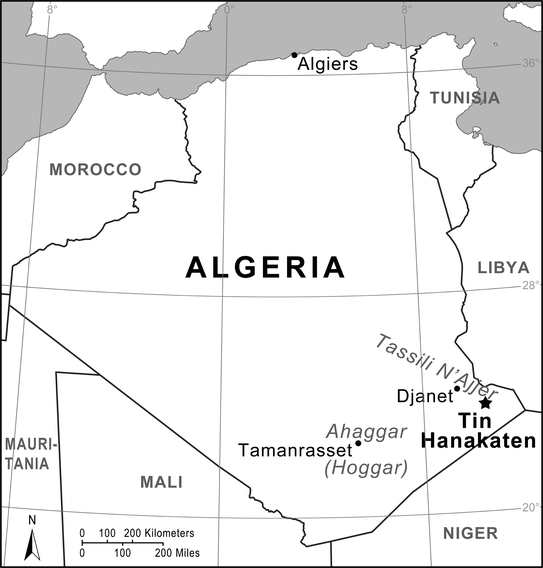


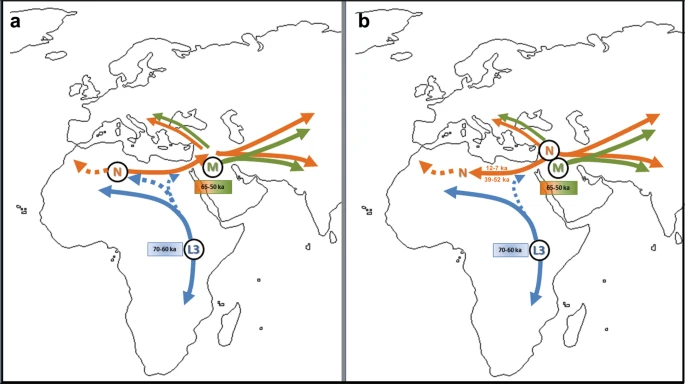


 Printer-friendly view of this topic