quote:Originally posted by osirion: Where is the abstract AE art that is similar to what we see in Sub-Saharan art?
Thought Writes:
If by "Art" you mean artifacts, then one clear example is the harps of Buganda and Ancient Egypt. Another example is the headrests of the Ancient Egyptians and southern Sudanese. How many examples do you need?
Posts: 2720 | Registered: May 2004
| IP: Logged |
This is not 100% true about African cultures never documented daily activities. For instance both the Yoruba people and people of Dahomey did carve bas-reliefs depiction various activities from war to spiritual ceremonies. Understand also that most contemporary Africans have a living traditions that have been documented and studied by anthropologist. The documents of daily life is not very necessary unless you have a dead culture like ancient Egypt or other cultures that have died out.
The information about ancient Western Africa is right there for you to reserch as long as you have acess to a library or published journal articles. If you want I can send you some articles about the Yoruba people I have collected. The Yoruba people have been the most studied group in Western Africa.
Other way to uncover historical data is through a methodology called historical linguistics. Through such methology you can uncover certain aspects of Western African traditions.
Sure, I would appreciate the info However, the issue is cultural similarities between Egypt and other parts of Africa, not whether I am the foremost expert on African cultures and the methods used to study such cultures.
Posts: 8940 | Registered: May 2005
| IP: Logged |
quote:Originally posted by Doug M: ... I believe that MOST cultures in Africa were hunter gatherers and pastorial nomads, who RARELY settled down LONG ENOUGH to build such structures.
Thought Writes:
Actually, you may need to do more research on the basic principles of human anthropology. There is a positive correlation between neolithic subsistence patterns and population growth. Hence, we see the dominance of genetic lineages associated with farmers in Africa (Haplogroup E), versus the genetic lineages associated with hunter gatherers (Haplogroup A and B).
Posts: 2720 | Registered: May 2004
| IP: Logged |
quote:Originally posted by Doug M: However, the issue is cultural similarities between Egypt and other parts of Africa, not whether I am the foremost expert on African cultures...
Thought Writes:
How can one recognize the cultural similarities between Egypt and other parts of Africa without being a expert on African cultures? How would one be able to recognize these similarities if one is ignorant of African culture in general?
Posts: 2720 | Registered: May 2004
| IP: Logged |
quote:Originally posted by alTakruri: Aren't farmers indicative of the subsistence of most African cultures out numbering foragers and pastoralists combined?
quote:Originally posted by Doug M: ... I believe that MOST cultures in Africa were hunter gatherers and pastorial nomads, who RARELY settled down LONG ENOUGH to build such structures. . . . .
But back to the thread and the topic.
It is about when and where. Until recently, the begining of agriculture was always thought to have begun OUTSIDE of Africa. Of course up to date research is proving that false, but there needs to be more research done. Agriculture is a key event in the development of human populations, however, it is also well known that there were many pastoral groups up to and after the development of organized agriculture. I actually believe that people planting crops is far older than we think, because it may have occurred on a much smaller scale, at earlier points in history than we NOW have evidence for. Most of the evidence we have for agriculture is associated with the development of complex societies, hence, agriculture is a key aspect in tracing the development of modern civilizations. That does not mean that people were not planting things on a much smaller scale at scattered points in history PRIOR to the development of complex social structures.
Posts: 8940 | Registered: May 2005
| IP: Logged |
quote:t should be noted, before going further, that many West African peoples did not choose the path of state formation (often said to be the path of 'civilizational development'), but instead created political systems based on elaborate kinship models that coupled local autonomy and wider networks to create viable political orders.
What do you think the likes of Ghana, Songhay or Mali were all about?
Posts: 5964 | Registered: Jan 2005
| IP: Logged |
This is not 100% true about African cultures never documented daily activities. For instance both the Yoruba people and people of Dahomey did carve bas-reliefs depiction various activities from war to spiritual ceremonies. Understand also that most contemporary Africans have a living traditions that have been documented and studied by anthropologist. The documents of daily life is not very necessary unless you have a dead culture like ancient Egypt or other cultures that have died out.
The information about ancient Western Africa is right there for you to **reserch** as long as you have acess to a library or published journal articles. If you want I can send you some articles about the Yoruba people I have collected. The Yoruba people have been the most studied group in Western Africa.
Other way to uncover historical data is through a methodology called historical linguistics. Through such methology you can uncover certain aspects of Western African traditions.
You can say it again.
Posts: 5964 | Registered: Jan 2005
| IP: Logged |
posted
Aren't farmers indicative of the subsistence of most African cultures out numbering foragers and pastoralists combined?
Can you answer the question please? The consideration made about where and when is just as applicable to foragers and pastoralist. The claim that "MOST cultures in Africa were hunter gatherers and pastorial nomads, who RARELY settled down LONG ENOUGH to build such structures" was made without regard to location or era.
Also the concept of a "neolithic revolution" is outdated now. Foragers made the first settlements and permanent housing structures. Agriculture could not begin without permanent settlement of people to tend gardens and fields.
And, I think, African pastoralist, especially herders, are predominantly transhumant instead of actually nomadic.
Another thing to bear in mind is that these three basic methods of food procurement are not mutually exclusive. Gathering, hunting, shepherding, herding, farming, can all be practiced in a single culture pending the desired taste for the evening's meal. Even in post-industrial cultures if you have a yen for venison you most likely will have to hunt the deer down.
quote:Originally posted by Doug M:
quote:Originally posted by alTakruri: Aren't farmers indicative of the subsistence of most African cultures out numbering foragers and pastoralists combined?
quote:Originally posted by Doug M: ... I believe that MOST cultures in Africa were hunter gatherers and pastorial nomads, who RARELY settled down LONG ENOUGH to build such structures. . . . .
But back to the thread and the topic.
It is about when and where. Until recently, the begining of agriculture was always thought to have begun OUTSIDE of Africa. Of course up to date research is proving that false, but there needs to be more research done. Agriculture is a key event in the development of human populations, however, it is also well known that there were many pastoral groups up to and after the development of organized agriculture. I actually believe that people planting crops is far older than we think, because it may have occurred on a much smaller scale, at earlier points in history than we NOW have evidence for. Most of the evidence we have for agriculture is associated with the development of complex societies, hence, agriculture is a key aspect in tracing the development of modern civilizations. That does not mean that people were not planting things on a much smaller scale at scattered points in history PRIOR to the development of complex social structures.
Posts: 8014 | From: the Tekrur in the Western Sahel | Registered: Feb 2006
| IP: Logged |
quote:Originally posted by Supercar: Doug M: posted this from a link:
quote:t should be noted, before going further, that many West African peoples did not choose the path of state formation (often said to be the path of 'civilizational development'), but instead created political systems based on elaborate kinship models that coupled local autonomy and wider networks to create viable political orders.
What do you think the likes of Ghana, Songhay or Mali were all about?
Posts: 8014 | From: the Tekrur in the Western Sahel | Registered: Feb 2006
| IP: Logged |
quote:Originally posted by alTakruri: Doug M is quite right though his wording is incorrect. Besides, he's not saying Africa only had rulerless societies.
And who said that he was saying that?
quote:alTakruri: One of the triumphant aspects of African social thinking is the fact of its complex asephalous states. This is nothing to deny or be defensive against.
quote:Supercar: What do you think the likes of Ghana, Songhay or Mali were all about?
Are you suggesting that the aforementioned cultural entities are examples of acephalous states?
Posts: 5964 | Registered: Jan 2005
| IP: Logged |
posted
No time for games. You know quite well that empires are not acephalous.
When acephalous states were mentioned you brought up three major West African empires as if to propose that there were not complex acephalous states in Africa, i.e., that Africa only had states with heads of state?
Is that what you were trying to get across?
quote:Originally posted by Supercar:
quote:Originally posted by alTakruri: Doug M is quite right though his wording is incorrect. Besides, he's not saying Africa only had rulerless societies.
And who said that he was saying that?
quote:alTakruri: One of the triumphant aspects of African social thinking is the fact of its complex asephalous states. This is nothing to deny or be defensive against.
quote:Supercar: What do you think the likes of Ghana, Songhay or Mali were all about?
Are you suggesting that the aforementioned cultural entities are examples of acephalous states?
Posts: 8014 | From: the Tekrur in the Western Sahel | Registered: Feb 2006
| IP: Logged |
quote:Originally posted by Doug M: ... I believe that MOST cultures in Africa were hunter gatherers and pastorial nomads, who RARELY settled down LONG ENOUGH to build such structures. . . . .
But back to the thread and the topic.
According to the latest evidence, agriculture was invented in several areas of Africa independently. In the Sahara, Ethiopia, and West Africa. There could be other areas as well that haven't discovered, so how did you come about this generalization that most Africans were either foragers or pastoralists??
In fact the majority of Africans today have had a longstanding tradition of agriculture, most of this having to do with the Bantu expansion.
Posts: 26853 | From: Atlanta, Georgia, USA | Registered: Feb 2005
| IP: Logged |
quote:Originally posted by alTakruri: No time for games.
...unless of course, you are engaged in one I am not yet aware of!
quote:alTakruri: You know quite well that empires are not acephalous.
Indeed. It makes me wonder about your response to my mentioning of those examples, as states!
quote:alTakruri: When acephalous states were mentioned...
Which acephalous states were mentioned?
quote:alTakruri: ...you brought up three major West African empires as if to propose that there were not complex acephalous states in Africa, i.e., that Africa only had states with heads of state?
Is that what you were trying to get across?
Your assumption, since there is nowhere in my post, that there was no such thing as acephalous societies in Africa. The question should rather be, what does your comments have anything to do with mine?
Posts: 5964 | Registered: Jan 2005
| IP: Logged |
quote:Originally posted by Supercar: The question should rather be, what does your comments have anything to do with mine?
My exact reaction when I read your reaction quoted below which had absolutely nothing to do with my statements:
quote:Supercar wrote: What do you think the likes of Ghana, Songhay or Mali were all about?
quote:Supercar wrote: Are you suggesting that the aforementioned cultural entities are examples of [b]acephalous states?
If what you say is to make any sense, then your reaction is indicative of a confused individual. If your comment had nothing to do with mine in the first place, then why quote me and make your comment?
Posts: 5964 | Registered: Jan 2005
| IP: Logged |
quote:Originally posted by Doug M: ... I believe that MOST cultures in Africa were hunter gatherers and pastorial nomads, who RARELY settled down LONG ENOUGH to build such structures. . . . .
But back to the thread and the topic.
According to the latest evidence, agriculture was invented in several areas of Africa independently. In the Sahara, Ethiopia, and West Africa. There could be other areas as well that haven't discovered, so how did you come about this generalization that most Africans were either foragers or pastoralists??
In fact the majority of Africans today have had a longstanding tradition of agriculture, most of this having to do with the Bantu expansion.
Interesting. Where is your evidence for this?
Posts: 8940 | Registered: May 2005
| IP: Logged |
This is not 100% true about African cultures never documented daily activities. For instance both the Yoruba people and people of Dahomey did carve bas-reliefs depiction various activities from war to spiritual ceremonies. Understand also that most contemporary Africans have a living traditions that have been documented and studied by anthropologist. The documents of daily life is not very necessary unless you have a dead culture like ancient Egypt or other cultures that have died out.
The information about ancient Western Africa is right there for you to **reserch** as long as you have acess to a library or published journal articles. If you want I can send you some articles about the Yoruba people I have collected. The Yoruba people have been the most studied group in Western Africa.
Other way to uncover historical data is through a methodology called historical linguistics. Through such methology you can uncover certain aspects of Western African traditions.
You can say it again.
It is not about how much I have studied West Africa, it is about how much of a relationship Egypt has to other parts of Africa. To be specific, my opinion is that the tradition of Egyptians carving scenes of daily life can be traced to the traditions of the Saharan populations that left scenes of daily life in their rock art. Am I an expert on Saharan rock art, no. But is that my opinion, yes. Therefore, it is not about me becoming an expert in Saharan rock art. It is about me being able to show the facts that I use to back up such an opinion.
Likewise, my opinion about Egyptians having scenes of daily life carved in stone on the walls of temples and tombs as being UNLIKE most African cultures is also an opinion. MOST ancient African cultures DID NOT carve scenes in stone on their monuments. If you feel this is incorrect, then prove me wrong, by showing me information that contradicts this. Otherwise, saying I should STUDY West Africa or some other such thing, in this case only covers for the LACK of evidence on your part to refute my opinion.
I STILL say that MOST African cultures, especially around 1000 BC did not build in stone and those that did DID NOT carve scenes of everyday life on the walls like the Egyptians. If ANYONE can PROVIDE EVIDENCE to the contrary, then fine I will be refuted. Up to this point, NO ONE has.
Posts: 8940 | Registered: May 2005
| IP: Logged |
quote:Originally posted by alTakruri: Aren't farmers indicative of the subsistence of most African cultures out numbering foragers and pastoralists combined?
Can you answer the question please? The consideration made about where and when is just as applicable to foragers and pastoralist. The claim that "MOST cultures in Africa were hunter gatherers and pastorial nomads, who RARELY settled down LONG ENOUGH to build such structures" was made without regard to location or era.
Also the concept of a "neolithic revolution" is outdated now. Foragers made the first settlements and permanent housing structures. Agriculture could not begin without permanent settlement of people to tend gardens and fields.
And, I think, African pastoralist, especially herders, are predominantly transhumant instead of actually nomadic.
Another thing to bear in mind is that these three basic methods of food procurement are not mutually exclusive. Gathering, hunting, shepherding, herding, farming, can all be practiced in a single culture pending the desired taste for the evening's meal. Even in post-industrial cultures if you have a yen for venison you most likely will have to hunt the deer down.
quote:Originally posted by Doug M:
quote:Originally posted by alTakruri: Aren't farmers indicative of the subsistence of most African cultures out numbering foragers and pastoralists combined?
quote:Originally posted by Doug M: ... I believe that MOST cultures in Africa were hunter gatherers and pastorial nomads, who RARELY settled down LONG ENOUGH to build such structures. . . . .
But back to the thread and the topic.
It is about when and where. Until recently, the begining of agriculture was always thought to have begun OUTSIDE of Africa. Of course up to date research is proving that false, but there needs to be more research done. Agriculture is a key event in the development of human populations, however, it is also well known that there were many pastoral groups up to and after the development of organized agriculture. I actually believe that people planting crops is far older than we think, because it may have occurred on a much smaller scale, at earlier points in history than we NOW have evidence for. Most of the evidence we have for agriculture is associated with the development of complex societies, hence, agriculture is a key aspect in tracing the development of modern civilizations. That does not mean that people were not planting things on a much smaller scale at scattered points in history PRIOR to the development of complex social structures.
Yes I agree that farming is a relatively settled activity. I also agree that there were MANY African groups that were practicing farming at an early period. That is WHY I stated the following:
quote: Agriculture is a key event in the development of human populations, however, it is also well known that there were many pastoral groups up to and after the development of organized agriculture. I actually believe that people planting crops is far older than we think, because it may have occurred on a much smaller scale, at earlier points in history than we NOW have evidence for.
Meaning that, like you said, pastoralism and subsistence agriculture are not mutually exclusive and that many of our modern ideas on ancient agriculture are tied to European definitions of historical processes associated with development of "complex" civilizations.
Also, just because a community was settled or practiced agriculture, does not mean that they built in stone. Many could have used wood, mud brick or grass to build complex communities. The point being that when someone wants to find evidence of "complex" societies, they may look for evidence of stone building before evidence of wood building. Likewise, because wood and such easily decay, much evidence may have been lost over time of complex compounds which could give us a better idea of the development of African societies. So I agree that it is not accurate to say that it is a difference of pastoral/sedentary populations that would have led to the absence of stone building in most African cultures around 1000BC. There are many other factors that go into it.
Posts: 8940 | Registered: May 2005
| IP: Logged |
quote:Originally posted by Djehuti: According to the latest evidence, agriculture was invented in several areas of Africa independently. In the Sahara, Ethiopia, and West Africa. There could be other areas as well that haven't discovered, so how did you come about this generalization that most Africans were either foragers or pastoralists??
In fact the majority of Africans today have had a longstanding tradition of agriculture, most of this having to do with the Bantu expansion.
Posts: 26853 | From: Atlanta, Georgia, USA | Registered: Feb 2005
| IP: Logged |
posted
Well, I don't approach the study of Africa from a penis envy level where everything is measured up to Europe's yardstick.
But all punning aside, neither architecture in stone nor majestic heads of state are necessary for benchmarking Africa's societies or "states". This is to say that as far as I can see, monumental stone cutting for public commemoration on the level of KM.t hardly exist outside of a few metro urban centers on any continent.
And yes, in general and for many reasons, Africa outside of the Nile Valley and later in time than KM.t didn't care as much for varied and lasting material productions as other continents did. Which is not to say they didn't have any because we know full well they did.
Yet I need not be reactionary and feel the need to "prove" Africa is equal or has the same developments as Asia or Europe that "hallowed benchmark" so many still hold up as "highest of the high". No, by doing that I would only miss out on the true unique value only Africa can offer and instead be off chasing white ghosts instead of heeding ancestral cries.
So those Africans who had stone or could get stone and valued stone used it for building (there are many stone sites scattered over the continent) and when they pleased, for engraving.
Likewise for those who chose mud brick or chose wood, or chose wattle, or who chose hide, for Africans did built with those more so than with stone.
I don't need an outlook on Africa that makes me fabricate multistorey stone dwellings or else Africa is inferior because I worship Europe/Asia and Europe/Asia abounds with such edifices and so every culure what don't build that way must be primitive or backward and I don't want to appear inferior/primitive/backward. Why you've accepted the game on Eurocentric terms!
No the African sees the complex beauty of his own through his own eyes not through imported foreign spectacles which frame a reference inadequite to appreciate what's right before the eyes.
A chess master from Europe/America/Australia visits rural inner Africa and observes a wari type game played in the dirt. Little pits dug in the dirt and pebbles may be all the gaming "pieces" he sees.
[At this point some of you are now having a knee jerk reaction and can only think on Europe's terms and so you want to interject and go on and on about the fine cast metal chess pieces made in West Africa or the high qaulity fine wooden and semi-precious stone wari sets. And in thinking that way you don't get it at all]
In cultural chauvinistic contempt he dismisses wari as below his gamesmen's application as a child invites him to squat and play. Not wanting to appear aloof he humours the kid and listens to the very simple mechanics of "cows and kraals". In his mind he thinks, how simple for me a chessmaster to instantly thoroughly understand this stupid native game and beat its best player less lone this child.
Come that night he drinks calabash after calabash of palm wine to drown his embarassment, all the while wondering how that kid could beat him over and over again, and in so few moves no less, as his hosts good naturedly rib him with praise while somewhere some guy improvises an ode to the Great Chessmaster who couldn't win wari once.
And so it is with architecture and public monuments, in trying to show a measure similar to Europe/Asia we miss what genius has gone into the commonmost.
So what if Africa isn't overflowing with "impressive" KM.t/Kush/Axum type monumental stone ruins or multistorey Swahili type houses or zemba bwe wallings? So what!
Its the people and the social order where its really at.
quote:Originally posted by Doug M: Meaning that, like you said, pastoralism and subsistence agriculture are not mutually exclusive and that many of our modern ideas on ancient agriculture are tied to European definitions of historical processes associated with development of "complex" civilizations.
Also, just because a community was settled or practiced agriculture, does not mean that they built in stone. Many could have used wood, mud brick or grass to build complex communities. The point being that when someone wants to find evidence of "complex" societies, they may look for evidence of stone building before evidence of wood building. Likewise, because wood and such easily decay, much evidence may have been lost over time of complex compounds which could give us a better idea of the development of African societies. So I agree that it is not accurate to say that it is a difference of pastoral/sedentary populations that would have led to the absence of stone building in most African cultures around 1000BC. There are many other factors that go into it. [/QB]
Posts: 8014 | From: the Tekrur in the Western Sahel | Registered: Feb 2006
| IP: Logged |
quote:Originally posted by ausar: Pax Dahomenias, I would appreciate if you or others would be kind enough to tell us more about these connections.
Hi Ausar and others, I'll try to post some informations about it at the end of the week. Please stay tuned.
Posts: 203 | Registered: Dec 2005
| IP: Logged |
posted
Hello all, There are several sources dealing with cultural comparative studies between Kmt and traditional other African cultures. Unfortunately I only have a few of them at home so the following information will be largely incomplete. Most of the following information is taken from Egyptologists Aboubacry Moussa Lam, Oum Ndigi and Jean Charles Coovi Gomez' francophone works. I have found myself a lot of other similarities but as I plan to publish them in the future, I don't want to post them on here for now.
I'll post some other infos later.
Myra and others: I have an anglophone article about masks in Kmt and modern Africa at home, please let me know via PM if you're interested in it.
I)Pantheon and Mythology: Many Kemetic deities are still worshipped in modern Africa.Here are a few. Oum Ndigi demonstrated by showing ten homophones of Geb's names identical to their counterparts in Basaa which are also homophones of a Basaa deity called Koba, that Geb and Koba are the very same deity. He also pointed out some mythological parallelisms such as the identification of Geb and Koba to the Time,to a goose sitting on the Primordial egg, to the fifth of the Primordial ancestors,etc...
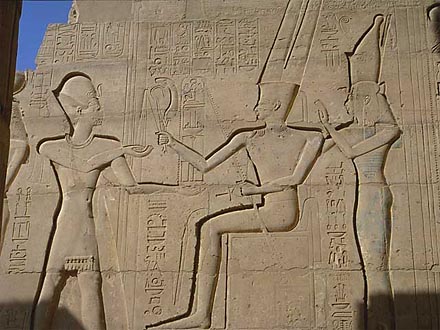
Aboubacry Moussa Lam pointed out some striking resemblances between Dogon and Kemetic mythologies. Like in Kmt, the Dogon creation began with primordial waters (called Nommo in the Dogon language ,a word related to the kmtic Nwmw which would most logically be the actual translitteration of one of the mdw ntr usually translitterated by Egyptologists as "Nwnw"(Nun)), which are "populated" in both areas by reptile-like creatures. From these waters came out eight creatures that came to life as couples:they are thus an ogdoad but become an ennead along with the creator god just like in Kmt. The supreme God of Dogon people is called Amma, a name related to 'Imn(Amun) according to Théophile Obenga and both Gods do use their penises and speech to create. Like Amun who was invoked by Pharaohs to make the level of water rise, Amma is a water god. Still according to French Africanist Marcel Griaule, Amma is a ram wearing a calabash between his horns representing the sun.We all know that Amun was often depicted as a Ram wearing but he actually wasn't before the New Kingdom:he was only a provincial unsolarized deity and wasn't assimilated to the ram back then.It would thus mean that contacts between the two populations occured after the NK.Pic of Amen-Ra at Abu Simbel:
Recently, Théophile Obenga said that the name of the supreme God of Dagari people of Burkina Faso was Myin and that this name was related to 'Imn.Interestingly enough, Myin is also considered to be the sun to Dagari people. Perhaps some meticulous comparative researchs about Myin and Amun could lead to the same conclusion as the relationship between Amun & Amma.
Posts: 203 | Registered: Dec 2005
| IP: Logged |
posted
^^ Pax, while I agree that some African gods may have a connection to Egyptian gods like Amun, I would be cautious in trying to connect them to Dynastic Egypt.
Rather, I believe such connections come from prehistoric periods and especially connections via the Sahara. There is evidence of Nubians worshipping a god identified with Amun as well as ancient Libyans around Siwa.
Posts: 26853 | From: Atlanta, Georgia, USA | Registered: Feb 2005
| IP: Logged |
posted
I understand your cautiousness Djehuti but I believe that Amma's description, as well as its relationship to the Nommo and the eight primordial ancestors is definitely dynastic Egyptian.
-------------------- Federico Da Montefeltro Posts: 203 | Registered: Dec 2005
| IP: Logged |
quote:Originally posted by Pax Dahomensis: I understand your cautiousness Djehuti but I believe that Amma's description, as well as its relationship to the Nommo and the eight primordial ancestors is definitely dynastic Egyptian.
If so, then what is the evidence to suggest that the Dogon had contact with dynastic Egypt?? Which culture are you suggesting first had these religious concepts??
Posts: 26853 | From: Atlanta, Georgia, USA | Registered: Feb 2005
| IP: Logged |
Kemetians had a conception of death quite similar to that of modern Africans. According to this page:
quote: Because Re was Atum as well as Amun, people saw him as simply another form of the Creator god. Because he traveled each day through the heavens, he was also the god of time. The “birth” and “death” of the sun each day helped the Egyptians to understand time, life, death, and resurrection. The sun gave the Egyptians confidence that life never ended, and that death was merely another form of life. The Kushites shared the same beliefs.
About the BaKongo people of Central Africa, this page says:
quote:Life in that sense is a cyclical and repetitive movement between the two worlds mentioned above, resembling the path of the sun. At the rising and setting of the sun then, the living and the dead exchange day and night. In Kongo belief, man's life does not end, it constitutes a cycle, and death is merely a transition in the process of change. Following that belief, a man's soul does not dwell in the grave after his death but leaves it to become a ghost (n'kuyu) in the land of the dead, which is called ku mpemba a fula.
Akh:
quote: This was the form in which the blessed dead lived on in the hereafter. It was also the result of the union between the Ba and the Ka. An Akh was believed to live on unharmed for eternity, they were sometimes referred to as 'The Shining Ones'.
French Africanist Louis Vincent Thomas reported a fon chant describing death(ku) as an illumination after which life would no more lived be into darkness.
quote: According to Egyptian beliefs, the soul of the dead accompanied the sun on its eternal journey in the Upper Waters (the heavens) around the world. A boat or at least a model of a boat was therefore included in every tomb.
Beninese anthropologist B.Adoukonou reported that the dead had to travel with a boat to the world of the deads. Many people of modern day Africa do use the same term as the Md Ntr "akh" meaning "to become a spirit",e.g. ku le-ku Of this word are also derived terms meaning "ghost" in these languages e.g. kutito(fon-gbe),okue(mbochi) just like akhu(ghost) derives from akh in the Mdw Ntr.
When French missionaries discovered the term "okue", they systematically and erroneously translated it by "devil". Interestingly in Coptic, akhu also means "devil "although we know that they were definitely considered as such during pharaonic Times. Perhaps the Christians who evangelized both Kemetians and Mbochi people had the same reaction vis à vis of the same concept.
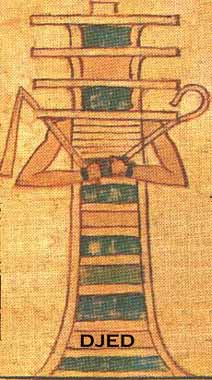
A representation of an animated Djed Pillar:
A Kutito/Egungun ceremony in Porto Novo,Benin:
In Togo,Benin and Nigeria, the Kutito(among Gbe speaking people) and Egungun (among Yoruba speaking people) are masked dancing ancestors returning to earth to help and punish living people. Jean Charles Coovi Gomez pointed out that this ceremony was exactly the same as what we know of Kemetic "raising the Djed Pillar Ceremony".
Egungun ,the Yoruba name of the ceremony means "bone, skeleton". In Kmt, the Djed pillar was considered as the backbone of the neter Ausar. There is ample evidence for mummification in traditional Africa.Félix Dubois reported it among Songhoi people, M.Delafosse among Baule(Akan) people of Ivory Coast, A.M.L Desplagnes among the Dogon and Mossi, J.C.C.Gomez among the Yoruba.
Mummy of the Obi Ijeh of Idumuoghu,Ibusa, Nigeria
More to come...
Posts: 203 | Registered: Dec 2005
| IP: Logged |
posted
^^Yes all of these similarities imply a connection to Egypt, but again where is the evidence to show that this was with dynastic Egypt instead of a prehistoric African connection??
Posts: 26853 | From: Atlanta, Georgia, USA | Registered: Feb 2005
| IP: Logged |
I find this mummy of a West African royal especially interesting, showing that West Africans also had a concern for preserving the dead of their rulers.
Posts: 26853 | From: Atlanta, Georgia, USA | Registered: Feb 2005
| IP: Logged |
posted
Here is a reference that I found in mainstream Egyptology publication comparing kingship in ancient Km.t and other contemporary African kingdoms:
94.1021 BONHÊME, Marie-Ange, Appétit de roi, in: Hommages Leclant 2, 45-53. Discussion of the theme "eating the kingship," a practice attested in Papyrus Brooklyn (47.218.50, col. XVI, 6-7) describing the rites of the "confirmation of the royal power in the New Year." In these rites the king is eating the jAw.t/jA.t symbol in bread. There seem to be some similarities between the described Egyptian rites and the conception and practice of "eating the kingship" in certain African kingdoms. M.W.K.
Do you have acess to this articles,Pax Dahomenias? If you do is there any way to scan it or translate at least some of it?
Posts: 8675 | From: Tukuler al~Takruri as Ardo since OCT2014 | Registered: Feb 2003
| IP: Logged |
quote:Originally posted by ausar: Do you have acess to this articles,Pax Dahomenias? If you do is there any way to scan it or translate at least some of it?
Yep, but It will probably take some time. I'll keep you updated.
Posts: 203 | Registered: Dec 2005
| IP: Logged |
quote:Originally posted by ausar: Here is a reference that I found in mainstream Egyptology publication comparing kingship in ancient Km.t and other contemporary African kingdoms:
94.1021 BONHÊME, Marie-Ange, Appétit de roi, in: Hommages Leclant 2, 45-53. Discussion of the theme "eating the kingship," a practice attested in Papyrus Brooklyn (47.218.50, col. XVI, 6-7) describing the rites of the "confirmation of the royal power in the New Year." In these rites the king is eating the jAw.t/jA.t symbol in bread. There seem to be some similarities between the described Egyptian rites and the conception and practice of "eating the kingship" in certain African kingdoms. M.W.K.
Which symbol was this, Ausar?
Posts: 26853 | From: Atlanta, Georgia, USA | Registered: Feb 2005
| IP: Logged |
posted
Djehuti: Some cultural elements that refer to specific Dynastic Egypt evolutions do imply a Dynastic contact with African people. As I said I don't want to post them on here for now but I promise I'll keep you updated when I'll publish them.
posted
From Oscar Pfouma "Histoire culturelle de l'Afrique Noire":
quote: The Dogon sign "gono" or "gonono",written at the end of the Sigi Time (sixty years) and identical to the Egyptian "ânkh" represents God after he created the world. Ancient Egyptians also celebrated, each sixty years, a ceremony called "hn" representing the renewing of the world. The osirian rite Sâh and the Dogon Sigi are isomorphic. The relationship between AE and modern Black Africa is irrefutable. Dogon gonono:"a 60 years time" Egypt hnn:"a 60 years time"(Budge) Dogon Sigi Egypt sâh Dogon Naporo=Osiris Egypt Npr=Osiris(E.Naville)
The Egyptian word for deity but also pharaoh, Ntr is also found in modern BA languages as thus:
BA and AE religious customs are exactly the same;Hermopolitan cosmogony is found among Northern Cameroon populations.According to M.Maubert "Coutumes du Gurma": "it is impossible(...)even for a layman, to not mention(...) AE, more precisely Hermopolis in Middle Egypt, whose specialists tell us that its cosmogony was about some elements (...)very similar to those we had the surprise to found among Fali people.A primordial egg or "Mother Egg".Two waters existing before everything, (...)"Waters containing waiting germs of creation(...) the only trait common to all the AE cosmogonies(...)" Existence of two lands and four rivers. The intervention of an ogdoad, whose members ,the organizers of the world who worked to built the more or less complete state of the world we know today(...) were originally one and same divinity but represented four entities and finally four couples(...), each couple representing the male and female aspect of one of the other entities(...) The classical iconography shows this eight characters as strange anthropomorphic creatures(...) frog-headed men, snake-headed women in Egypt and are described as crawling beasts living in muddy waters in Cameroon. Even the black ape, mentioned by Lebeuf reminds us of Thot, the baboon-headed god of Hermopolis."
The name of Thot(Greek name for Djehuti) is still found in Modern BA:Zukta, Zigta,(Muhuleh), Jukta(Jukun).
quote:Originally posted by Pax Dahomensis: Aboubacry Moussa Lam pointed out the resemblance between the kmtic khepesh and this weapon held by Mangbetu King Munza:
That weapon (scyth) is also an agricultural tool and is shown wielded by kings from earlier periods.
Agriculture as been around since the predynastic era and agriculture may have once been practiced in the Sahara. Thus a prehistoric overall African connection.
Posts: 26853 | From: Atlanta, Georgia, USA | Registered: Feb 2005
| IP: Logged |
quote:Originally posted by Pax Dahomensis: From Oscar Pfouma "Histoire culturelle de l'Afrique Noire":
[QUOTE] The Dogon sign "gono" or "gonono",written at the end of the Sigi Time (sixty years) and identical to the Egyptian "ânkh" represents God after he created the world. Ancient Egyptians also celebrated, each sixty years, a ceremony called "hn" representing the renewing of the world. The osirian rite Sâh and the Dogon Sigi are isomorphic. The relationship between AE and modern Black Africa is irrefutable. Dogon gonono:"a 60 years time" Egypt hnn:"a 60 years time"(Budge) Dogon Sigi Egypt sâh Dogon Naporo=Osiris Egypt Npr=Osiris(E.Naville)
The Egyptian word for deity but also pharaoh, Ntr is also found in modern BA languages as thus:
BA and AE religious customs are exactly the same;Hermopolitan cosmogony is found among Northern Cameroon populations.According to M.Maubert "Coutumes du Gurma": "it is impossible(...)even for a layman, to not mention(...) AE, more precisely Hermopolis in Middle Egypt, whose specialists tell us that its cosmogony was about some elements (...)very similar to those we had the surprise to found among Fali people.A primordial egg or "Mother Egg".Two waters existing before everything, (...)"Waters containing waiting germs of creation(...) the only trait common to all the AE cosmogonies(...)" Existence of two lands and four rivers. The intervention of an ogdoad, whose members ,the organizers of the world who worked to built the more or less complete state of the world we know today(...) were originally one and same divinity but represented four entities and finally four couples(...), each couple representing the male and female aspect of one of the other entities(...) The classical iconography shows this eight characters as strange anthropomorphic creatures(...) frog-headed men, snake-headed women in Egypt and are described as crawling beasts living in muddy waters in Cameroon. Even the black ape, mentioned by Lebeuf reminds us of Thot, the baboon-headed god of Hermopolis."
The name of Thot(Greek name for Djehuti) is still found in Modern BA:Zukta, Zigta,(Muhuleh), Jukta(Jukun).
Words for 'gods' or 'divine' are even more ancient in origin still. Such word similarities only proves a prehistoric connection instead of a dynastic one.
Besides, weren't YOU the one that cautioned me about using simple word comparisons, even though the example I used was between Egyptian and Somali-- two languages which we know are closely related!
Posts: 26853 | From: Atlanta, Georgia, USA | Registered: Feb 2005
| IP: Logged |
quote:Originally posted by Pax Dahomensis: Djehuti: Do you agree with most Egyptologists that the concept of the Nun was inspired by the vision of the Nile in spate?
Yes, but I don't see what this has to do with your premise. The Egyptians concieved Nun as the primeval waters. There are many cultures outside of Africa that held similar mythological beliefs. But especially an ancient belief in primeval orgins again could only point to prehistoric connections. Do you realize that there were many lakes and rivers in holocene Sahara?
It seems that you are espousing the diffusion theory, that whatever similarities other African cultures have to Egypt is derived from Egypt during dynastic times. Why not accept the fact that such connection reach further back in time to when Egypt didn't even exist?
So far all of the examples you have provided-- the agricultural tool/weapon, similar words for god, and words for a watery primeval origin hark back to times way before the dynastic era.
Posts: 26853 | From: Atlanta, Georgia, USA | Registered: Feb 2005
| IP: Logged |
posted
Djehuti: To be really honest, I have never said I agreed with Pfouma's method. For example, I've noticed that a lot of the words he compared with Egyptian, like Fon-Gbe "hwenu e dja" supposedly similar with kmtic "hnty dj" both meaning "future" are actually unrelated since the Fon word is a compound word.I'm just trying to make francophone documentation about the thread launched by Ausar available for everyone on this board. Take it as you want.
Posts: 203 | Registered: Dec 2005
| IP: Logged |
posted
You're misunderstanding the point of my posts here. Ausar started a thread quoting me about the cultural similarities between AE and modern Africa some cannot being explained by a 6000+ years old separation IMO. I've never said all the information I'd provide would prove that the concerned people came from KMT.
quote:Originally posted by Djehuti:
quote:Originally posted by Pax Dahomensis: Djehuti: Do you agree with most Egyptologists that the concept of the Nun was inspired by the vision of the Nile in spate?
Yes, but I don't see what this has to do with your premise. The Egyptians concieved Nun as the primeval waters. There are many cultures outside of Africa that held similar mythological beliefs. But especially an ancient belief in primeval orgins again could only point to prehistoric connections. Do you realize that there were many lakes and rivers in holocene Sahara?
It seems that you are espousing the diffusion theory, that whatever similarities other African cultures have to Egypt is derived from Egypt during dynastic times. Why not accept the fact that such connection reach further back in time to when Egypt didn't even exist?
So far all of the examples you have provided-- the agricultural tool/weapon, similar words for god, and words for a watery primeval origin hark back to times way before the dynastic era.
posted
Now I would like you to tell me how idiomatic expressions identical by both sound and meaning such as these can be found among languages that haven't been in contact for more than 6000 years.
Mdw Ntr: her,"head" Pulaar(Fulani dialect spoken in Senegal) hoore,"head"
Mdw Ntr: spd"pointed" Pulaar(Fulani dialect spoken in Senegal) seebde,"pointed"
Mdw Ntr: seped her,"clever" Pulaar(Fulani dialect) seebde hoore,"to be clever"
posted
What can we say about musical similarities between Kemet and the rest of Africa???
Posts: 4028 | From: NW USA | Registered: May 2005
| IP: Logged |
posted
Well, that was not my point at all, It's just as you seemed knowledgeable about mythologies, I wanted to have a discussion on a point with you, but since you seem more interested in pointing out "contradictions" or "errors" on other people's discourses, then go for it. And don't forget to start caring about yours.
quote:Originally posted by Djehuti:
quote:Originally posted by Pax Dahomensis: Djehuti: Do you agree with most Egyptologists that the concept of the Nun was inspired by the vision of the Nile in spate?
Yes, but I don't see what this has to do with your premise. The Egyptians concieved Nun as the primeval waters. There are many cultures outside of Africa that held similar mythological beliefs. But especially an ancient belief in primeval orgins again could only point to prehistoric connections. Do you realize that there were many lakes and rivers in holocene Sahara?
^^Sorry, but the physical similarities escape me!! As for cultural similarities, which ones are those? LOLPosts: 26853 | From: Atlanta, Georgia, USA | Registered: Feb 2005
| IP: Logged |
quote:Originally posted by Pax Dahomensis: Well, that was not my point at all, It's just as you seemed knowledgeable about mythologies, I wanted to have a discussion on a point with you, but since you seem more interested in pointing out "contradictions" or "errors" on other people's discourses, then go for it. And don't forget to start caring about yours.
Actually I never said that anything you've presented was an error or contradiction, on the contrary I have already known about such similarities! I am merely stating that non them really show evidence of influence from dynastic Egypt.
Posts: 26853 | From: Atlanta, Georgia, USA | Registered: Feb 2005
| IP: Logged |
posted
OK, sorry for the misunderstanding. The Fulani stuff from Lam I've posted refutes your claim IMO though. These idioms are irrefutably related in some way to Kemetic's and as far I know, are not reconstructable for any earlier state of Dynastic Egyptian language.
-------------------- Federico Da Montefeltro Posts: 203 | Registered: Dec 2005
| IP: Logged |
quote:Originally posted by Pax Dahomensis: From Oscar Pfouma "Histoire culturelle de l'Afrique Noire":
quote: The Dogon sign "gono" or "gonono",written at the end of the Sigi Time (sixty years) and identical to the Egyptian "ânkh" represents God after he created the world. Ancient Egyptians also celebrated, each sixty years, a ceremony called "hn" representing the renewing of the world. The osirian rite Sâh and the Dogon Sigi are isomorphic. The relationship between AE and modern Black Africa is irrefutable. Dogon gonono:"a 60 years time" Egypt hnn:"a 60 years time"(Budge) Dogon Sigi Egypt sâh Dogon Naporo=Osiris Egypt Npr=Osiris(E.Naville)
The Egyptian word for deity but also pharaoh, Ntr is also found in modern BA languages as thus:
BA and AE religious customs are exactly the same;Hermopolitan cosmogony is found among Northern Cameroon populations.According to M.Maubert "Coutumes du Gurma": "it is impossible(...)even for a layman, to not mention(...) AE, more precisely Hermopolis in Middle Egypt, whose specialists tell us that its cosmogony was about some elements (...)very similar to those we had the surprise to found among Fali people.A primordial egg or "Mother Egg".Two waters existing before everything, (...)"Waters containing waiting germs of creation(...) the only trait common to all the AE cosmogonies(...)" Existence of two lands and four rivers. The intervention of an ogdoad, whose members ,the organizers of the world who worked to built the more or less complete state of the world we know today(...) were originally one and same divinity but represented four entities and finally four couples(...), each couple representing the male and female aspect of one of the other entities(...) The classical iconography shows this eight characters as strange anthropomorphic creatures(...) frog-headed men, snake-headed women in Egypt and are described as crawling beasts living in muddy waters in Cameroon. Even the black ape, mentioned by Lebeuf reminds us of Thot, the baboon-headed god of Hermopolis."
The name of Thot(Greek name for Djehuti) is still found in Modern BA:Zukta, Zigta,(Muhuleh), Jukta(Jukun).
More to come.
The Akan also have a special class of deities that they call Ntoro.
Posts: 11 | Registered: Aug 2007
| IP: Logged |



 UBBFriend: Email this page to someone!


![[Smile]](smile.gif)






![[Wink]](wink.gif)

![[Big Grin]](biggrin.gif)

![[Embarrassed]](redface.gif) Actually I never said that anything you've presented was an error or contradiction, on the contrary I have already known about such similarities! I am merely stating that non them really show evidence of influence from dynastic Egypt.
Actually I never said that anything you've presented was an error or contradiction, on the contrary I have already known about such similarities! I am merely stating that non them really show evidence of influence from dynastic Egypt.


 Printer-friendly view of this topic